Updates automatically as you type.
Calculated in your browser; your inputs are not sent to us. Privacy
General estimate for planning only — not medical advice. Consult a doctor about your specific situation.
Calculation details
Review the generated output before relying on it.
This tool runs in your browser. Your calculator inputs and results are never transmitted to us or to ad/affiliate partners. Ads and sponsored links may set third-party cookies to serve and measure them, but they never receive your calculation values. If you explicitly save a scenario, its permitted fields stay in local browser storage until you clear them. See our Privacy Policy.
Use this result
Share the current inputs or ask ChatGPT to explain the calculation in context.
More options
What does this calculator estimate?
A 30-year-old man who is 180 cm and 80 kg has a Mifflin-St Jeor BMR of about 1,780 kcal, and about 2,759 kcal of maintenance calories at moderate activity. Enter your age, height, weight, sex, and activity in the BoringToolsKit maintenance calorie calculator.
- Mifflin-St Jeor uses weight, height, age, and a sex-specific constant to estimate resting kcal/day. (Source: Mifflin et al., 1990.)
- The five activity factors in this calculator are 1.2, 1.375, 1.55, 1.725, and 1.9.
- Katch-McArdle = 370 + 21.6 × lean body mass in kg; it is a comparison formula, not an input mode here. (Source: NutriAdmin.)
- At the default inputs, resting calories are 1,780 kcal/day and moderate-activity maintenance is 2,759 kcal/day.
What a calorie maintenance calculator estimates
Maintenance calories are the daily energy intake that, on average, keeps your body weight stable. Total daily energy expenditure (TDEE) includes resting energy use, digestion, exercise, and ordinary movement such as walking or standing. A calorie maintenance calculator estimates that total; it does not measure your metabolism or prescribe a diet.
Enter age in years, height in centimeters, weight in kilograms, and the sex coefficient used by the equation: 0 for male or 1 for female. Choose an activity code from 0 to 4. The default inputs are age 30, height 180 cm, weight 80 kg, male, and moderate activity (2). They produce 2,759 kcal/day. A food Calorie is one kilocalorie (kcal).
Mifflin-St Jeor formula: resting calories before activity
The Mifflin-St Jeor study published in the American Journal of Clinical Nutrition gives these simplified resting energy expenditure equations: male = 10 × weight (kg) + 6.25 × height (cm) − 5 × age (years) + 5; female = 10 × weight (kg) + 6.25 × height (cm) − 5 × age (years) − 161. Both return kcal/day. The calculator uses these equations, not a body-fat estimate.
The original research predicts resting energy expenditure (REE). Calculator shorthand often calls this BMR, although laboratory BMR and resting metabolic rate are measured under different conditions. Neither number includes your full daily activity. Multiply the resting estimate by the selected activity factor to estimate maintenance calories. The sex codes in this tool are input labels, not the original study’s combined-equation coding.
Katch-McArdle formula: a lean-body-mass comparison
Katch-McArdle estimates resting calories from lean body mass: BMR = 370 + 21.6 × lean body mass (kg). If you know body-fat percentage, lean body mass = weight (kg) × (1 − body-fat percentage / 100). Divide a percentage such as 20 by 100 before subtracting it; do not subtract 20 directly. NutriAdmin’s nutrition-professional reference, linked by NASM, describes this equation.
For an 80 kg person at 20% body fat, lean mass is 80 × 0.80 = 64 kg. Katch-McArdle gives 370 + 21.6 × 64 = 1,752.4 kcal/day at rest. Using 1.55 for moderate activity gives 2,716.22 kcal/day, or about 2,716. The form above does not run Katch-McArdle and has no body-fat input; this is a manual comparison, not a selectable calculation mode.
A lean-mass formula is only as useful as the body-composition measurement supplied. An uncertain body-fat estimate can make its result less useful, not more precise. Do not assume the alternative is automatically better for every athlete or adult.
TDEE activity multipliers: the exact values behind codes 0–4
The calculator uses TDEE = resting calories × activity multiplier. Code 0, sedentary, uses 1.2; code 1, light, uses 1.375; code 2, moderate, uses 1.55; code 3, heavy, uses 1.725; code 4, athlete, uses 1.9. These are broad planning categories, not measured personal activity levels.
As a starting interpretation, sedentary means mostly seated days with little planned exercise; light means some walking and light exercise; moderate means regular exercise plus ordinary daily movement. Heavy means frequent demanding training or substantial physical work. Athlete is the highest category for sustained very high activity, not simply anyone who plays a sport. Consider your whole week, including work and rest days, rather than your hardest workout.
For the default resting estimate of 1,780 kcal/day, those five multipliers produce 2,136; 2,447.5; 2,759; 3,070.5; and 3,382 kcal/day respectively. The displayed results round to 2,136; 2,448; 2,759; 3,071; and 3,382. The activity factor already represents daily movement and exercise, so adding wearable exercise calories again can double-count them.
Worked example: maintenance calories for an 80 kg adult
Use the default male example: 10 × 80 = 800; 6.25 × 180 = 1,125; 5 × 30 = 150. Resting calories = 800 + 1,125 − 150 + 5 = 1,780 kcal/day. Moderate activity then gives 1,780 × 1.55 = 2,759 kcal/day. Keep the intermediate value unrounded until the final result.
For the female coefficient at the same age, height, weight, and activity, resting calories = 800 + 1,125 − 150 − 161 = 1,614 kcal/day. That illustrates why the coefficient matters; it is not a recommendation that every person of the same sex eat the same amount. Your activity selection and individual physiology still affect the appropriate starting estimate.
How to check your maintenance estimate in practice
Treat the result as a starting point for generally healthy adults. If tracking intake and weight is appropriate for you, compare average intake with weight trends over several weeks under reasonably similar conditions. Single-day scale changes reflect water, food, and other fluctuations as well as tissue change. A stable trend is more informative than one weigh-in.
If weight consistently trends up or down, revisit portions, activity selection, and the observation period before assuming the equation is wrong. Recalculate after meaningful changes in body weight or routine. The form accepting an age does not establish clinical suitability: children and adolescents, pregnancy or breastfeeding, eating-disorder concerns, and medical conditions require individualized guidance from a qualified clinician or registered dietitian. These estimates are not medical advice or a guaranteed weight-change forecast.
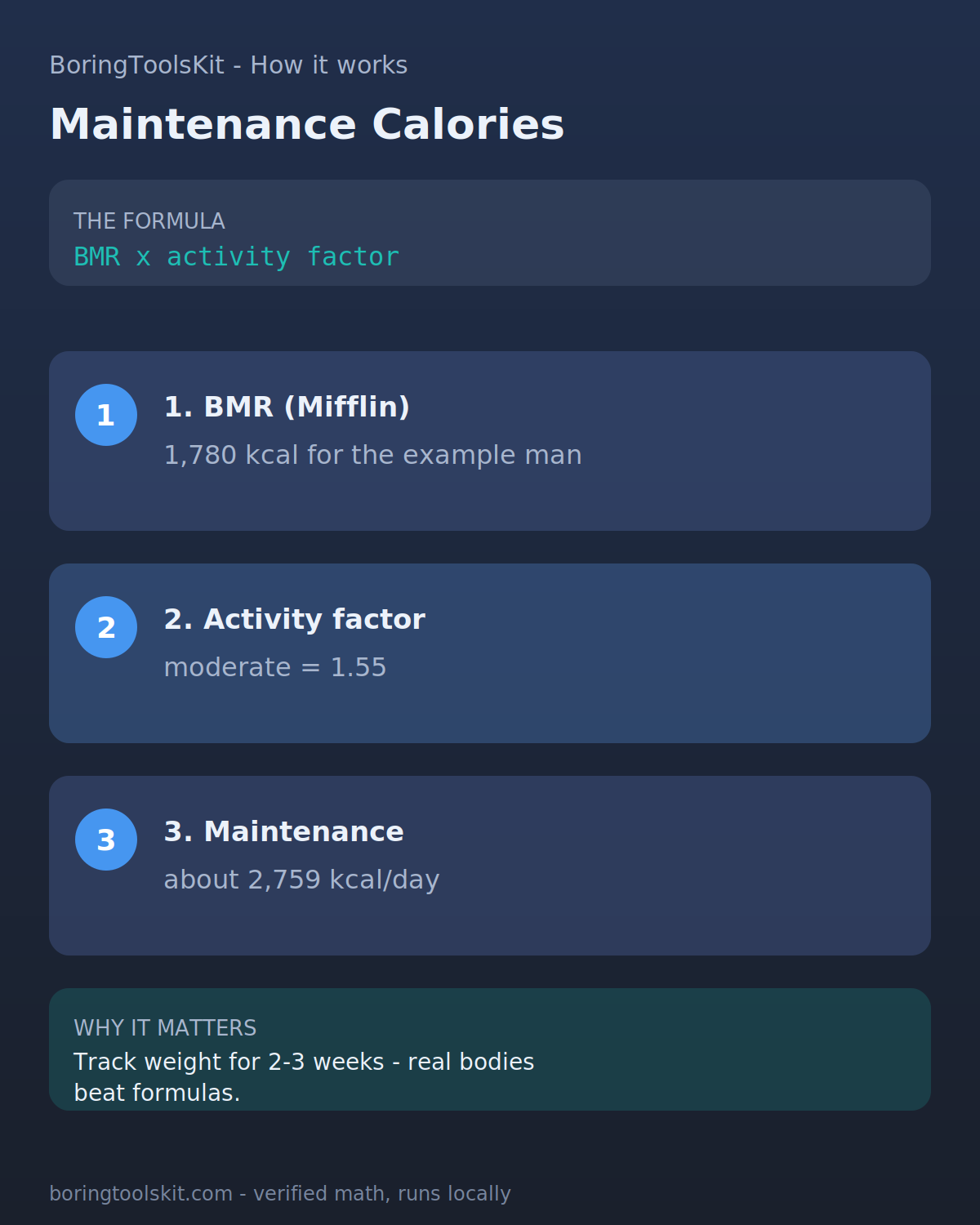
How this calculator works
Formula
Mifflin-St Jeor BMR = 10 x weight(kg) + 6.25 x height(cm) - 5 x age + 5 (male) or -161 (female); maintenance = BMR x activity multiplier.
Worked example
A 30-year-old, 180 cm, 80 kg man: BMR 1,780 kcal, x 1.55 for moderate activity = about 2,759 kcal/day maintenance.
Sources
- American Journal of Clinical Nutrition / PubMed — Mifflin et al. (1990): A new predictive equation for resting energy expenditure in healthy individuals
- BoringToolsKit — Calculation methodology
- NutriAdmin — Katch-McArdle equation and lean body mass
- NASM — Resting metabolic rate: estimates, limitations, and TDEE
Assumptions to verify
- The calculator uses the simplified Mifflin-St Jeor adult resting-energy equation and an activity factor; it does not measure energy expenditure.
- Activity codes must be whole numbers 0–4 and the sex coefficient code must be 0 or 1. Inputs use years, centimeters, and kilograms.
- Katch-McArdle is explained for manual comparison only and requires a reliable lean-mass or body-fat measurement.
- General education for adults, not medical advice. Seek qualified guidance for pregnancy, breastfeeding, growth, medical conditions, or eating-disorder concerns.
Frequently asked questions
What is BMR?
Basal metabolic rate: the calories your body burns at complete rest.
How accurate is the maintenance estimate?
It is an estimate, not an individual accuracy guarantee. Activity selection, body composition, health, and tracking error affect the result. Compare weight trends and average intake over several weeks if tracking is appropriate for you.
How does this calorie maintenance calculator work?
It calculates resting calories with Mifflin-St Jeor, then multiplies by your activity factor. The default 30-year-old, 180 cm, 80 kg male at moderate activity gives 1,780 × 1.55 = 2,759 kcal/day.
Does a maintenance calories calculator give BMR or TDEE?
The main result is estimated TDEE: calories to maintain weight across the whole day. BMR is only the resting component. Eating at the resting estimate is not the same as eating at maintenance.
Does this maintenance calories calculator use Katch-McArdle?
No. The interactive form uses Mifflin-St Jeor. Katch-McArdle is explained above as a manual comparison using 370 + 21.6 × lean body mass in kilograms; it needs body-composition information this form does not collect.
Which activity number should I enter?
Enter 0 for sedentary (1.2), 1 for light (1.375), 2 for moderate (1.55), 3 for heavy (1.725), or 4 for athlete-level activity (1.9). Use your typical weekly routine, not your most active day.
Should I add workout calories to maintenance calories?
Usually not when your activity factor already accounts for those workouts. Adding them separately can count the same exercise twice. Check the overall activity assumption rather than automatically adding a wearable estimate.
Cite this tool
BoringToolsKit. “Maintenance Calories Calculator.” boringtoolskit.com/maintenance-calories-calculator/. Free to reference in articles, syllabi, and answer posts with a link.
Privacy: Inputs and results stay in this browser. Any future sponsored recommendation or advertisement will be clearly labeled and kept separate from the calculation.