Calorie Target Calculator

Calorie target calculator: get daily calories for cutting, maintaining, or bulking from your stats and activity level. Free, runs in your browser, no signup.

Updates automatically as you type.

Calculated in your browser; your inputs are not sent to us. Privacy

Results will appear here.

General estimate for planning only — not medical advice. Consult a doctor about your specific situation.

Calculation details
Every figure above is calculated locally in your browser from the assumptions shown. No inputs are sent anywhere. See the methodology section below for how this tool works.
Use this resultShare the current inputs, or ask ChatGPT to explain the calculation in context.
Ask an AI to explain this result
Share this result

Review the generated output before relying on it.

This tool runs in your browser. Your calculator inputs and results are never transmitted to us or to ad/affiliate partners. Ads and sponsored links may set third-party cookies to serve and measure them, but they never receive your calculation values. If you explicitly save a scenario, its permitted fields stay in local browser storage until you clear them. See our Privacy Policy.

Use this result

Share the current inputs or ask ChatGPT to explain the calculation in context.

More options
Report a calculation issue
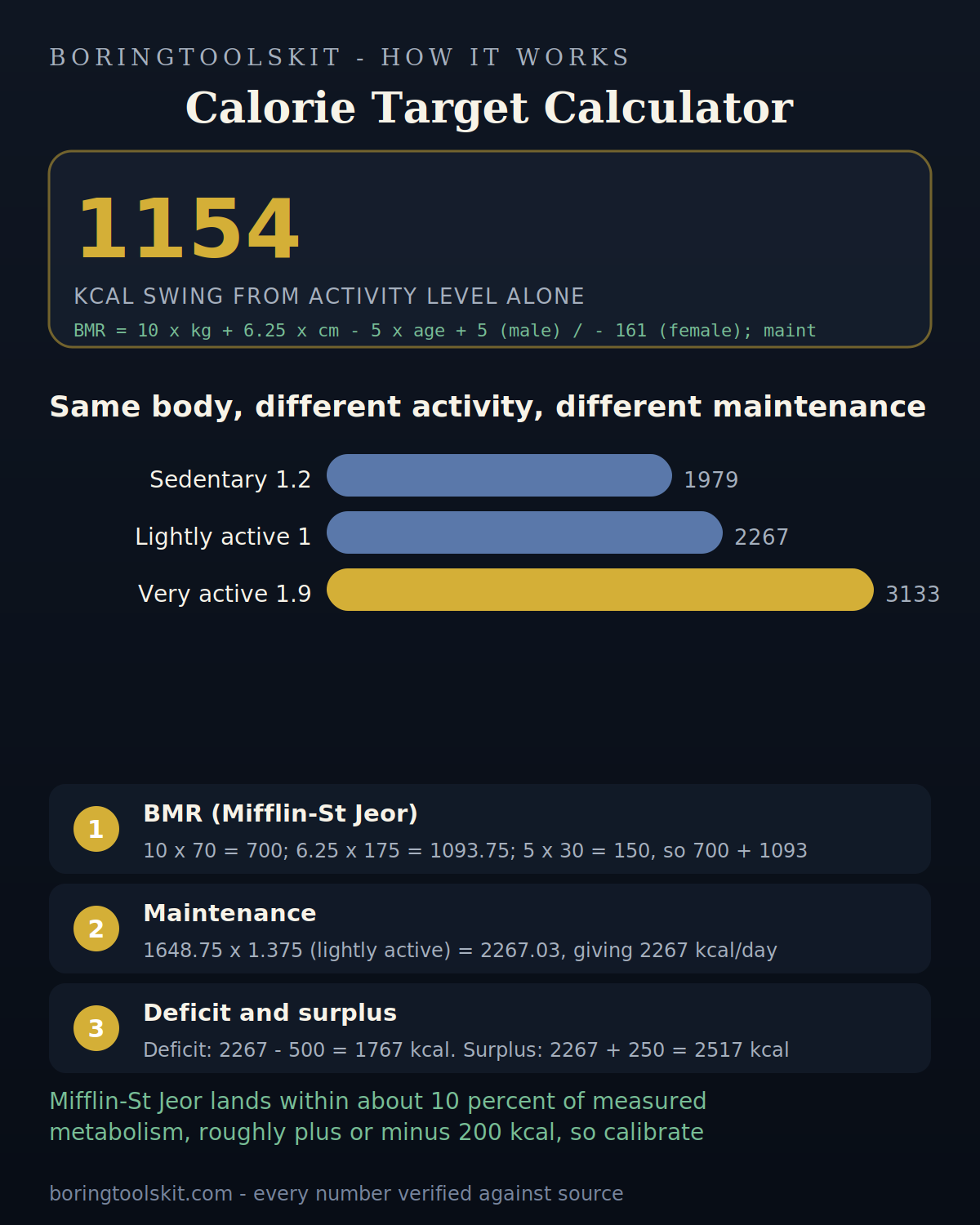
Maintenance calories by activity level for a 70 kg man
Activity level alone swings maintenance calories by 1154 kcal
Method & verification

How This Tool Works

fact-checked against our calculation methodology

Calculation Method

Computes Maintenance from Weight, Height, Age, Sex and Activity.

Site methodology

No unrelated authority link is added merely to make this page look sourced. Tool-specific external sources are shown only when they directly support the method, rate, or rule.

Assumptions to Verify

  • These tools provide general estimates for planning and education only.
  • They are not medical advice and not a substitute for a qualified healthcare professional.
  • Always consult your doctor or another healthcare provider about your specific situation.

Privacy: The calculation runs in this browser. Shared links contain the page address only, not your inputs or results.

A worked example: 70 kg, 175 cm, 30-year-old man, lightly active

Start with Mifflin-St Jeor. Ten times weight gives 700. Height: 6.25 x 175 = 1093.75. Age: 5 x 30 = 150, so the male formula runs 700 + 1093.75 - 150 + 5 = 1648.75 kcal, which the page rounds to 1649 for the BMR line.

Multiply by the lightly active factor of 1.375: 1648.75 x 1.375 = 2267.03 kcal. That becomes the maintenance figure of 2267 kcal/day. The deficit row is 2267 - 500 = 1767 kcal and the surplus row is 2267 + 250 = 2517 kcal. Everything after the BMR step is linear, so the same person at sedentary 1.2 would sit at 1979 kcal and at very active 1.9 at 3133 kcal: a 1154 kcal swing from activity alone, larger than the entire 500 kcal deficit the tool applies.

That swing is why guessing the activity level honestly matters more than the exact weight figure. If this user overstates his activity by one notch, maintenance rises about 278 kcal and a real intake of 2267 looks like a deficit when it is actually maintenance.

Where the standard formula drifts in practice

Mifflin-St Jeor predicts resting metabolism for the average person of your size, not yours. Controlled testing shows it typically lands within about 10 percent of measured values, which is roughly plus or minus 200 kcal for our 2267 kcal example. A 500 kcal deficit built on a 200 kcal overestimate is really a 300 kcal deficit and loses about 0.26 kg per week rather than 0.45 kg.

Three groups drift more than that. Very muscular people can run 5 to 15 percent above prediction because the formula only knows total weight, not composition. Adults over 60 show wider residuals as body composition shifts. And the flat multipliers hide huge real differences: two office workers who both check moderately active can differ by 300 kcal in true daily burn depending on steps outside the gym, a gap that shows up in research as NEAT varying by up to roughly 2000 kcal between individuals.

The practical fix is calibration, not precision. Log intake for two weeks at the calculated maintenance, track weekly weight, and divide the daily calorie change by 7: gaining 0.5 kg means maintenance is about 550 kcal lower than the estimate. Adjust the target once, not daily, and re-check after each 5 percent change in body weight because maintenance falls as you get lighter.