Intermittent Fasting Calculator

Intermittent fasting calculator: pick 16:8, 18:6, or OMAD and get your eating window, fasting schedule, and daily calorie target. Free, runs locally, no signup.

Updates automatically as you type.

Calculated in your browser; your inputs are not sent to us. Privacy

Results will appear here.

General estimate for planning only — not medical advice. Consult a doctor about your specific situation.

Calculation details
Every figure above is calculated locally in your browser from the assumptions shown. No inputs are sent anywhere. See the methodology section below for how this tool works.
Use this resultShare the current inputs, or ask ChatGPT to explain the calculation in context.
Ask an AI to explain this result
Share this result

Review the generated output before relying on it.

This tool runs in your browser. Your calculator inputs and results are never transmitted to us or to ad/affiliate partners. Ads and sponsored links may set third-party cookies to serve and measure them, but they never receive your calculation values. If you explicitly save a scenario, its permitted fields stay in local browser storage until you clear them. See our Privacy Policy.

Use this result

Share the current inputs or ask ChatGPT to explain the calculation in context.

More options
Report a calculation issue
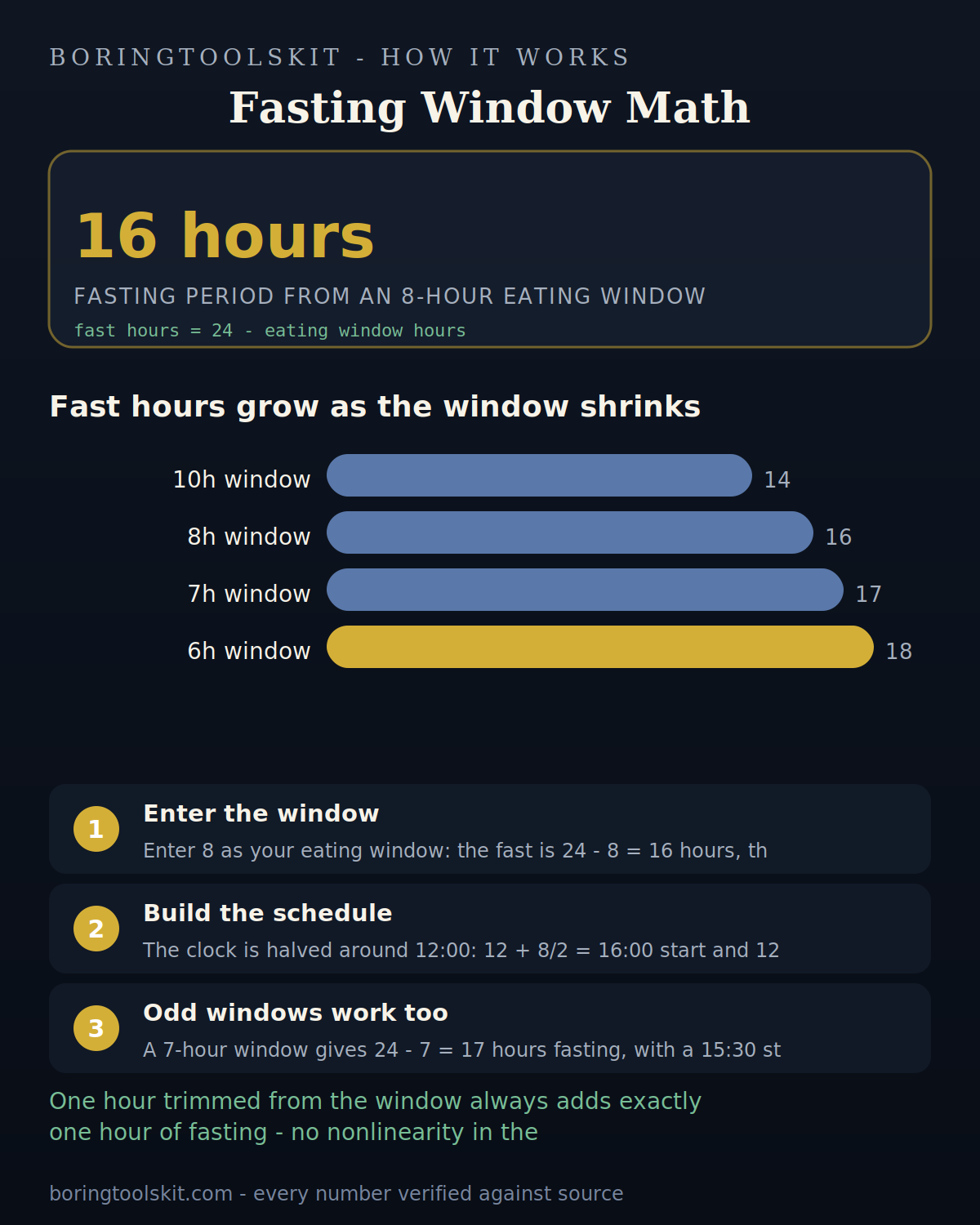
Fasting hours gained as eating window shrinks from 10 to 6 hours
Each hour cut from the window adds an hour of fasting: 8:16 down to 6:18.
Method & verification

How This Tool Works

fact-checked against our calculation methodology

Calculation Method

Fasting period = 24 - Eating window

Site methodology

No unrelated authority link is added merely to make this page look sourced. Tool-specific external sources are shown only when they directly support the method, rate, or rule.

Assumptions to Verify

  • These tools provide general estimates for planning and education only.
  • They are not medical advice and not a substitute for a qualified healthcare professional.
  • Always consult your doctor or another healthcare provider about your specific situation.

Privacy: The calculation runs in this browser. Shared links contain the page address only, not your inputs or results.

Worked example: the 16:8 split, step by step

Enter 8 as your eating window. The fast is 24 - 8 = 16 hours, so you land on the classic 16:8 pattern. The example clock schedule is built by halving the window around a 12:00 midpoint: 12 + 8/2 = 16:00 start, and 12 - 8/2 = 8:00 end. Eating from 8:00 to 16:00 leaves 16 hours fasting, and the two numbers always sum to 24.

Now try an odd window, say 7 hours. The fast is 24 - 7 = 17 hours. The schedule formula produces 12 + 3.5 = 15:30 as the start and 8:30 as the end, because a 7-hour window cannot be centered on a whole hour. Fasting from 15:30 to 8:30 is exactly 17 hours, which the calculator reports as '17 hours'. One hour trimmed from the window always adds exactly one hour of fasting; there is no nonlinearity in the formula.

Note the validation boundary: a window of 24 or more is rejected because it leaves zero fasting time, and 0 is rejected because it is not an eating window at all. Only 1 through 23 produce a result.

Limits the math does not capture

The 24-hour day is an idealized cycle. A 16-hour fast measured from a 16:00 last meal assumes you actually stop eating at that minute; in practice a 20:30 finish turns a planned 16:8 into a real 14.5:9.5, since 20:30 to 12:00 the next day is only 15.5 hours. Coffee with cream or a 60-calorie snack technically ends the fast, though it barely moves total intake.

Sleep absorbs most of the fasting window, which is why a 14:10 schedule (10-hour window, for example 9:00 to 19:00) is a common starting point: only about 5 waking hours are food-free. Going from 16:8 to 18:6 removes just 2 hours of eating but does not halve calories on its own. Hunger typically peaks around hours 12 to 16 of a fast, and medications that must be taken with food can force an earlier window start, effectively shortening the fast below what you entered.

Shift workers should anchor the clock to their own wake time rather than midnight; a nurse on a 19:00 to 07:00 shift running the standard 8:00 to 16:00 window would eat only during sleep hours, defeating the schedule.