Fasting Window Calculator

Fasting window calculator: plan 16:8, 18:6, and custom intermittent fasting schedules from your last meal and wake time. Free, runs locally, no signup.

Updates automatically as you type.

Calculated in your browser; your inputs are not sent to us. Privacy

Results will appear here.

General estimate for planning only — not medical advice. Consult a doctor about your specific situation.

Calculation details
Every figure above is calculated locally in your browser from the assumptions shown. No inputs are sent anywhere. See the methodology section below for the formulas used.
Use this resultShare the current inputs, or ask ChatGPT to explain the calculation in context.
Ask an AI to explain this result
Share this result

Review the generated output before relying on it.

This tool runs in your browser. Your calculator inputs and results are never transmitted to us or to ad/affiliate partners. Ads and sponsored links may set third-party cookies to serve and measure them, but they never receive your calculation values. If you explicitly save a scenario, its permitted fields stay in local browser storage until you clear them. See our Privacy Policy.

Use this result

Share the current inputs or ask ChatGPT to explain the calculation in context.

More options
Report a calculation issue
Eating window calculation showing 16 hour fast from 7 PM
A 16 hour fast from 7 PM ends at 11 AM.
Method & verification

How This Tool Works

fact-checked against our calculation methodology

Calculation Method

Eating window = (Fast start + Fast length)%24

Site methodology

No unrelated authority link is added merely to make this page look sourced. Tool-specific external sources are shown only when they directly support the method, rate, or rule.

Assumptions to Verify

  • These tools provide general estimates for planning and education only.
  • They are not medical advice and not a substitute for a qualified healthcare professional.
  • Always consult your doctor or another healthcare provider about your specific situation.

Privacy: The calculation runs in this browser. Shared links contain the page address only, not your inputs or results.

Worked example: a 16:8 schedule that starts at 7 AM

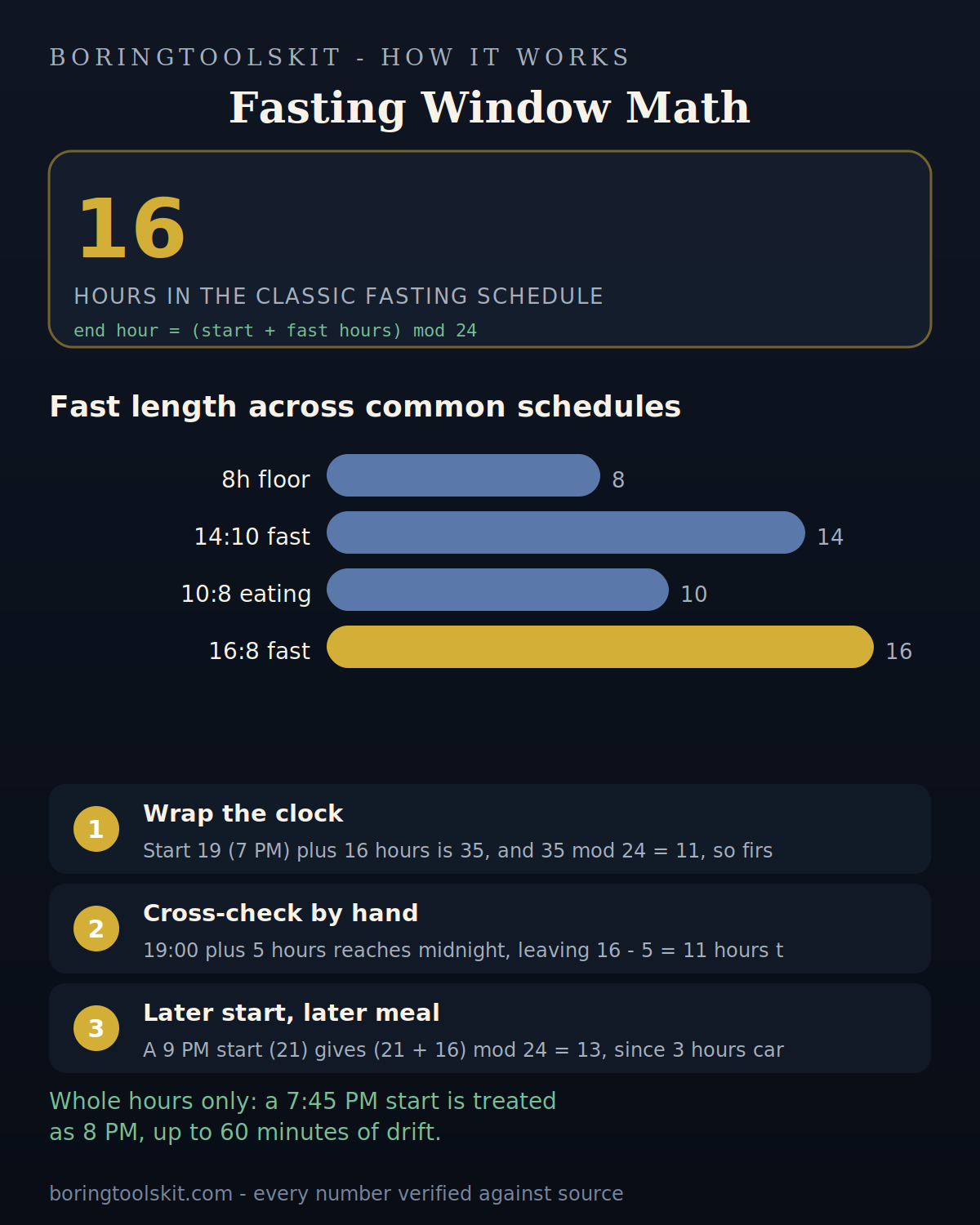
Say you finish dinner at 7 PM and set start = 19, hours = 16. The calculator computes the end of the fast as (19 + 16) mod 24 = 35 mod 24 = 11. So the eating window runs from 11 to 19 on the 24-hour clock, displayed as 11 AM to 7 PM, and your first meal lands at 11 AM the next day.

Cross-check it by hand: 19:00 plus 5 hours is midnight, leaving 16 - 5 = 11 hours to reach 11:00 AM. The mod 24 step is what handles the wrap past midnight; a 9 PM start (21) with a 16-hour fast gives (21 + 16) mod 24 = 13, a 1 PM first meal, because 3 hours carry past midnight and 13 remain. That wrap arithmetic is the entire formula: end hour = (start + fast hours) mod 24.

Where the hour-only model breaks down

The tool works in whole hours and ignores minutes, so a fast that starts at 7:45 PM for 16 hours is computed as an 8 PM start and reports a first meal of noon, 15 minutes later than the real 11:45 AM. For a 14:10 schedule the drift is the same 60 minutes or less, which is fine for planning a meal time but not for tracking adherence to the minute.

Two inputs are also missing from the model. Drinks count: black coffee, plain tea, and water do not break most fasting protocols, but a splash of milk (roughly 40 calories in 2 tablespoons) technically ends the fast, so your effective window depends on what you add, not just the clock times. And the minimum of 8 hours is a sanity floor, not a health recommendation: shift workers rotating between a 19:00 start one week and a 05:00 start the next face circadian disruption that no fixed window absorbs. Research on time-restricted eating typically reports benefits with 8 to 10 hour consistent windows; a schedule that changes by 10 or more hours week to week has not been shown to carry the same results.