Freelancer budgeting playbook · October 2, 2026
Freelancer Budget Calculator: Irregular Income Workflow
If your income arrives in fits and starts, a common budgeting mistake is re-running the budget on whatever landed this month. Below is the exact workflow we use with our own calculators - a tax reserve taken off the top of every deposit, a baseline built from your average, a lean/normal/strong month buffer, and an hourly-rate backstop as a separate scenario. Calculator outputs in this article were produced by executing the actual production formulas in a headless Node test harness (formulas, not the UI); derived arithmetic is shown so you can check it yourself.
Jump straight to the tools: 50/30/20 budget · self-employment tax · freelance hourly rate · savings goal
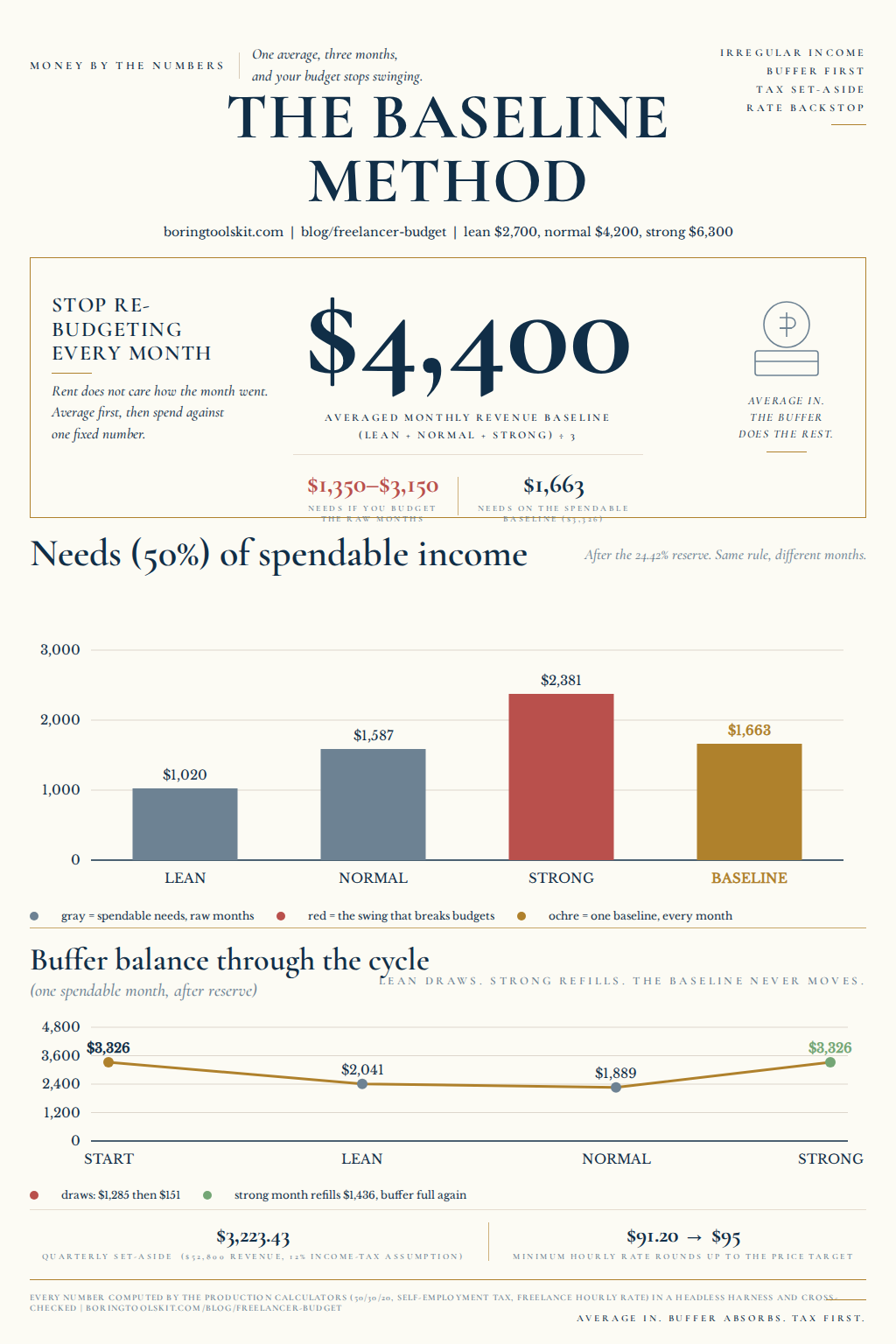
- Reserve tax first: 24.42% of every deposit moves to a separate account before you budget anything (at the $4,400 baseline that is $1,074.48 per month - the funding of the $3,223.43 quarterly estimate; the bill itself is paid quarterly).
- Budget the spendable remainder: baseline $4,400 - reserve $1,074.48 = $3,325.52 split 50/30/20 into $1,662.76 / $997.66 / $665.10 - not the full $4,400.
- The buffer is the shock absorber: one spendable month ($3,325.52). Our worked cycle draws it down to $1,889.50 and the strong month refills it to $3,325.52.
- Rate check is a separate scenario: at $52,000 take-home the calculator says $91.20/hour, pricing target $95/hour.
Why re-budgeting every month fails
We ran three representative months - a lean month at $2,700, a normal month at $4,200, and a strong month at $6,300 - through the 50/30/20 budget calculator applied to raw revenue before any tax reserve (the common mistake):
| Month | Income | Needs (50%) | Wants (30%) | Savings & debt (20%) |
|---|---|---|---|---|
| Lean | $2,700 | $1,350 | $810 | $540 |
| Normal | $4,200 | $2,100 | $1,260 | $840 |
| Strong | $6,300 | $3,150 | $1,890 | $1,260 |
Two things go wrong at once: your "needs" number swings from $1,350 to $3,150 across three months (rent does not care how the month went), and none of it has money set aside for tax. Fix both with the order below.
Step 1: Reserve tax before you budget
On the $4,400 baseline ($52,800/year) minus $1,800 of expenses, the self-employment tax calculator reports: net business profit $51,000 (92.35% net-earnings rule puts $47,098.50 of it under SE tax), self-employment tax $7,206.07, and a quarterly federal planning amount (SE tax + 12% assumed income tax, single filer) of $3,223.43.
Translate that quarterly estimate into a standing rule: move 24.42% of every deposit into a separate tax account ($1,074.48 ÷ $4,400 = the rate; at the $4,400 monthly revenue baseline that totals $1,074.48 per month - the rounded monthly funding amount for the $3,223.43 quarterly estimate). Funding the reserve is continuous; the quarterly payment itself is a scheduled event you pay from that account. The 12% income-tax assumption is a planning figure for a single filer, not a federal liability - verify real rules, rates, and deadlines with your own situation or a tax professional. This page is budgeting help, not tax advice.
Step 2: Set the baseline from an average (spendable)
(2,700 + 4,200 + 6,300) / 3 = $4,400 revenue baseline. After the 24.42% reserve, spendable baseline = $4,400 - $1,074.48 = $3,325.52 (equivalently $4,400 × 0.7558). That spendable number is what you split - run it once through the 50/30/20 calculator:
Step 3: Let the buffer absorb the swing
The buffer holds one spendable month ($3,325.52). Each month's money is reserved first (24.42%), then the spendable remainder is compared with the baseline. The math for our cycle:
| Month | Revenue | Tax reserve (24.42%) | Spendable | Buffer action | Buffer after |
|---|---|---|---|---|---|
| Start | - | - | - | - | $3,325.52 |
| Lean | $2,700 | $659.34 | $2,040.66 | draw $1,284.86 | $2,040.66 |
| Normal | $4,200 | $1,025.64 | $3,174.36 | draw $151.16 | $1,889.50 |
| Strong | $6,300 | $1,538.46 | $4,761.54 | refill $1,436.02 | $3,325.52 |
The buffer never dropped below $1,889.50 (57% of a spendable month). The strong month's surplus refills the buffer to target first; in this cycle there was nothing left over after the refill - when there is, the remainder gets the same 50/30/20 split. A pattern of persistent draws has several possible causes - too short a sample, seasonality, late-paying clients, or a rate that needs work - so diagnose before raising prices or cutting costs. Our savings goal calculator handles "how long until the buffer is full".
Step 4: Rate backstop (a separate scenario)
This one is deliberately a different scenario: what price produces a take-home target, not a continuation of the budget above. Running $52,000 take-home, 25% tax rate, $1,800 expenses, 48 weeks × 25 hours at 65% billable through the freelance hourly rate calculator:
- Required annual revenue: $71,133.33
- Estimated billable hours: 780
- Minimum hourly rate: $91.20 - pricing target rounds up to $95/hour
The one-page routine
- Every deposit: move 24.42% (or your own computed rate) to the tax account first. The quarterly payment comes out of that account.
- Budget the spendable remainder against one fixed 50/30/20 split. Recompute the baseline quarterly, not every month, so the plan stays stable between reviews.
- Lean month: draw the gap from the buffer. Strong month: refill the buffer to its target first; split only what remains.
- Twice a year: re-run the rate calculator against real expenses and hours; if the minimum rate is above your price, price is one of the levers to pull.
How these numbers were produced (methodology)
Calculator outputs (the 50/30/20 splits, the self-employment tax figures, the hourly-rate figures) came from executing the production formulas - the same code this site runs - in a headless Node test harness, then cross-checked with an independent arithmetic pass: 50/30/20 budget calculator, self-employment tax calculator, freelance hourly rate calculator. Derived figures (the $4,400 average, the 24.42% reserve rate, the buffer sequence) are arithmetic on those outputs and are shown step by step above; the infographic rounds dollars to whole numbers. Scenarios are illustrative, not personalized financial advice; the $3,223.43 quarterly amount is an estimate under a 12% assumed income-tax rate for a single filer, not a federal liability.
Disclosure: BoringToolsKit built the calculators used in this article - we are not an independent reviewer of them. The site is free, requires no account, runs your inputs locally, and is funded by ads (shown only after you accept them), affiliate links, and donations.