Updates automatically as you type.
Calculated in your browser; your inputs are not sent to us. Privacy
Calculation details
Planning estimate only, not financial, tax, or legal advice. Verify assumptions and current rules before making decisions.
This tool runs in your browser. Your calculator inputs and results are never transmitted to us or to ad/affiliate partners. Ads and sponsored links may set third-party cookies to serve and measure them, but they never receive your calculation values. If you explicitly save a scenario, its permitted fields stay in local browser storage until you clear them. See our Privacy Policy.
Use this result
Share the current inputs or ask ChatGPT to explain the calculation in context.
More options
What does this calculator estimate?
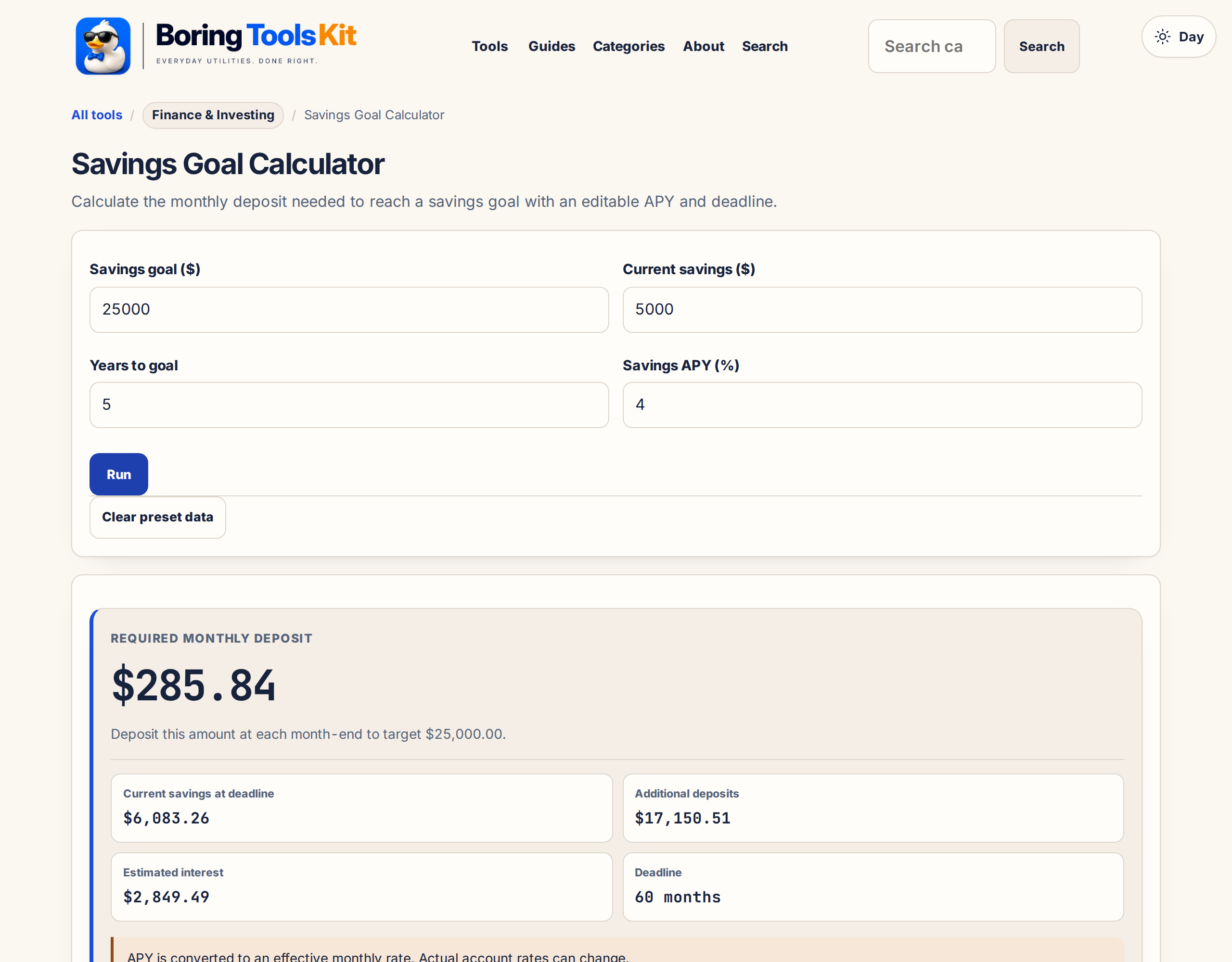
This calculator tells you the exact monthly deposit you need to reach a savings goal by a target date. Enter your starting balance, target amount, annual percentage yield, and time horizon. The result is the amount to set aside each month, accounting for compound interest on both your current savings and future deposits. Use that figure as your recurring transfer amount to stay on track.

Should I extend the timeline or raise the monthly deposit?
The two levers trade off directly, and compounding makes time the cheaper one: starting six months earlier usually beats depositing slightly more each month, because early contributions earn interest the longest. When the timeline is fixed by an external date, the deposit is forced; when it is flexible, compare both schedules here and weigh deposit strain against deadline value.
How does the target amount change with inflation?
A $20,000 goal set for eight years from now is a claim about future purchasing power. Prices rising 3% annually make today's $20,000 cost roughly $25,000 then. Goals tied to prices, like a car or a down payment, should be inflated to the target date before the monthly deposit is computed; goals in fixed dollars need no adjustment.
How this calculator works
Formula
Required monthly deposit = (goal - current x (1 + apy/12)^(12n)) x (r/12) / ((1 + r/12)^n - 1), n in months.
Worked example
A $25,000 goal in 3 years at 4% APY with $5,000 saved: $508 a month, with $1,712 of it coming from interest.
Sources
Sources support the method, terminology, or planning context. Editable assumptions remain your responsibility.
Assumptions to verify
- APY stays constant through the deadline.
- Deposits occur at the end of each month.
- Taxes, fees, rate tiers, and withdrawal restrictions are excluded.
Frequently asked questions
How does a savings goal calculator help me reach my financial targets?
A savings goal calculator shows you exactly how much you need to save each month to reach your target by a specific date, breaking down your goal into manageable steps.
Is my financial data safe since this is a no-signup tool?
Yes, because this savings goal calculator runs entirely in your browser, no data is ever sent to a server or stored, ensuring your financial information remains completely private and secure.
Do I need to create an account to use the savings goal calculator?
No, this is a no-signup tool, so you can calculate your savings goals instantly without providing an email or creating an account.
Cite this tool
BoringToolsKit. “Savings Goal Calculator.” boringtoolskit.com/savings-goal-calculator/ (reviewed August 2026). Free to reference in articles, syllabi, and answer posts with a link.
Privacy: Inputs and results stay in this browser. Results are planning estimates based on your inputs; verify assumptions and current rules before making decisions.