Updates automatically as you type.
Calculated in your browser; your inputs are not sent to us. Privacy
Calculation details
Planning estimate only, not financial, tax, or legal advice. Verify assumptions and current rules before making decisions.
This tool runs in your browser. Your calculator inputs and results are never transmitted to us or to ad/affiliate partners. Ads and sponsored links may set third-party cookies to serve and measure them, but they never receive your calculation values. If you explicitly save a scenario, its permitted fields stay in local browser storage until you clear them. See our Privacy Policy.
Use this result
Share the current inputs or ask ChatGPT to explain the calculation in context.
More options
What does this calculator estimate?
APY is the real yearly rate of return once compounding is included. A 5.00% nominal rate compounded monthly produces a 5.1162% APY, so $25,000 earns $1,279.05 in one year at monthly compounding versus $1,281.69 at daily: APY = (1 + r/n)^n - 1, where r is the nominal rate and n the number of compounding periods per year. The figure comes from Regulation DD Appendix A. Run your own rate and deposit through the APY calculator above.
- APY includes compounding; nominal (APR-style) rates do not.
- 5.00% nominal compounded monthly is 5.1162% APY, worth $1,279.05 on a $25,000 deposit in one year.
- Compounding 5.00% every hour raises the APY just past daily, to 5.1271%: the frequency gain caps out.
- Comparing accounts by APY is apples-to-apples; comparing nominal rates is not.
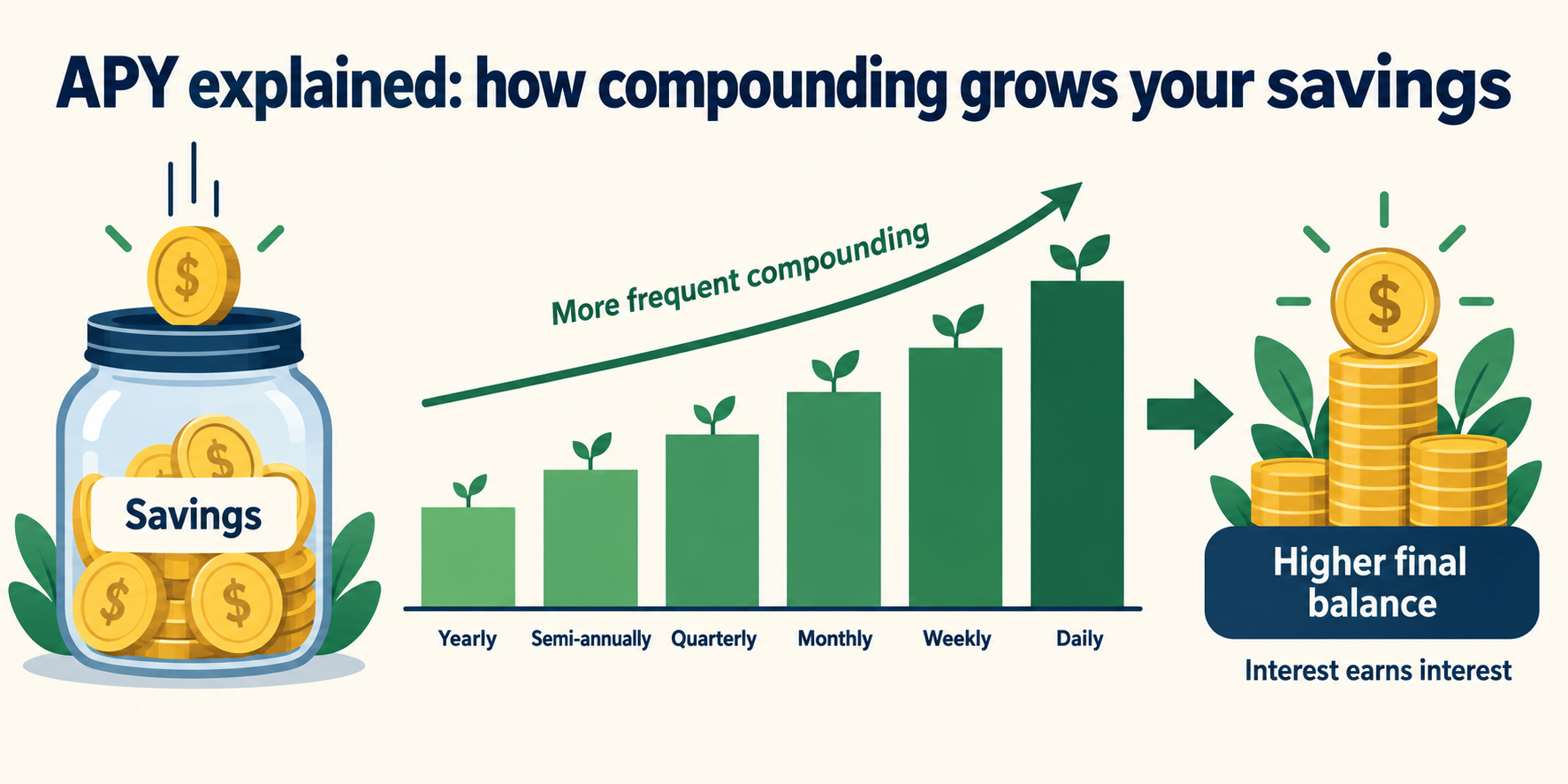
What APY actually measures
APY answers one question: if you put money in and leave it for exactly one year, what percentage will you have gained, counting every compound of interest along the way? A bank advertising 5% APY promises $500 per year per $10,000. A bank advertising a 5% rate without saying APY is quoting the nominal rate, and the true yield depends on how often that rate compounds.
The distinction matters most when compounding is frequent. At annual compounding, nominal and APY are identical. At monthly they diverge slightly; at daily, slightly more. The APY number is the honest one, which is why United States depository institutions are required by the Truth in Savings Act to disclose it.
How compounding frequency changes the yield
Each time interest compounds, it starts earning its own interest. Compounding annually gives interest one chance per year. Monthly gives twelve, daily gives three hundred sixty-five. Each increase in frequency adds a little yield, but the increments shrink fast: 5% nominal is 5.00% APY annually, about 5.12% monthly, about 5.13% daily.
This is why the difference between daily and continuous compounding is worth pennies on a $10,000 balance, while the difference between a 4.50% and a 5.00% APY is worth $50. Frequency is a rounding error next to the rate itself. Shop by APY first, frequency second.
APY versus APR
APY and APR are both annualized rates, but they run in opposite directions. APY is what you earn; it accounts for compounding in your favor. APR is what you pay on a loan; it accounts for fees and compounding in the lender's favor. Savings ads quote APY, loan ads quote APR, and both are quoted in the form that flatters the advertiser.
When comparing deposit accounts, convert everything to APY. When comparing loans, compare APR, and read the fee schedule: two loans with the same APR can differ in total cost if one front-loads fees.
The effect of monthly contributions
Contributions change the math more than most people expect, because each deposit starts compounding on the day it lands. Adding $200 a month at a 5% nominal rate compounded monthly yields a 5.1162% APY and ends year one at $2,466.00, of which $66.00 is interest on money that was only in the account for part of the year.
Over long horizons the contribution stream dominates the principal. Twenty years of $200 monthly deposits is $48,000 contributed; at the same monthly-compounded 5% rate it grows to $82,549.26, of which $34,549.26 is interest. The earlier each deposit lands, the more years it compounds, which is the entire argument for automating savings on payday rather than in a year-end lump.
Worked scenarios: $10,000, $25,000, and $200 per month
The tables below are scenario paths the calculator reproduces directly from its formula at a 5.00% nominal rate. They show how the same compounding mechanics scale with balance size and with time more than with frequency: moving from annual to daily compounding adds $11.67 on a $10,000 balance in one year, while moving from one year to ten years adds about ten times the whole balance in interest.
The growth table holds the deposit steady and varies the term. Because each year's interest joins the following year's base, the yearly gain accelerates: $10,000 at the 5.1162% monthly APY gains $511.62 in year 1, $1,641.63 in year 10, and $3,460.49 between years 29 and 30. Every figure in both tables is computable from APY = (1 + r/n)^n - 1 compounded forward; none is a quoted bank offer.
| Compounding frequency | APY | Year-one interest | End balance |
|---|---|---|---|
| Annually | 5.0000% | $1,250.00 | $26,250.00 |
| Semi-annually | 5.0625% | $1,265.62 | $26,265.62 |
| Quarterly | 5.0945% | $1,273.63 | $26,273.63 |
| Monthly | 5.1162% | $1,279.05 | $26,279.05 |
| Daily | 5.1267% | $1,281.69 | $26,281.69 |
| Every hour | 5.1271% | $1,281.77 | $26,281.77 |
Growth of $10,000 at the 5.1162% monthly APY
This table holds the frequency fixed (monthly) and scales the term, so it answers the question the frequency table cannot: how long does compounding need before the interest column overtakes the principal? The gain crosses $10,000, equal to the original deposit, between years 14 and 15 under these scenario assumptions.
$200 a month of new deposits compounds faster than either table shows, because each deposit carries its own compounding clock. Twenty years of $200 monthly deposits at this APY reaches $82,549.26 on $48,000 contributed, and thirty years reaches $177,145.28 on $72,000: the interest portion outgrows the deposits in the final decade.
| Years invested | Interest earned | End balance |
|---|---|---|
| 1 | $511.62 | $10,511.62 |
| 5 | $2,833.59 | $12,833.59 |
| 10 | $6,470.09 | $16,470.09 |
| 14 | $10,061.65 | $20,061.65 |
| 15 | $11,143.22 | $21,143.22 |
| 20 | $17,126.40 | $27,126.40 |
| 30 | $34,677.44 | $44,677.44 |
Using the calculator well
Enter the APY, not the nominal rate, when the bank shows both. Set compounding frequency to match the account: savings accounts typically compound daily and pay monthly, CDs compound and pay on their stated schedule. Check that deposit and contribution fields match how you actually save.
The projection assumes the rate holds for the whole term. Variable-rate savings accounts reprice when the Federal Reserve moves, so treat long projections at today's APY as a scenario, not a forecast. For rate-risk planning, run the projection at a rate one point lower and see whether the plan still works.
Assumptions and limits
Results assume interest compounds at the entered frequency with no missed payments, no withdrawal penalties, and no taxes on interest. Interest earnings are taxable as ordinary income in most cases, which lowers the effective after-tax yield. The tool is an educational calculator, not tax or investment advice.
How this calculator works
Formula
APY = (1 + r/n)^n - 1, where r is the nominal annual rate and n is the number of compounding periods per year. With a monthly contribution C, the end balance adds the future value of the contribution stream: C * ((1 + APY/12)^m - 1) / (APY/12).
Worked example
$10,000 at a 5% nominal rate: annual compounding ends year one at $10,500.00; monthly compounding ends at $10,511.62; daily compounding at $10,512.67. Over 20 years the compounding gap widens to roughly $180 between annual and daily on principal alone.
Assumptions to verify
- Nominal rate and compounding frequency are entered as advertised by the institution.
- No fees, penalties, or taxes are modeled; after-tax yield will be lower.
- Variable APYs are treated as fixed for the projection term.
- Scenario tables use monthly-cycle compounding for contribution streams; banks may post interest on a different schedule.
Frequently asked questions
Is APY or the nominal rate the right number to compare?
APY, always. It is the rate that includes compounding, so two accounts with different compounding frequencies can be compared directly on APY.
Why does daily compounding barely beat monthly?
Each extra compounding event earns interest on interest for only a slightly longer effective period. The gains shrink geometrically: the jump from annual to monthly is worth about ten times the jump from monthly to daily.
Can a bank advertise a high rate with a low APY?
No. United States Truth in Savings rules require APY disclosure, and APY is computed from the rate and frequency, so the numbers cannot be gamed apart. Marketing can emphasize one over the other, but both must be available.
How much does one percentage point of APY matter?
On $10,000, one point is about $100 the first year, and it compounds: over 20 years at 5% versus 4%, the gap is roughly $2,500 on principal alone.
Does APY apply to loans?
No. Loans quote APR, which reflects fees and the borrower's cost. A loan's effective cost and a savings account's effective yield are different calculations and are not comparable.
Cite this tool
BoringToolsKit. “APY Calculator.” boringtoolskit.com/apy-calculator/ (reviewed October 2026). Free to reference in articles, syllabi, and answer posts with a link.
Privacy: Inputs and results stay in this browser. Any future sponsored recommendation or advertisement will be clearly labeled and kept separate from the calculation.