Updates automatically as you type.
Calculated in your browser; your inputs are not sent to us. Privacy
Calculation details
Review the generated output before relying on it.
This tool runs in your browser. Your calculator inputs and results are never transmitted to us or to ad/affiliate partners. Ads and sponsored links may set third-party cookies to serve and measure them, but they never receive your calculation values. If you explicitly save a scenario, its permitted fields stay in local browser storage until you clear them. See our Privacy Policy.
Use this result
Share the current inputs or ask ChatGPT to explain the calculation in context.
More options
What does this calculator estimate?
To round to significant figures, count the digits before the first non-zero digit, find the place of the last kept digit, and round there. For example, 12345 to 3 significant figures: the third digit is the hundreds place, so 12345 becomes 12300 (1.23 x 10^4). Zeros used only as placeholders are not significant.
- Math.round rounds .5 ties toward positive infinity, so Math.round(-123.5) gives -123, not -124
- Values with magnitude 0 are returned as 0 and the scientific notation shows 0 x 10^0
- Significant figures input is restricted to the range 1 through 15; anything else shows an error
How the significant figures calculator works
The calculator converts your number to scientific-notation thinking. It takes log10 of the absolute value and floors it to find the position of the leading digit. For 12345, log10 is about 4.09, so the leading digit sits in the 10^4 place. For 0.00456, log10 is about -2.34, so the leading digit sits in the 10^-3 place. That exponent determines where counting starts.
Once it knows the leading position, it computes the place value of the last digit you keep: 10 raised to (digits - sig + 1). Rounding 12345 to 3 significant figures gives a factor of 100, so the tool divides by 100, rounds to the nearest whole number, and multiplies back: 123.45 rounds to 123, and 123 times 100 is 12,300. The display formats this with commas and up to 8 decimal places.
The scientific notation line comes from the same exponent. Dividing by 10^4 turns 12345 into 1.2345, which is then fixed to sig minus 1 decimal places, giving 1.23 x 10^4. Because the mantissa is written with sig - 1 decimals, both the rounded integer and the notation always show the same count of significant figures.
Limitations and edge cases
Ties behave asymmetrically. JavaScript's Math.round rounds halves toward positive infinity, so rounding 2.5 to 1 significant figure gives 3, but rounding -2.5 to 1 significant figure gives -2, not -3. If you expect round-half-away-from-zero, negatives at an exact midpoint will surprise you. The same applies inside larger numbers: -12345 to 3 sig figs yields -12,300 without issue, but -125 at 2 sig figs yields -120 rather than -130 because -1.25 rounds up toward zero.
Binary floating point can shift results at the boundary. A value like 0.145 stored as a double is actually about 0.14499999999999999, so rounding to 2 significant figures can produce 0.14 where a decimal-paper method would give 0.15. The tool reports what JavaScript's arithmetic actually does rather than a textbook ideal, which is why the same input may differ from a hand calculation by one unit in the last place.
The significant figures field is constrained to whole values from 1 to 15; entering 0, a negative number, or more than 15 shows an error message instead of a result. The scientific notation exponent for any input is computed as floor(log10(abs(v))), and exactly zero is special-cased to 0 x 10^0 to avoid the undefined log of zero. Very large or very small magnitudes still round fine, but the comma-formatted output caps at 8 decimal places, so extreme small-magnitude results may hide trailing detail.
Using sig figs in practice
Significant figures express measurement precision. If a scale reads 12.4 g, writing 12.4000 g claims precision the instrument does not have. Round to the digits the instrument actually supports: a 3-sig-fig measurement of 0.004567 becomes 0.00456, keeping the 4, 5, and 6 and dropping the trailing 7. In chemistry class rules, multiplication and division results carry the smallest sig-fig count of any input, and addition and subtraction results carry the fewest decimal places.
Check your rounding mode when the digit after the last kept one is exactly 5. Rounding 148.5 to 3 significant figures works cleanly because the fractional part after dividing by 10 is 0.85, not a tie. But a value like 9.95 rounded to 2 sig figs divides to 0.995, and the stored double may sit just above or below the true midpoint. When a grade or a lab report hinges on one digit, compute the midpoint case by hand and use this tool to verify everything else.
For work and study, the fastest workflow is to round your final answer, not intermediate values. Chain 2.34 x 1.7 = 3.978 and round once at the end to 2 significant figures for 4.0; rounding each step would drift the result. Use the scientific notation output when the magnitude spans many zeros: 12,300 and 1.23 x 10^4 are the same number, but the notation makes the precision explicit and survives copy-paste into spreadsheets that strip trailing zeros.
How this calculator works
Formula
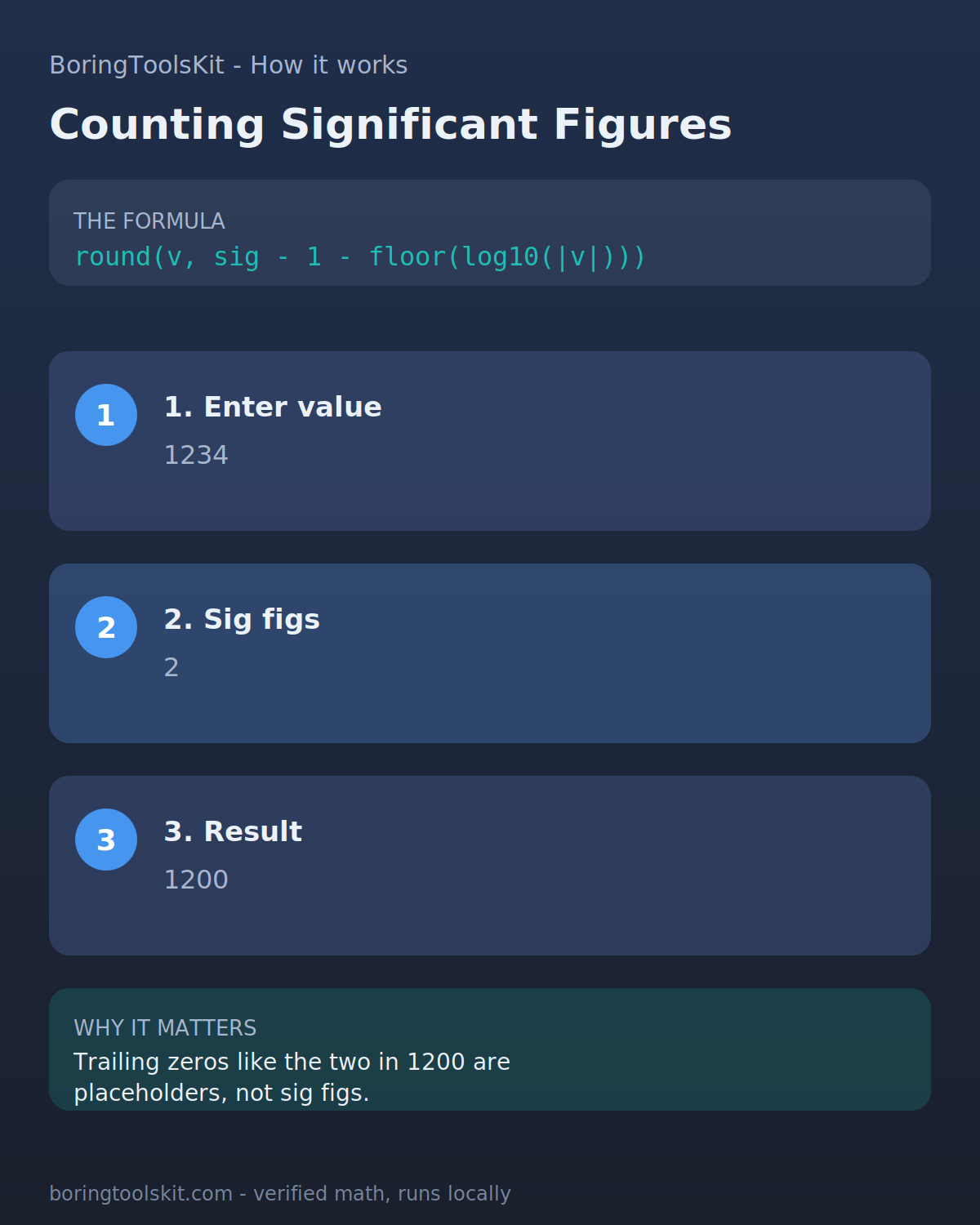
Rounds a number v to sig significant figures: digits = floor(log10(|v|)); factor = 10^(digits - sig + 1); result = Math.round(v / factor) * factor, then formatted with toLocaleString('en-US', maximumFractionDigits 8). Scientific notation: mantissa = (v / 10^digits).toFixed(sig - 1), exponent = digits.
Worked example
Input 12345 with 3 significant figures. Step 1: log10(12345) = 4.09, so digits = 4. Step 2: factor = 10^(4 - 3 + 1) = 10^2 = 100. Step 3: 12345 / 100 = 123.45; Math.round(123.45) = 123. Step 4: 123 * 100 = 12300, shown as 12,300. Scientific notation: 1.23 x 10^4. A value of 0 returns 0 with 0 x 10^0 notation, since log10(0) is undefined and the code special-cases zero.
Assumptions to verify
- Math.round uses round-half-toward-positive-infinity: an exact .5 tie rounds -2.5 to -2, not -3, because JavaScript's round is asymmetric for negatives.
- Binary floating point means stored values may sit just off a decimal midpoint (0.145 is really about 0.14499999999999999), so a tie can round down where decimal arithmetic would round up.
- The significant figures input must be a whole number from 1 to 15; 0, negatives, and values above 15 are rejected with an error, and an input of exactly 0 returns 0 with 0 x 10^0 notation.
Frequently asked questions
How do you round to significant figures?
Find the position of the first non-zero digit, count that digit plus the next sig-1 digits, then round at the following place. For 12345 to 3 significant figures, the last kept digit is the hundreds place, giving 12300.
What is a significant figure?
A significant figure is any digit that carries meaning in a number: all non-zero digits, zeros between non-zero digits, and trailing zeros after a decimal point. Leading zeros, like the 0.00 in 0.00456, are placeholders and not significant.
How many significant figures does 0.00456 have?
Three: the 4, 5, and 6. The leading zeros only locate the decimal point and do not count, so 0.00456, 0.0456, and 45600 written this way can all carry three significant figures.
How does the calculator handle negative numbers?
It rounds the magnitude the same way and keeps the sign, but JavaScript's Math.round breaks .5 ties toward positive infinity, so -2.5 rounds to -2, not -3. Numbers without an exact tie behave normally, such as -12345 to 3 sig figs giving -12,300.
Why does 0.145 round to 0.14 instead of 0.15?
In binary floating point, 0.145 is stored as approximately 0.14499999999999999, so it falls below the true midpoint and rounds down at 2 significant figures. The calculator shows what JavaScript's arithmetic actually computes rather than an idealized decimal result.
What is the difference between rounding to decimal places and to significant figures?
Decimal-place rounding fixes the absolute position, like the hundredths place, regardless of the number's size. Significant-figure rounding keeps a fixed count of meaningful digits, so 12345 to 2 sig figs is 12,000 while 0.012345 to 2 sig figs is 0.012.
What are the calculator's input limits?
The significant figures field accepts whole numbers from 1 to 15; anything outside that range shows an error message. An input value of exactly 0 returns 0, since logarithms of zero are undefined, and the scientific notation output displays 0 x 10^0.
Cite this tool
BoringToolsKit. “Significant Figures Calculator.” boringtoolskit.com/significant-figures-calculator/ (reviewed September 2026). Free to reference in articles, syllabi, and answer posts with a link.
Privacy: Inputs and results stay in this browser. Any future sponsored recommendation or advertisement will be clearly labeled and kept separate from the calculation.