Calculated in your browser; your inputs are not sent to us. Privacy
Results update when you run the tool.
This tool processes the selected input in your browser. Review the output before relying on it; format and file behavior can vary by browser and source data.
Your inputs and results stay in this browser. This page may send privacy-bounded aggregate interaction events described in Privacy; it does not send your entered values or result contents.
Use this result
Share the current inputs or ask ChatGPT to explain the calculation in context.
More options
What does this converter do?
Scientific notation converter: turn decimals into scientific or engineering notation and back, with adjustable significant figures. Free, runs in your browser.
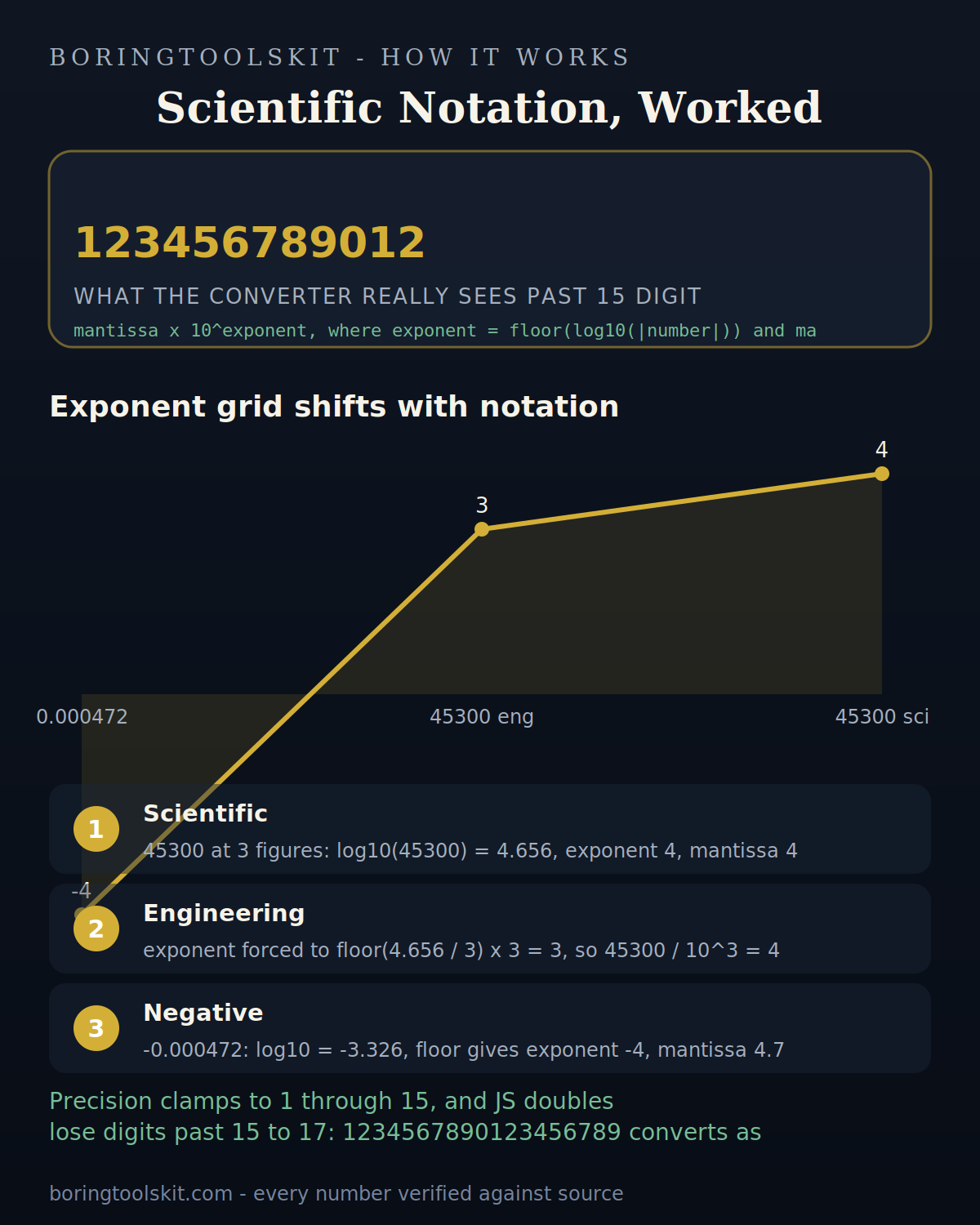
- Engineering notation forces the exponent to a multiple of 3; scientific notation keeps the mantissa in [1, 10).
How this calculator works
Formula
Scientific notation = mantissa x 10^exponent, with the mantissa normalised to 1 <= |mantissa| < 10. Engineering notation uses the same mantissa but rounds the exponent down to a multiple of 3, so 1.23e-5 and 12.3e-6 are equivalent.
Sources
Sources support the method, terminology, or planning context. Editable assumptions remain your responsibility.
Assumptions to verify
- Inputs are treated as exact decimal values.
- Standard (not historical or survey) unit definitions are used.
- The calculation uses the factors at the precision shown in the formula panel; rounding beyond that is display-only and adds no accuracy.
Frequently asked questions
What does the significant-figures setting change?
It sets how many digits are kept in the mantissa. The value itself is unchanged - this only controls how precisely the same number is written, not its accuracy.
Cite this tool
BoringToolsKit. “Scientific Notation Converter.” boringtoolskit.com/scientific-notation-converter/ (reviewed 2026-09-20). Free to reference in articles, syllabi, and answer posts with a link.
Privacy: Inputs and results stay in this browser. Conversion runs locally in your browser; review the output before relying on it.