Calculated in your browser; your inputs are not sent to us. Privacy
Results update when you run the tool.
This tool processes the selected input in your browser. Review the output before relying on it; format and file behavior can vary by browser and source data.
Your inputs and results stay in this browser. This page may send privacy-bounded aggregate interaction events described in Privacy; it does not send your entered values or result contents.
Use this result
Share the current inputs or ask ChatGPT to explain the calculation in context.
More options
What does this converter do?
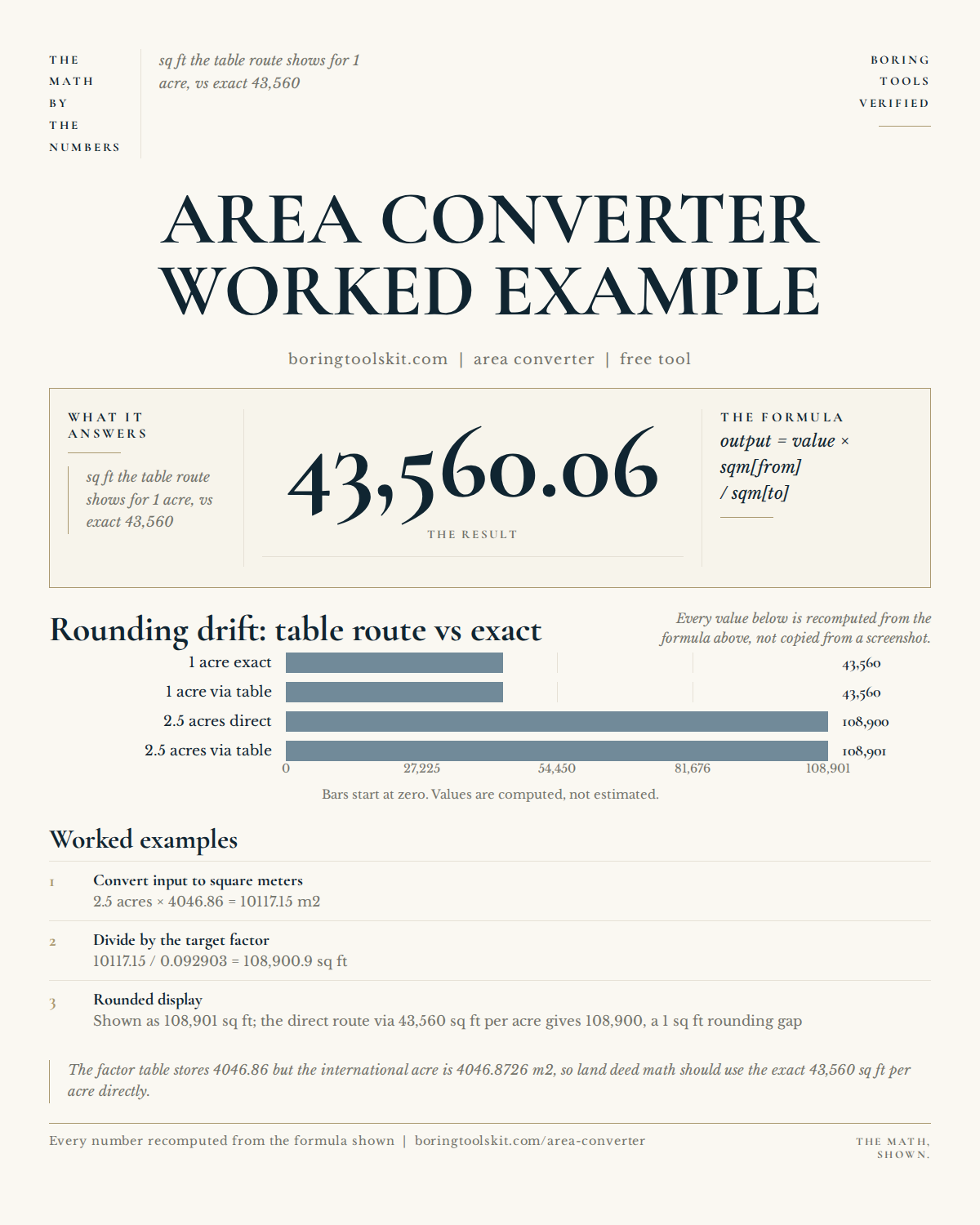
Area converts through square metres, so a unit raised to the second power uses its factor squared. 1 square foot is 0.09290304 square metres, 1 acre is 4046.8564224 square metres and 1 hectare is exactly 10000 square metres, which is why an acre comes out at about 0.4047 hectares. Rounding a linear factor before squaring it is the usual source of a small error here.
- An acre is 4840 square yards. With the international yard that is 4046.8564224 square metres, while the US survey acre uses the survey foot and differs by about 4 parts per million (NIST, Special Publication 811).
- One hectare is exactly 10000 square metres, a unit defined with the metric system and widely used for land (BIPM, SI Brochure).
Reference factors (area)
Exact factors in terms of the square meter, from NIST standards:
- 1 sq inch = 0.00064516 square meter
- 1 sq foot = 0.092903 square meter
- 1 sq meter = 1 square meter
- 1 acre = 4046.86 square meter
- 1 hectare = 10000 square meter
- 1 sq kilometer = 1e+06 square meter
How this converter works
Formula
Area = value x (square metres per source unit) / (square metres per target unit). Factors: 1 m2 = 0.092903 ft2, 4046.86 m2 per acre, 10000 m2 per hectare.
Worked example
1 acre = 4047 sq meter · 1 hectare = 2.471 acre · 1 sq foot = 0.0929 sq meter · 1 acre = 0.4047 hectare
Sources
Sources support the method, terminology, or planning context. Editable assumptions remain your responsibility.
Assumptions to verify
- Inputs are treated as exact decimal values.
- Standard (not historical or survey) unit definitions are used.
- The calculation uses the factors at the precision shown in the formula panel; rounding beyond that is display-only and adds no accuracy.
Frequently asked questions
Why convert through square meter instead of directly?
Routing every unit through a single base (square meter) means each unit needs only one exact factor against the standard, and any pair combines cleanly. Direct pair factors drift apart over time in hand-maintained tables; a base-unit graph cannot.
Where do these exact factors come from?
From published standards (NIST: SP 811 conversion factors). Units like the inch are defined exactly (1 in = 2.54 cm since 1959), so conversions between standard units are exact, not approximate.
How many decimal places should I trust?
The math is exact to the precision shown. The practical limit is your input: a tape measure is only good to ~1 mm and a kitchen scale to ~1 g, so 3–4 significant figures already exceeds the measurement's own accuracy.
Cite this tool
BoringToolsKit. “Area Converter.” boringtoolskit.com/area-converter/ (reviewed 2026-09-20). Free to reference in articles, syllabi, and answer posts with a link.
Privacy: Inputs and results stay in this browser. Conversion runs locally in your browser; review the output before relying on it.