Updates automatically as you type.
Calculated in your browser; your inputs are not sent to us. Privacy
Calculation details
Planning estimate only, not financial, tax, or legal advice. Verify assumptions and current rules before making decisions.
This tool runs in your browser. Your calculator inputs and results are never transmitted to us or to ad/affiliate partners. Ads and sponsored links may set third-party cookies to serve and measure them, but they never receive your calculation values. If you explicitly save a scenario, its permitted fields stay in local browser storage until you clear them. See our Privacy Policy.
Use this result
Share the current inputs or ask ChatGPT to explain the calculation in context.
More options
What does this calculator estimate?
Enter your student loan principal, annual interest rate, and monthly payment to estimate how long repayment may take. The calculator applies each monthly payment to interest first, then principal, and counts months until payoff. Your payment must exceed monthly interest; results stop after 600 months.
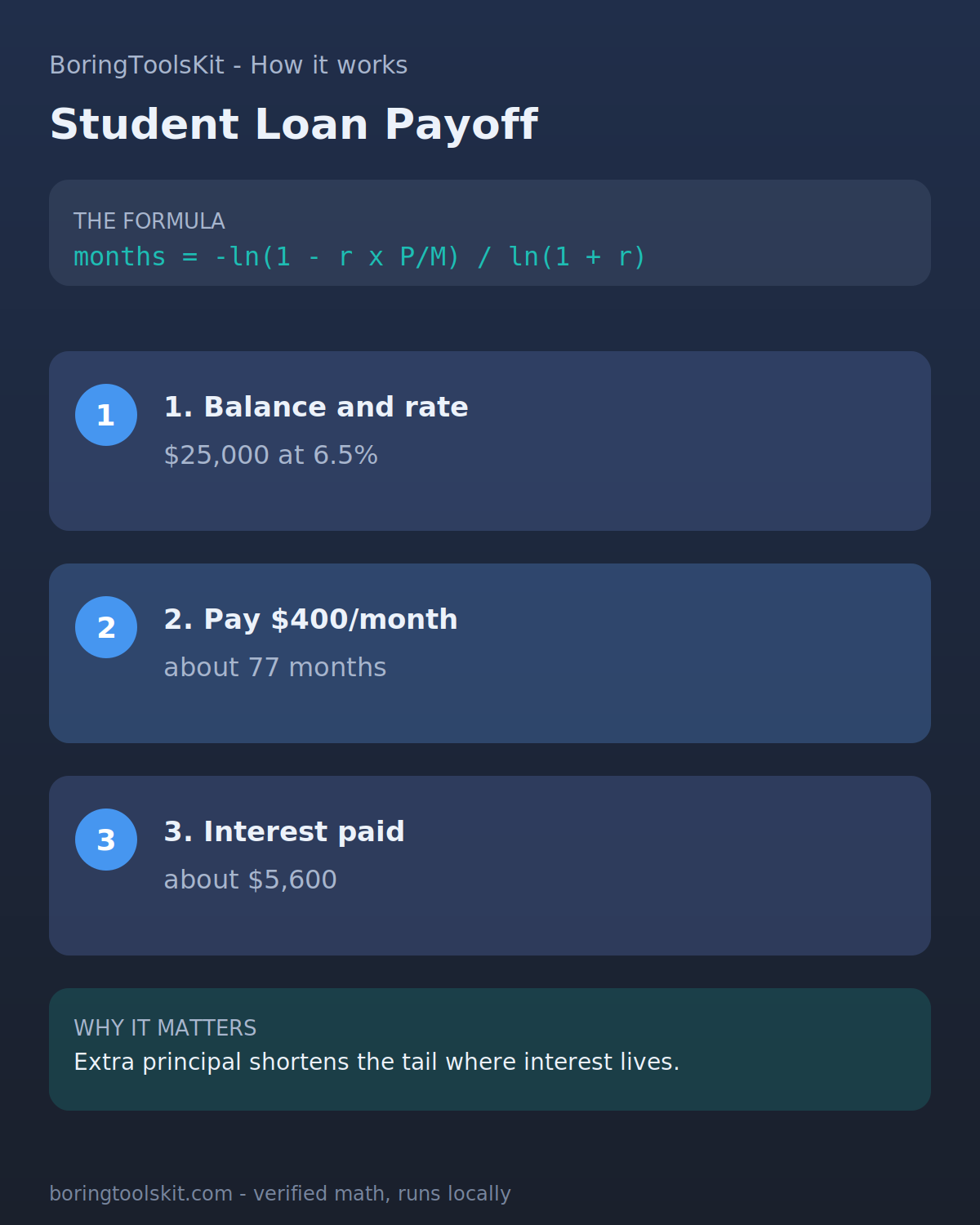
- Paying $400 a month on $25,000 at 6.5% clears the loan in about 77 months with about $5,600 of interest. (Source: BoringToolsKit calculation methodology)
- Adding $50 to the payment typically cuts several months off a payoff this size. (Source: BoringToolsKit calculation methodology)
- Federal loans keep income-driven and forgiveness options that refinancing privately would remove. (Source: CFPB)
Where should extra payments go first?
Extra dollars do the most work on the highest-rate loan, regardless of balance. Applying them to principal on a 7% loan beats prepaying a 4% one in every scenario. If multiple loans share a rate, killing the smallest first delivers a psychological win and frees a payment that can roll into the next target.
Do extra payments lower my monthly bill?
Usually no: extra principal shortens the term rather than reducing the required payment, unless the servicer recalculates or you formally recast. That is actually the efficient outcome, because the same payment now retires debt faster. Verify with your servicer that extra amounts apply to principal and not to next month's bill.
Interest first, then principal, on every single payment
Every monthly payment on an amortizing loan is split in the same order. Interest is charged first as principal times the monthly rate, and only what remains reduces the balance. On a $30,000 loan at 6% annual interest, the monthly interest charge is 30,000 times 0.005, or $150. A $350 payment sends $200 to principal and $150 to the lender as a fee for holding the money.
Early in the loan the interest portion is large and the payoff feels slow; late in the loan it flips. A $25,000 loan at 6.5% paid at roughly $288 per month would normally take 120 months and cost about $9,524 in interest. Add $25 a month and the payoff drops to 107 months with $8,391 of interest. Add $50 and it drops to 97 months with $7,504. The first extra dollars do more work than the last, because each dollar of principal removed stops generating interest for the rest of the loan.
The payoff time is sensitive to the rate as well as the payment. At a 24.9% credit card APR, $9,000 paid at $250 per month takes about 67 months and costs $7,730 in interest; the same balance paid at $350 takes 38 months and costs $3,997. High-rate balances reward every extra dollar far more than a low-rate student loan does, which is the arithmetic reason most payoff guides say to attack the credit card before the student loan.
Federal repayment plans the calculator does not model
This calculator assumes one fixed monthly payment until the balance reaches zero. Federal student loans do not have to follow that pattern. Income-driven plans such as SAVE, PAYE, or IBR set the payment from your income and family size rather than from the balance, and can produce payments lower than the interest accruing each month, which means the balance grows even while you pay.
A concrete shape of the gap: a borrower with a $45,000 balance at 5.3% facing the standard 10-year payment of about $484 per month, versus an income-driven payment that could legally be $0 in a low-income year. This calculator has no field for family size or income, so it cannot produce that number at all. It also has no field for the Public Service Loan Forgiveness qualifying payment count, which is the real end date for many federal borrowers rather than an amortization.
Use this tool for the fixed-payment case, including a refinance into a private loan or a period on the standard plan, and use the federal loan simulator on studentaid.gov for income-driven, deferment, or forgiveness scenarios. Applying an amortization calculator to a plan that is not amortizing silently replaces the real answer with a guess. If you are unsure which plan you are actually on, log in to your servicer portal and check the plan code before trusting the answer here.
Refinancing trades your federal protections for a lower rate
A refinance replaces the loan with a new one, usually through a private lender, and can genuinely drop the rate. On a $32,000 balance, moving from a 6.8% loan with $368 monthly payments on a 10-year schedule to a 5.5% loan with $347 payments saves roughly $2,517 in interest over the same 120 months. This calculator can estimate the new payoff time and interest cost if you enter the new principal, rate, and payment.
What the calculator will not show is what you lose. Federal loans carry income-driven repayment, deferment and forbearance during hardship, and access to Public Service Loan Forgiveness for qualifying employment. The moment a federal loan is refinanced into a private one, those rights are gone permanently, not paused. The $2,517 saved becomes a bad trade if your income drops next year and the only available option is a forbearance program your new lender does not offer.
The decision rule worth writing down: refinance only stable debt you are confident of paying on the standard schedule, and keep any loan you might need relief on federal. Before signing, run the proposed refinance terms back through this calculator and note the exact interest savings, then compare that figure honestly against what the federal protections are worth to you in your actual life, not in an abstract sense.
Re-entering school, capitalization, and fees the math ignores
This calculator runs one amortization from the principal you enter to zero on the rate you enter, with no additions along the way. Real loans sometimes add to the balance instead of shrinking. Unsubsidized federal loans accrue interest while you are in school, and when that interest is not paid it is capitalized, meaning it is added to the principal and starts accruing interest of its own. A $30,000 balance at 7% can become a $33,888 balance by the time repayment begins after four years, if none of that interest was paid.
Fees are a second blind spot. Some private lenders charge origination fees, typically 1% to 5% of the loan, which are usually deducted from the amount you receive. A $30,000 loan with a 3% origination fee delivers $29,100 while the payoff is calculated on the full $30,000 you owe. This calculator takes the principal you give it and has no field for the fee, so it cannot adjust for this.
Deferment and forbearance pause the regular payment, but many of these periods still accrue interest that capitalizes when payments resume. If any of those situations apply to you, update the principal in this calculator to the actual current balance rather than the original amount, or the payoff estimate will be wrong from the first month.
Snowball versus avalanche, with numbers on real balances
The avalanche method puts every spare dollar on the highest-rate debt first. The snowball method puts it on the smallest balance first. The math favors avalanche; the psychology often favors snowball, because closing one account entirely is a morale win. This calculator handles one loan at a time and will not orchestrate the ordering across several, so the ordering has to happen in a spreadsheet next to it.
Using illustrative balances: $9,000 on a credit card at 24.9% and $30,000 on a student loan at 5.8%. If you can pay $100 extra each month, the avalanche answer is to put it on the credit card. Raising the card payment from $250 to $350 saves about $3,733 in interest and cuts the payoff from 67 months to 38, compared with the same $100 going to the student loan, which saves about $791 and cuts that payoff by roughly 10 months.
The honest limitation on the other side is liquidity and motivation. If a $100 avalanche dollar goes to the credit card and you were three months from unexpectedly needing that cash, the aggressive plan can backfire without an emergency fund behind it. A practical split worth considering is the minimum-payment floor on every debt, one modest emergency balance, and then every extra dollar on the highest rate balance until the sheet says it no longer matters.
How this calculator works
Formula
Monthly interest = principal × (annual rate ÷ 100 ÷ 12). Each month, the payment is applied to interest first, then the remainder reduces principal. Months are counted until the balance reaches zero, capped at 600 months (50 years).
Worked example
For a $30,000 loan at 6% annual interest with a $350 monthly payment, monthly interest is 30,000 × 0.005 = $150, so $200 reduces principal each month; the calculator counts months until the balance reaches zero, up to 600 months.
Assumptions to verify
- The annual interest rate is converted to a flat monthly rate and applied to the current balance.
- A monthly payment that does not exceed monthly interest cannot pay off the loan under this model.
- This is a payoff-time estimate and does not include fees, capitalization changes, deferment, or program-specific terms.
Frequently asked questions
How long will it take to pay off my student loan?
Enter your principal, annual rate, and monthly payment. The calculator simulates monthly interest and principal payments to estimate months until your balance reaches zero.
What if my payment does not cover student loan interest?
If your monthly payment is not greater than monthly interest, the balance cannot pay off under this calculation. Increase the payment or review the loan terms.
Can extra payments help pay off a student loan faster?
Yes. A larger monthly payment leaves more money for principal after interest, which can reduce the estimated payoff time.
Cite this tool
BoringToolsKit. “Student Loan Payoff Calculator.” boringtoolskit.com/student-loan-payoff/ (reviewed August 2026). Free to reference in articles, syllabi, and answer posts with a link.
Privacy: Inputs and results stay in this browser. Any future sponsored recommendation or advertisement will be clearly labeled and kept separate from the calculation.