Updates automatically as you type.
Calculated in your browser; your inputs are not sent to us. Privacy
Calculation details
Planning estimate only, not financial, tax, or legal advice. Verify assumptions and current rules before making decisions.
This tool runs in your browser. Your calculator inputs and results are never transmitted to us or to ad/affiliate partners. Ads and sponsored links may set third-party cookies to serve and measure them, but they never receive your calculation values. If you explicitly save a scenario, its permitted fields stay in local browser storage until you clear them. See our Privacy Policy.
Use this result
Share the current inputs or ask ChatGPT to explain the calculation in context.
More options
What does this calculator estimate?
Loan comparison calculator: compare monthly payments and total interest across up to three loans side by side. Free, private, runs in your browser, no signup.
Is the lowest monthly payment always the cheapest loan?
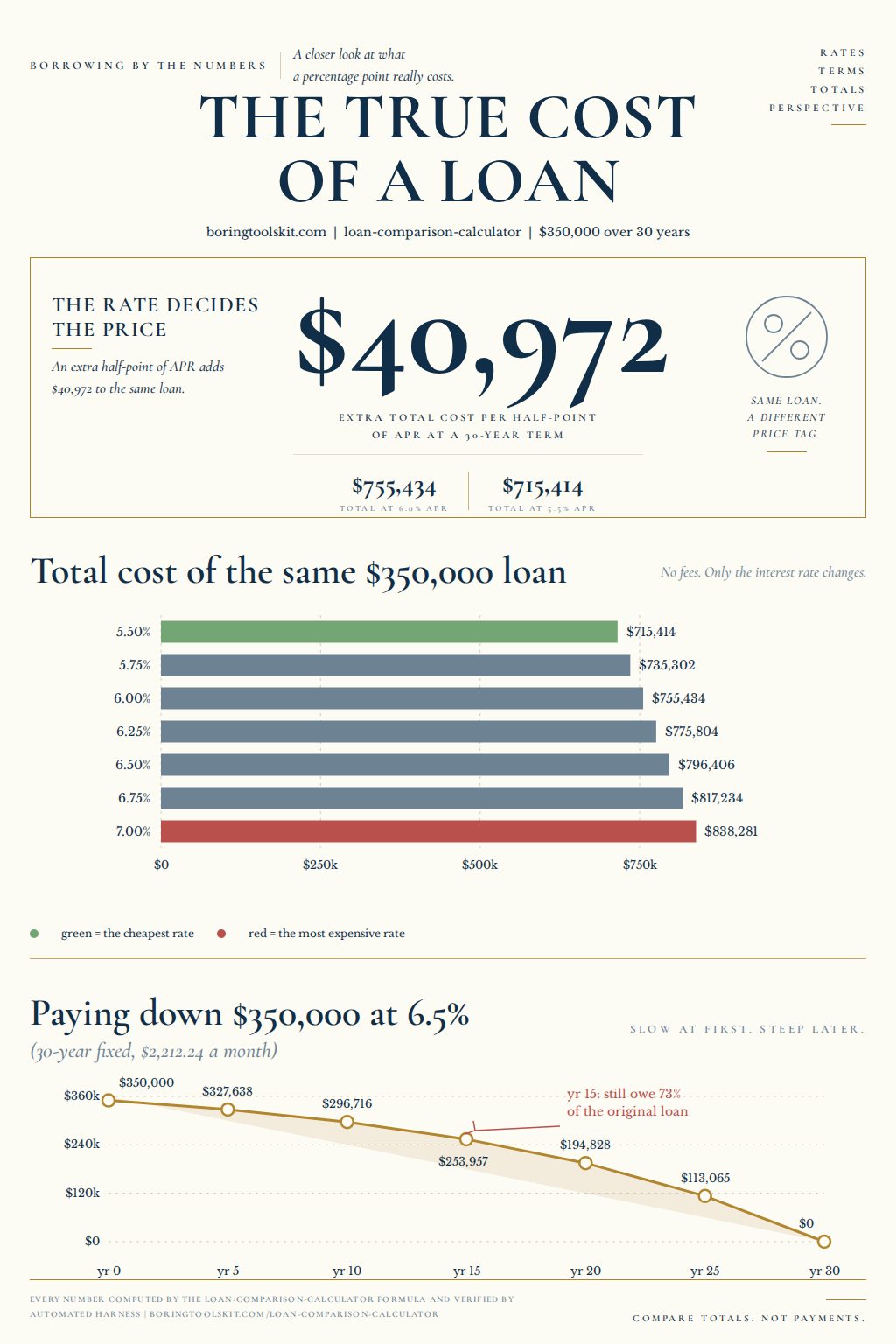
No. Stretching a loan over more months lowers each payment while raising total interest paid, sometimes dramatically. The cheapest loan by total cost often has the highest payment. Decide what you are optimizing, cash-flow room or lifetime cost, then use the comparison to see both numbers side by side; the difference is frequently thousands of dollars on mid-size loans.
How should fees enter the comparison?
Origination fees, points, and prepayment penalties change the real cost beyond the rate. The cleanest comparison computes each loan's total out-of-pocket: payments plus upfront fees, minus anything prepayment saves. Two loans with identical rates can diverge sharply once a 2% origination fee lands on one; the APR partially captures this, but totaling actual dollars is harder to game.
How this calculator works
Formula
Payment = amount x r/12 / (1 - (1 + r/12)^-n); total cost = payment x n + fees; compare total cost across offers.
Worked example
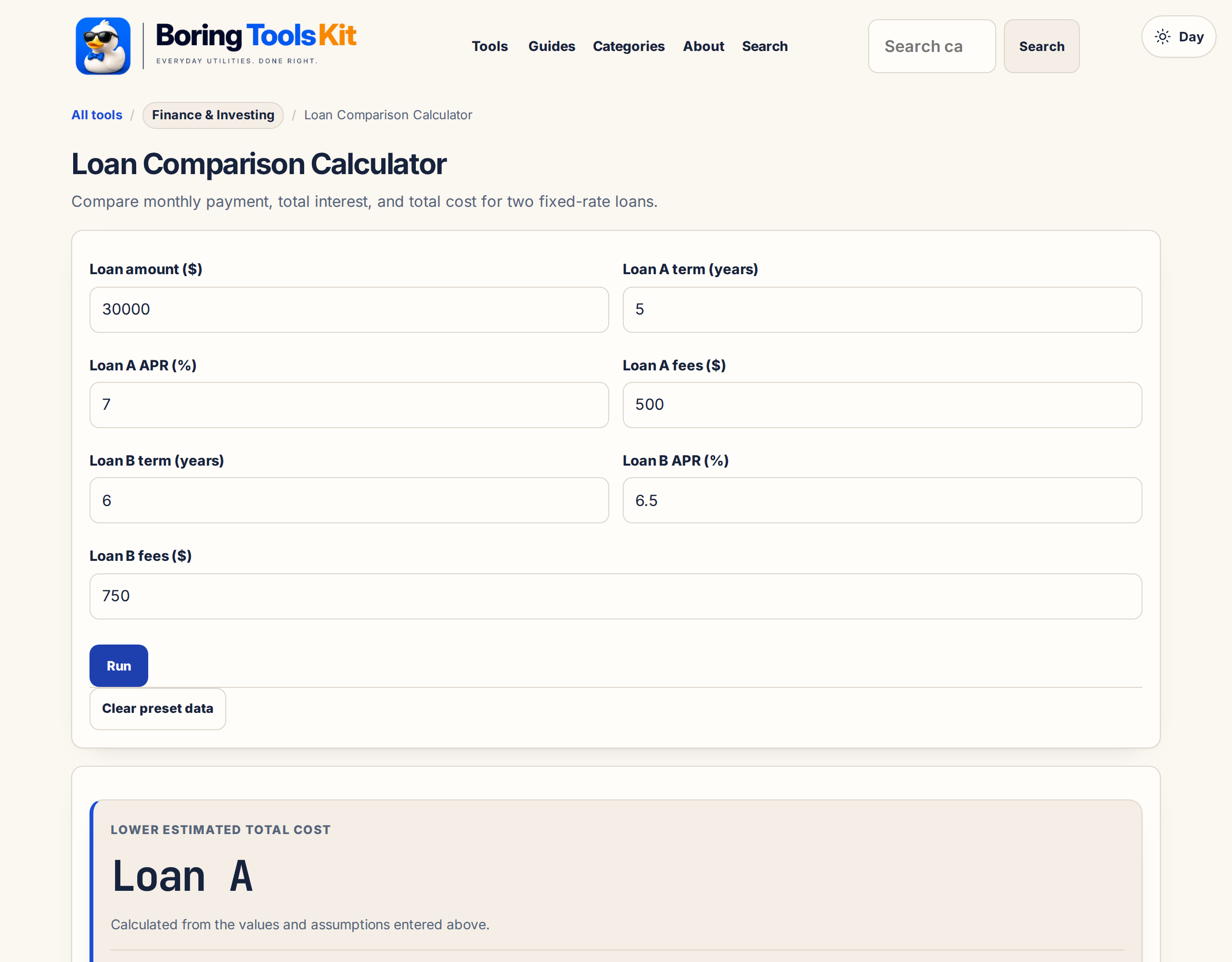
A $30,000 loan: offer A (5 yrs, 7%, $500 fees) costs $594.04 a month, $36,142.16 total; offer B (6 yrs, 6.5%, $750 fees) costs $504.30 a month but $37,059.45 total, so A wins on cost by about $917 despite the higher payment.
Assumptions to verify
- Both loans are fixed-rate and fully amortizing.
- Payments are monthly and made on schedule.
- Taxes, insurance, late charges, and optional products are excluded.
Frequently asked questions
Why can the lower payment cost more overall?
A longer term can reduce the monthly payment while creating more interest payments.
Are origination fees included?
Enter known lender fees in the fee fields. Financing a fee instead of paying it upfront can change the result.
Should I choose solely by total cost?
No. Cash flow, prepayment rules, collateral, risk, and loan features can also matter.
Cite this tool
BoringToolsKit. “Loan Comparison Calculator.” boringtoolskit.com/loan-comparison-calculator/. Free to reference in articles, syllabi, and answer posts with a link.
Privacy: Inputs and results stay in this browser. Any future sponsored recommendation or advertisement will be clearly labeled and kept separate from the calculation.