Property Tax Appeal Success Rates: DIY vs. Protest Companies (2026 Data Study)
Key Takeaways
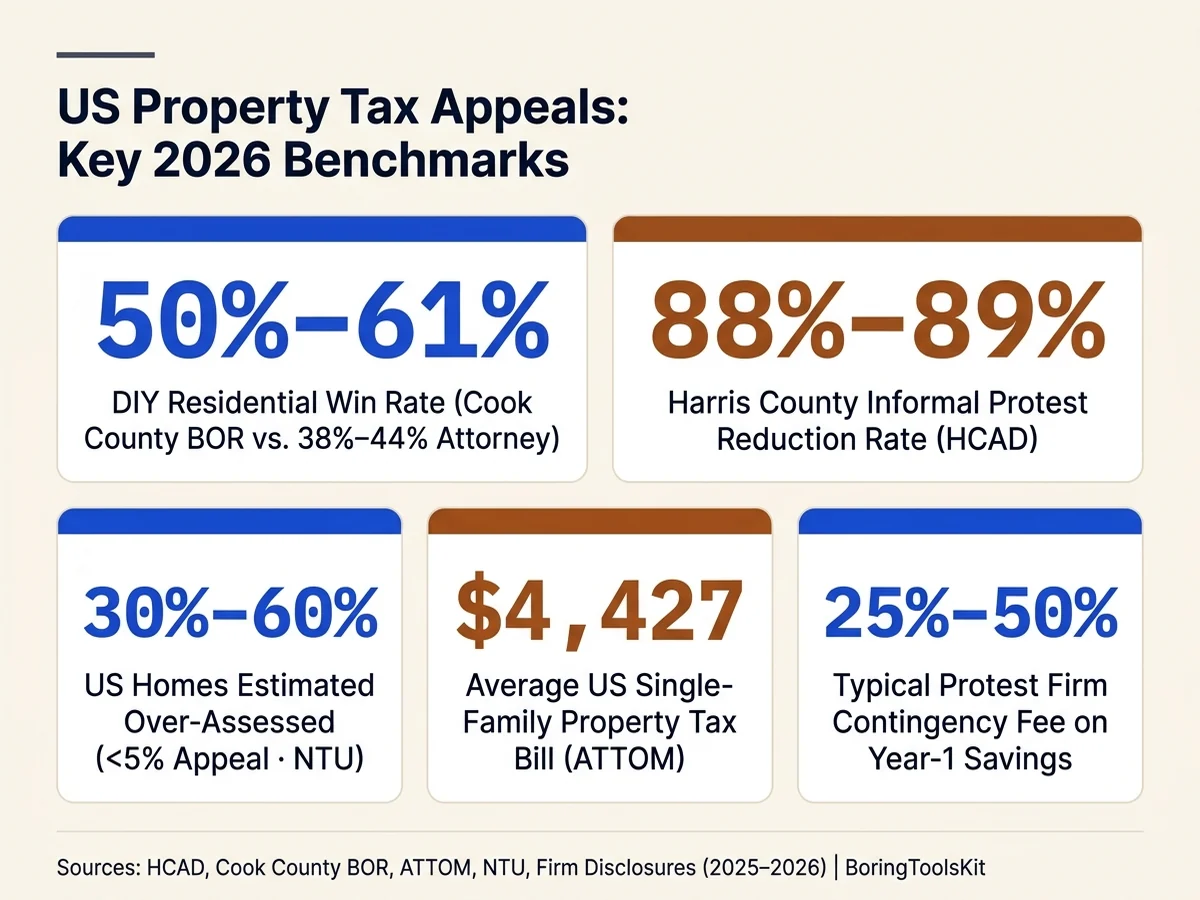
- 50%–61% vs. 38%–44% — DIY single-family homeowners outperformed attorneys by 10 to 17 percentage points at the Cook County Board of Review (Cook County Board of Review, 2024–2025).
- 88%–89% informal win rate — Harris Central Appraisal District (HCAD) logged 567,154 protests in 2025 (+9.77% YoY), with nearly nine in ten informal iSettle reviews securing a value reduction (HCAD, 2025).
- 1.28 million informal victories — Across Texas, informal protests settle with a reduction 70%–90% of the time, compared to 55%–70% at formal Appraisal Review Board hearings (Texas Comptroller PTAD, 2024–2025).
- 30%–60% over-assessed; <5% appeal — An estimated 30% to 60% of U.S. taxable properties are over-assessed, yet fewer than one in twenty owners formally challenge their bill (National Taxpayers Union).
- $4,427 average bill (0.90% rate) — U.S. single-family property taxes totaled $396.8 billion across 89.6 million homes, rising roughly 3% year-over-year (ATTOM, 2024–2025).
- 25%–50% Year-1 contingency fees — Major protest firms charge 25% (Ownwell TX), 40% (Five Stone), or 50% (O'Connor) of first-year savings, requiring +33% to +100% larger gross cuts just to match a DIY appeal (Ownwell, Five Stone, O'Connor, 2025–2026).
- Systematic regressivity — Lower- and middle-priced U.S. homes are consistently assessed at higher ratios of fair market value than luxury estates (Lincoln Institute of Land Policy, 2024–2025).

1 DIY vs. Protest Firm Win Rates in Public County Records
Public county assessment records contradict the assumption that hiring a property tax protest firm guarantees higher win odds. At the Cook County Board of Review, DIY residential homeowners won 50%–61% of appeals versus 38%–44% for attorney-represented properties, while well-prepared Texas DIY filers won 65%–88% compared to a broad 13%–75% agent range.
| Jurisdiction & Filing Group | Win Rate | Source |
|---|---|---|
| Cook County Board of Review — DIY Residential (Pro Se) | 50%–61% | Cook County Board of Review (2024–2025) |
| Cook County Board of Review — Attorney-Represented Residential | 38%–44% | Cook County Board of Review (2024–2025) |
| Cook County Assessor (Stage 1) — DIY Residential | 17%–26% | Cook County Assessor (2024–2025) |
| Cook County Assessor (Stage 1) — Agent-Represented Residential | 17%–23% | Cook County Assessor (2024–2025) |
| Texas Major Metros (Harris/Collin) — Prepared DIY Residential | 65%–88% | Texas County Protest Records (2024–2025) |
| Texas Major Metros — Broad Commercial Agent Range | 13%–75% | Texas County Protest Records (2024–2025) |
The primary driver behind the DIY win-rate advantage is selection bias rather than legal superiority. High-volume contingency protest companies automatically enroll and protest tens of thousands of properties every spring—including homes that are already fairly assessed—because zero-upfront agreements cost the homeowner nothing if the protest fails. Homeowners who file on their own typically invest an hour pulling neighborhood comparable sales and verifying their baseline liability with a county effective tax rate estimator before submitting, which filters out weak claims before they ever reach an appraiser. Notably, at Stage 1 of the Cook County Assessor process, successful professional agents do secure 38% to 74% larger median gross assessed-value cuts when they win—a trade-off that must be weighed directly against contingency fees.
2 Informal Reviews vs. Formal Hearings: Where Reductions Actually Happen
Most residential property tax reductions occur during early informal desk reviews rather than adversarial board hearings. Across Texas, 1.28 million informal protests settled with a value reduction (70%–90% success rate), led by Harris County's digital iSettle channel at 88%–89%, whereas formal Appraisal Review Board hearings succeeded 55%–70% of the time statewide.
| Metric & Hearing Stage | Verified Figure | Source |
|---|---|---|
| Harris County (HCAD) Total Protests Filed (2025) | 567,154 (+9.77%) | Harris Central Appraisal District (2025) |
| Harris County (HCAD) Informal iSettle Reduction Rate | 88%–89% | Harris Central Appraisal District (2024–2025) |
| Harris County (HCAD) Informal Taxable Value Cut (2024) | $24.8 billion | Harris Central Appraisal District (2024) |
| Harris County (HCAD) Formal ARB Hearing Success Rate | 60%–70% | Harris Central Appraisal District (2024–2025) |
| Texas Statewide Informal Protest Victories | 1,280,000 | Texas Comptroller PTAD (2024–2025) |
| Texas Statewide Written ARB Decisions | 923,756 | Texas Comptroller PTAD (2024–2025) |
| Travis County (TCAD) Residential Protest Participation | ~46% (174K–186K) | Travis County / Texas PTAD (2024–2025) |
| Travis County (TCAD) Informal vs. Formal ARB Win Rate | 87% / 89% | Travis County / Texas PTAD (2024–2025) |
Appraisal districts process hundreds of thousands of parcels inside narrow statutory windows—Harris County alone jumped from 516,674 protests in 2024 to 567,154 in 2025. Because informal digital review desks can clear clear-cut valuation errors in minutes, submitting clean closing statements, comparable sales, or dated contractor quotes for deferred repairs often triggers an immediate settlement offer before a formal hearing is ever scheduled. Homeowners who recently financed a purchase can see how an informal value cut lowers their monthly escrow share inside a monthly PITI payment breakdown, while buyers still shopping can stress-test higher post-sale assessments with a home buying affordability check before locking a rate.
3 Gross Reduction vs. Net Cash Kept After 25%–50% Contingency Fees
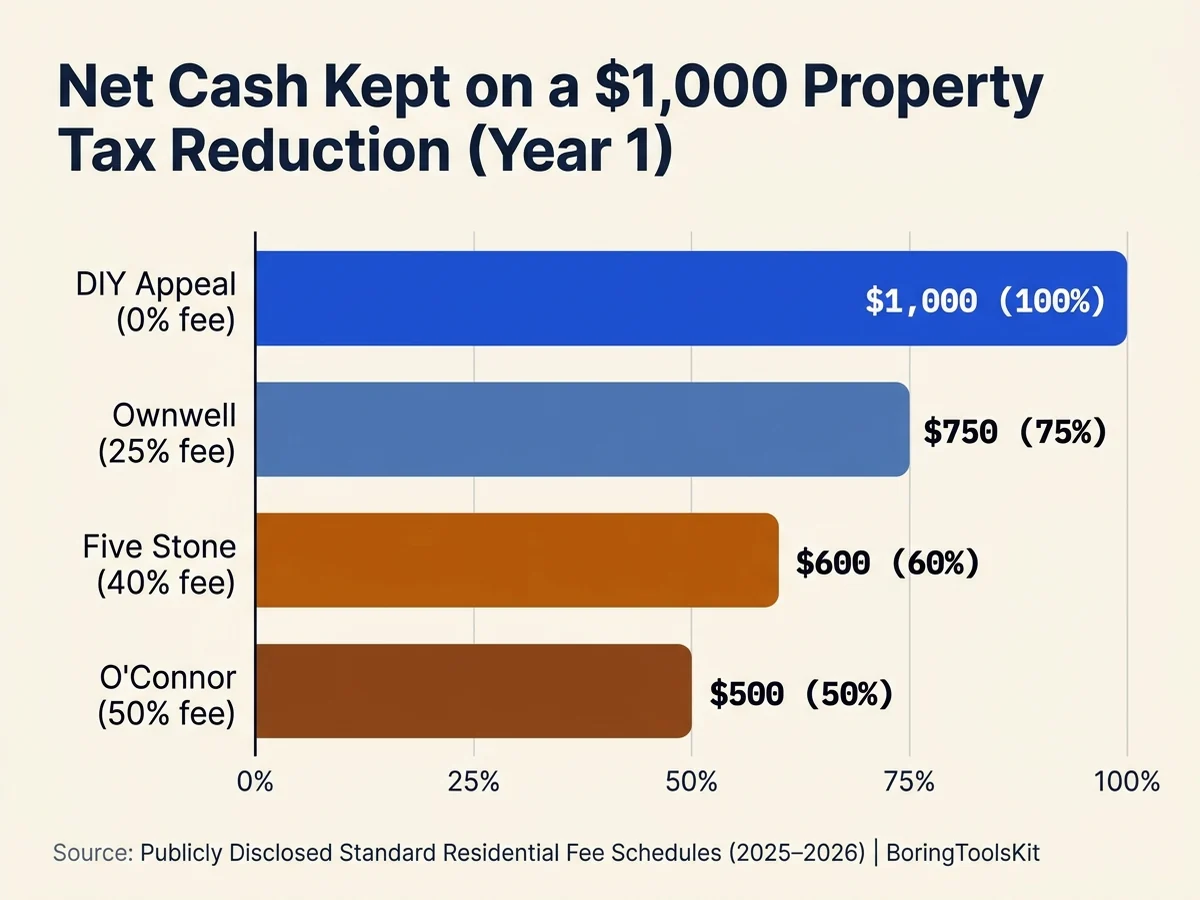
Even when a protest company negotiates a slightly larger gross assessment cut than a homeowner, Year-1 contingency fees of 25% to 50% sharply erode net cash savings. A 25% contingency firm must beat your DIY reduction by 33% just to break even; a 40% firm must beat it by 67%, and a 50% firm must double it.
| Filing Option / Firm | Year-1 Fee | Net Kept on $1,000 Cut | Gross Outperformance Needed to Beat DIY | Source & Key Terms |
|---|---|---|---|---|
| DIY Homeowner Appeal | 0% ($0) | $1,000 | Baseline (1.00×) | Free online county filing portals |
| Ownwell (Standard TX Residential) | 25% (25%–35% other) | $750 | +33.3% (1.33×) | Ownwell ($0 upfront; $774 avg savings; auto-renews) |
| Five Stone Tax Advisers | 40% (or ~$149 min) | $600 | +66.7% (1.67×) | Five Stone ($0 upfront; minimum fee may apply) |
| O'Connor & Associates (Standard) | 50% (25% over-65) | $500 | +100.0% (2.00×) | O'Connor ($0 upfront; 30-day written cancel notice) |
Auto-renewal clauses add a second hidden cost that rarely appears in headline marketing copy. Ownwell and O'Connor both automatically re-enroll residential properties every tax year unless the owner cancels in writing before the contract deadline (O'Connor requires 30 days' written notice), and Five Stone's minimum service fee (~$149 on select plans) can apply even when a homestead cap prevents immediate cash bill savings. Households tracking recurring fixed expenses inside a monthly needs-wants-savings budget or building a dedicated homeowner cash reserve can treat an annual 45-minute DIY filing as a high-hourly-rate financial habit.
Interactive Tool: DIY vs. Protest Firm Net Savings Break-Even Calculator
Enter your expected gross Year-1 property tax reduction and compare how much net cash you keep DIY versus hiring a contingency firm—plus the exact gross reduction the firm must win just to match your DIY payout.
4 U.S. Property Tax Baseline & The Overassessment Gap
U.S. single-family property taxes averaged $4,427 (0.90% effective rate, $396.8 billion total levy across 89.6 million homes) according to ATTOM, while the U.S. Census median sat at $3,211. Despite National Taxpayers Union estimates that 30%–60% of properties are over-assessed, fewer than 5% of homeowners ever appeal.
| National Property Tax Metric | Verified Figure | Source |
|---|---|---|
| Average U.S. Single-Family Property Tax Bill | $4,427 (+~3% YoY) | ATTOM Data Solutions (2024–2025) |
| National Effective Single-Family Tax Rate | 0.90% (from 0.86%) | ATTOM Data Solutions (2024–2025) |
| Total Single-Family Property Taxes Levied (89.6M Homes) | $396.8 billion | ATTOM Data Solutions (2024–2025) |
| U.S. Median Owner-Occupied Property Tax Bill | $3,211 (<$900–$9,300+) | U.S. Census Bureau ACS (2024–2025) |
| Share of U.S. Properties Estimated Over-Assessed | 30%–60% | National Taxpayers Union (Foundational) |
| Share of U.S. Taxpayers Who Formally Appeal | <5% | National Taxpayers Union (Foundational) |
Academic research curated by the Lincoln Institute of Land Policy (drawing on University of Chicago Harris School datasets) reveals why mass-appraisal systems leave so many entry-level and mid-market homes over-assessed: automated valuation models regress toward neighborhood averages, systematically taxing lower-priced properties at higher shares of true market value than top-tier estates. Recent buyers are especially exposed to reassessment shocks in Year 2, when county assessors replace the prior owner's capped tax base with the new purchase price—a recurring surprise alongside upfront home purchase closing costs and long-term net home equity projections.
5 When Hiring a Protest Firm Pays Off vs. Filing DIY
Filing DIY is the mathematically stronger choice for most single-family homes under $1M with clean neighborhood comparable sales or clear deferred-maintenance evidence. Hiring a protest firm or tax attorney becomes rational primarily for commercial properties, multi-family portfolios, unique estates above $1M–$2M, or formal state-board appeals like Illinois PTAB.
| Property Scenario | Recommended Path | Evidence-Backed Rationale |
|---|---|---|
| Suburban single-family home (<$1M) with recent neighborhood comps | DIY Appeal | 50%–88% residential DIY win range; keeps 100% of Year-1 savings. |
| Recent purchase assessed above actual closing price | DIY Appeal | Arm's-length closing disclosure is decisive in informal desk reviews. |
| Home needing major roof, foundation, or interior repairs | DIY Appeal | Itemized contractor bids and photos directly justify condition adjustments. |
| Luxury estate (>$1M–$2M) or custom property lacking comps | Specialist / Attorney | Higher gross AV cuts (+38%–74% at Stage 1) can offset 25%–35% fees. |
| Commercial, multi-family, or LLC-held appeal to state board (PTAB) | Tax Attorney | Income-approach appraisals and legal representation rules apply. |
If your home's interior or exterior condition is weaker than the renovated comps your county assessor selected, documenting deferred maintenance is one of the fastest ways to win an informal reduction. Homeowners preparing condition packets can pair contractor estimates with objective scope benchmarks—whether quantifying aging roofing geometry via a roof slope factor check, pricing under-insulated attics with an insulation upgrade savings model, or separating realistic remodeling cost versus resale value from surface finishes like wallpaper roll quantities and kitchen backsplash tile estimates—to prove why a property should not be valued like a freshly flipped neighbor.
Methodology & Data Limitations
Research Date: November 27, 2026. BoringToolsKit consulted 14 sources and cited 11 verified sources (8 primary government, academic, policy, and industry datasets = 73%, plus 3 primary residential protest-firm fee disclosures). Freshness distribution across our 22 verified data points: 15 data points from 2025–2026, 5 from 2024, and 2 foundational benchmarks (National Taxpayers Union overassessment estimates and Lincoln Institute regressivity studies) actively cited in 2025–2026 policy reports.
Key Limitation: As confirmed by state oversight reviews from the Texas Comptroller, DC Real Property Tax Appeals Commission, and Illinois Property Tax Appeal Board, no federal agency publishes a uniform nationwide property tax appeal "win rate." County-level DIY vs. attorney comparisons above reflect the largest transparent public-record residential markets (Cook County, IL; Harris and Travis Counties, TX) and should not be extrapolated blindly to jurisdictions with fixed acquisition-value caps (such as California Prop 13).
Frequently Asked Questions
Do DIY property tax appeals really win more often than protest companies?
In public residential appeal records, yes—primarily due to selection bias. At the Cook County Board of Review, DIY homeowners won 50%–61% of residential appeals versus 38%–44% for attorney-represented cases, while well-prepared Texas DIY filers won 65%–88%. High-volume contingency firms file thousands of marginal cases automatically, which pulls down their average win rate.
How much do property tax protest companies charge in 2026?
Most major residential protest firms charge $0 upfront and take 25% to 50% of your first-year tax savings: Ownwell charges 25% in Texas (25%–35% in other markets), Five Stone charges 40% (or roughly a $149 minimum service fee), and O'Connor charges 50% on standard residential accounts (25% for over-65 exemptions).
How much bigger must a firm's reduction be to beat a DIY appeal after fees?
To leave you with the same net cash in Year 1, a firm charging a 25% contingency fee must secure a gross reduction 33% larger than your DIY result. A 40% contingency firm must beat your DIY reduction by 67%, and a 50% contingency firm must double your DIY reduction just to break even.
What percentage of U.S. homes are over-assessed for property taxes?
The National Taxpayers Union estimates that 30% to 60% of U.S. taxable properties are over-assessed relative to fair market value, yet fewer than 5% of homeowners ever file a formal appeal. Research from the Lincoln Institute of Land Policy also shows lower- and middle-priced homes face systematically higher assessment ratios.
Is an informal property tax protest better than a formal ARB hearing?
Informal reviews resolve the vast majority of residential protests faster and with high reduction rates. In Harris County (HCAD), 88%–89% of informal iSettle protests secured a value cut (out of 567,154 protests in 2025), while Texas statewide informal settlements succeed 70%–90% of the time versus 55%–70% in formal ARB hearings.
When is hiring a property tax protest company or attorney actually worth it?
Hiring a specialist pays off primarily for commercial properties, multi-family portfolios, luxury homes above $1M–$2M with complex comps, or upstream state-board/judicial appeals (such as Illinois PTAB, where LLCs must use an attorney). For standard single-family homes with clean neighborhood comps, DIY filing usually keeps more net cash.
Sources & References
- Cook County Board of Review. "Residential Property Tax Appeal Records & Statistics." https://www.cookcountyboardofreview.com/. Accessed November 27, 2026.
- Cook County Assessor's Office. "Residential Appeal Outcomes & Open Data." https://www.cookcountyassessoril.gov/. Accessed November 27, 2026.
- Harris Central Appraisal District (HCAD). "Annual Protest Volumes, iSettle Informal & ARB Statistics." https://hcad.org/. Accessed November 27, 2026.
- Texas Comptroller of Public Accounts — Property Tax Assistance Division (PTAD). "Property Tax Assistance & ARB Data." https://comptroller.texas.gov/taxes/property-tax/. Accessed November 27, 2026.
- ATTOM Data Solutions. "Annual U.S. Property Tax Analysis (Single-Family Homes)." https://www.attomdata.com/news/category/market-trends/. Accessed November 27, 2026.
- U.S. Census Bureau. "American Community Survey (ACS) — Real Estate Taxes Paid." https://www.census.gov/programs-surveys/acs. Accessed November 27, 2026.
- National Taxpayers Union (NTU). "Property Overassessment & Taxpayer Appeal Participation Estimates." https://www.ntu.org/. Accessed November 27, 2026.
- Lincoln Institute of Land Policy. "Significant Features of the Property Tax & Assessment Regressivity Research." https://www.lincolninst.edu/data/significant-features-property-tax/. Accessed November 27, 2026.
- District of Columbia Real Property Tax Appeals Commission (RPTAC) & Illinois Property Tax Appeal Board (PTAB). "Annual Administrative Appeal Reports." https://rptac.dc.gov/ & https://www.ptab.illinois.gov/. Accessed November 27, 2026.
- Ownwell. "Residential Property Tax Protest Pricing & Savings Terms." https://www.ownwell.com/. Accessed November 27, 2026.
- Five Stone Tax Advisers & O'Connor & Associates. "Standard Residential Contingency Fee Schedules." https://www.fivestonetax.com/ & https://www.poconnor.com/. Accessed November 27, 2026.