Updates automatically as you type.
Calculated in your browser; your inputs are not sent to us. Privacy
Calculation details
Planning estimate only. Verify dimensions, waste, coverage, product specifications, and local requirements before purchasing materials.
This tool runs in your browser. Your calculator inputs and results are never transmitted to us or to ad/affiliate partners. Ads and sponsored links may set third-party cookies to serve and measure them, but they never receive your calculation values. If you explicitly save a scenario, its permitted fields stay in local browser storage until you clear them. See our Privacy Policy.
Use this result
Share the current inputs or ask ChatGPT to explain the calculation in context.
More options
What does this calculator estimate?
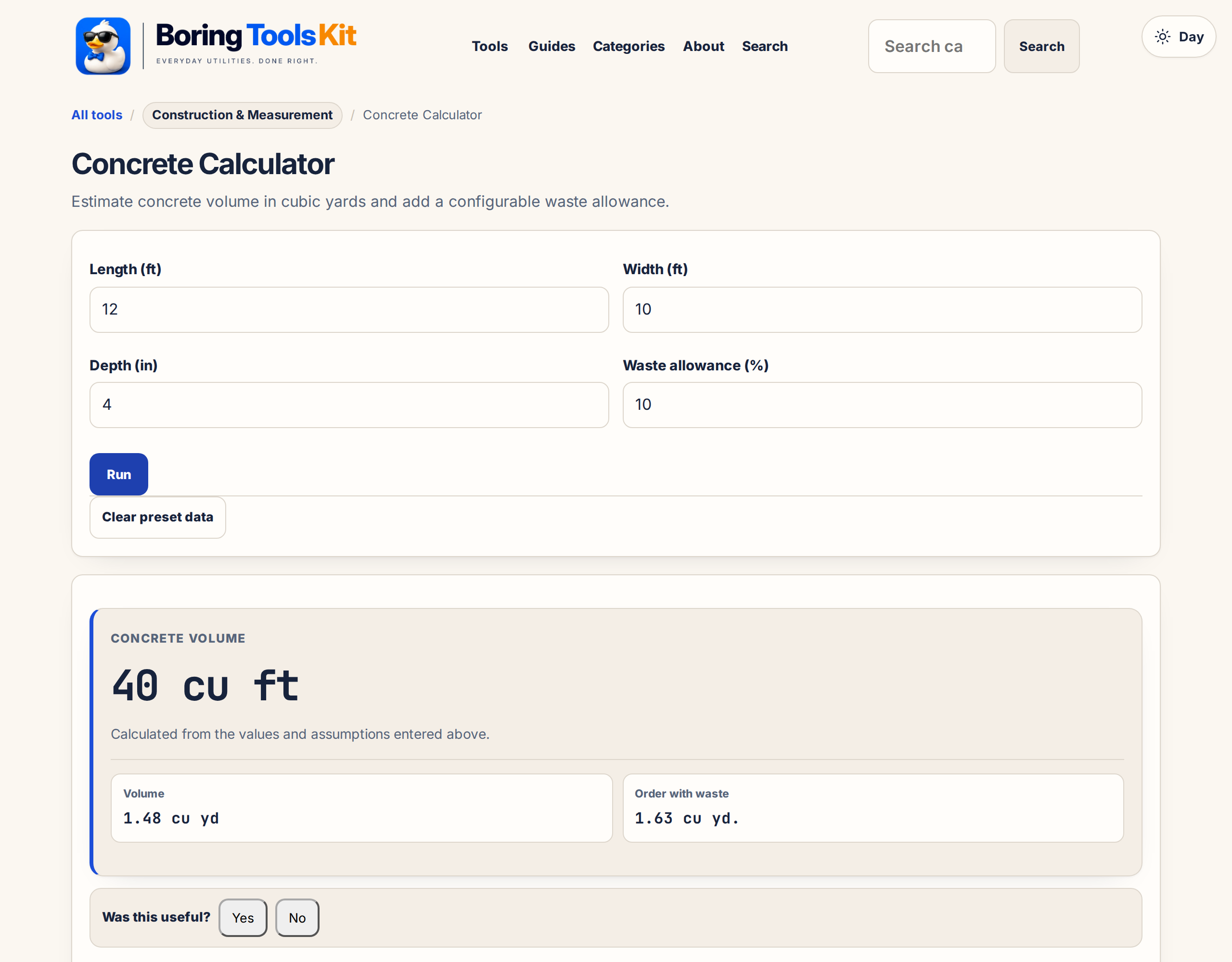
You need about 4.94 cubic yards of concrete for a 20x20 slab that's 4 inches thick. The math is simple: multiply the slab's length by its width by its depth to get cubic feet, then divide by 27 to convert to cubic yards. For a quick exact number, BoringToolsKit's concrete calculator runs this for free with no signup. As a reference, a 10 ft by 12 ft slab at 4 inches deep is roughly 1.48 cubic yards before adding waste.
How this calculator works
Formula
volume = length × width × depth; convert cubic feet to cubic yards by dividing by 27
Worked example
A 10 ft by 12 ft slab at 4 inches deep is about 1.48 cubic yards before waste.
Assumptions to verify
- Depth is converted to feet
- Subgrade and form dimensions are accurate
- Overage is considered for spills/uneven grade
Frequently asked questions
How much extra concrete should I order?
Small jobs often add 5–10%, but confirm with the supplier and contractor.
Why cubic yards?
Ready-mix concrete is commonly ordered by cubic yard in the US.
Cite this tool
BoringToolsKit. “Concrete Calculator.” boringtoolskit.com/concrete-calculator/ (reviewed August 2026). Free to reference in articles, syllabi, and answer posts with a link.
Privacy: Inputs and results stay in this browser. Any future sponsored recommendation or advertisement will be clearly labeled and kept separate from the calculation.