Paint Calculator

Paint calculator: find how much paint you need in gallons from your total wall area, number of coats, and can coverage. Free, no signup, runs locally.

Updates automatically as you type.

Calculated in your browser; your inputs are not sent to us. Privacy

Results will appear here.
Calculation details
Every figure above is calculated locally in your browser from the assumptions shown. No inputs are sent anywhere. See the methodology section below for how this tool works.
Use this resultShare the current inputs, or ask ChatGPT to explain the calculation in context.
Ask an AI to explain this result
Share this result

Review the generated output before relying on it.

This tool runs in your browser. Your calculator inputs and results are never transmitted to us or to ad/affiliate partners. Ads and sponsored links may set third-party cookies to serve and measure them, but they never receive your calculation values. If you explicitly save a scenario, its permitted fields stay in local browser storage until you clear them. See our Privacy Policy.

Use this result

Share the current inputs or ask ChatGPT to explain the calculation in context.

More options
Report a calculation issue
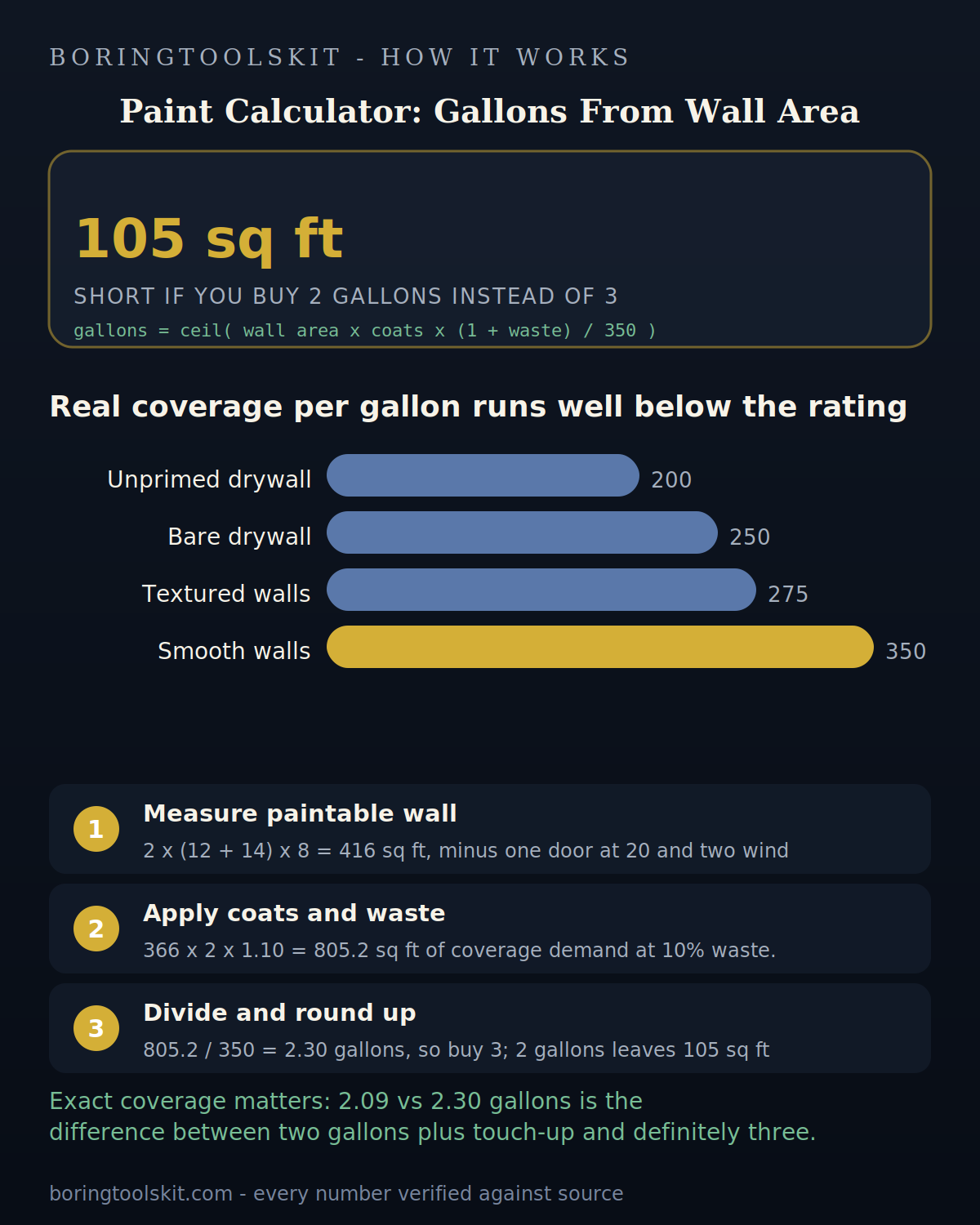
Coverage per gallon on smooth, textured and unprimed walls
Bare drywall can drop coverage from 350 to as low as 200 sq ft per gallon.
Method & verification

How This Tool Works

Calculation Method

Computes Paint needed from Area, Coats, Wall area, Room length, Room width, Ceiling height, Doors, Windows, Coverage per gallon and Waste factor.

Site methodology

No unrelated authority link is added merely to make this page look sourced. Tool-specific external sources are shown only when they directly support the method, rate, or rule.

Assumptions to Verify

  • Measurements describe the simplified geometry entered.
  • Verify waste, package yield, product specifications, and supplier minimums before purchase.

Privacy: The calculation runs in this browser. Shared links contain the page address only, not your inputs or results.

Worked example: a 12 x 14 bedroom

Take a 12 x 14 ft bedroom with 8 ft ceilings, one door, and two windows. Wall area is the perimeter times height, doubled for opposite walls: 2 x (12 + 14) x 8 = 416 sq ft. The door subtracts 20 sq ft and each window 15 sq ft, so 416 - 20 - 30 = 366 sq ft of paintable wall.

Two coats with 10% waste makes the coverage demand 366 x 2 x 1.10 = 805.2 sq ft. At the standard 350 sq ft per gallon rating, that is 805.2 / 350 = 2.30 gallons. Since paint only sells in whole gallons, the calculator rounds up to 3. Note the rounding gap: buying 2 gallons leaves you about 105 sq ft short, roughly a third of a coat, which is exactly the shortfall that forces a mid-job store run.

Change one variable and the answer moves fast. Drop to one coat on a repainted wall in the same color and demand falls to 402.6 sq ft, still 2 gallons. Skip the waste allowance and 2 coats need 732 sq ft, or 2.09 gallons, so rounding up to 3 hides the fact that you are only 18 sq ft over two gallons. That is why the exact coverage line in the result matters: 2.09 versus 2.30 is the difference between 'two gallons plus touch-up' and 'definitely three'.

Where the 350 sq ft rating breaks down

The 350 sq ft per gallon figure is a smooth-wall ideal from manufacturer coverage charts. Real numbers run lower: heavily textured walls knock coverage down 20 to 25%, so budget closer to 275 sq ft per gallon. Bare new drywall is worse still; the first coat soaks into the porous compound and joints, often cutting effective coverage to 200 to 250 sq ft per gallon unless you prime first. Dark paint over a light wall typically needs a tinted gray primer plus two finish coats, effectively three coverage passes.

Other costs the formula does not see. The 20 sq ft per door and 15 sq ft per window defaults are averages; a 3 ft x 6 ft 8 in door slab is 20 sq ft flat, but wide patio doors or picture windows can be 40 sq ft or more, so measure anything oversized. Ceilings are excluded entirely: paint them separately at about length x width, using ceiling paint rated around 300 to 350 sq ft per gallon. Finally, coverage ratings assume 40 to 70 degrees F and a rolled application; spraying loses 10 to 30% to overspray depending on masking, and cold paint can add a full extra coat through poor flow.