Updates automatically as you type.
Calculated in your browser; your inputs are not sent to us. Privacy
Calculation details
Planning estimate only. Verify dimensions, waste, coverage, product specifications, and local requirements before purchasing materials.
This tool runs in your browser. Your calculator inputs and results are never transmitted to us or to ad/affiliate partners. Ads and sponsored links may set third-party cookies to serve and measure them, but they never receive your calculation values. If you explicitly save a scenario, its permitted fields stay in local browser storage until you clear them. See our Privacy Policy.
Use this result
Share the current inputs or ask ChatGPT to explain the calculation in context.
More options
What does this calculator estimate?
This calculator estimates the tons of asphalt needed for your project. Enter the length, width, and compacted thickness of the area, and it applies a standard density plus a waste factor. Use the result to order material or compare supplier quotes. It runs entirely in your browser, so no data leaves your device.
How this calculator works
Formula
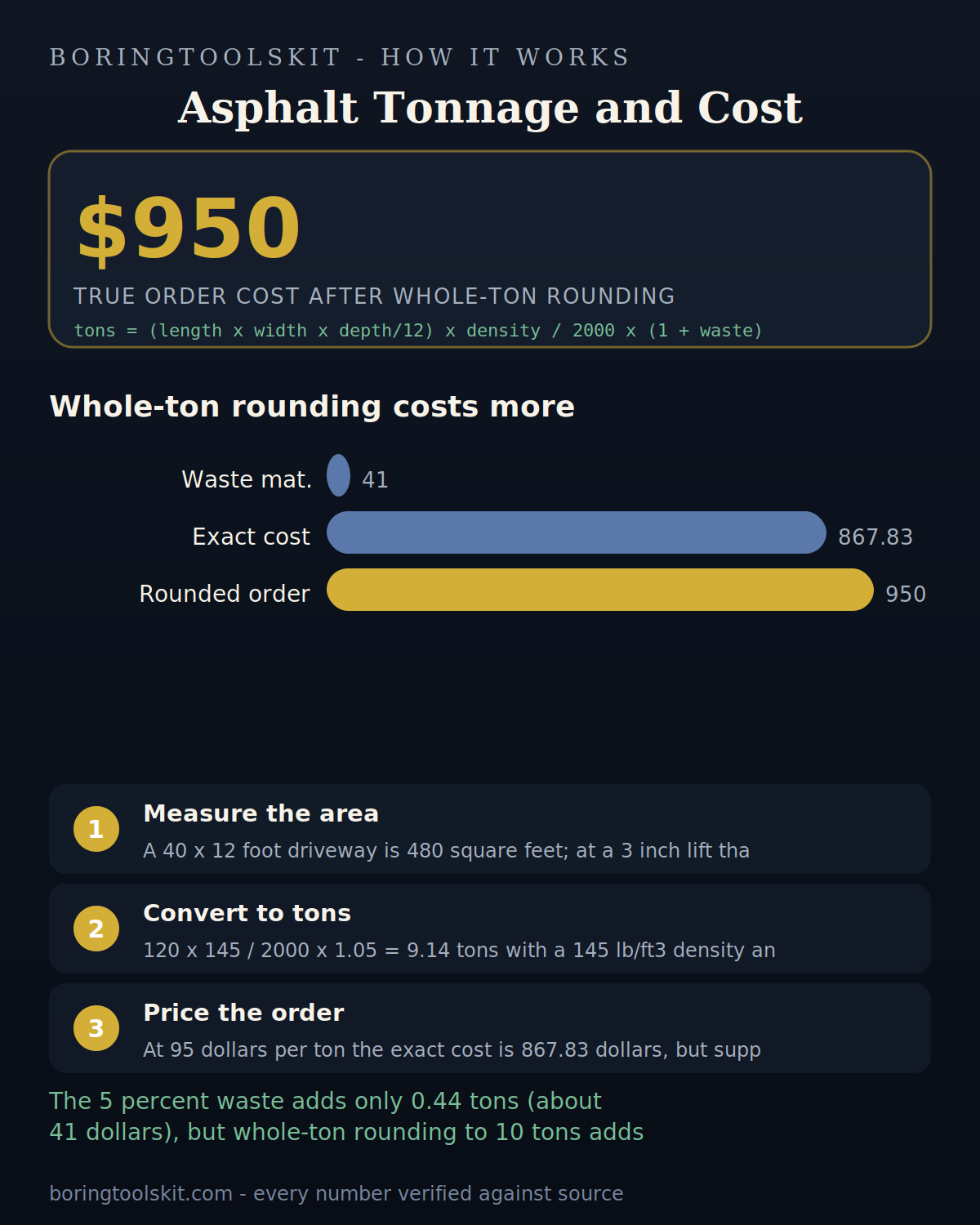
Tons = area (sq ft) x depth (in) / 12 / 27 x density (lb/yd3) / 2000 x (1 + waste).
Worked example
A 50 x 20 ft driveway at 3 inches deep: 1,000 sq ft, 9.26 compacted cubic yards, about 19.03 tons with 5% waste, roughly $2,284 at $120/ton.
Sources
Sources support the method, terminology, or planning context. Editable assumptions remain your responsibility.
Assumptions to verify
- Dimensions describe a rectangular area with uniform compacted thickness.
- 145 lb/ft³ is only a starting density and is editable.
- Base aggregate, tack coat, labor, delivery, and equipment are excluded.
Frequently asked questions
How does the asphalt calculator work?
The asphalt calculator runs entirely in your browser — it takes your project dimensions (length, width, thickness) and estimates the tons of asphalt needed using standard density values. No data is sent to a server, and no account or signup is required.
Do I need to create an account to use the asphalt calculator?
No. The asphalt calculator is a no-signup, browser-based tool. Everything is processed locally on your device, so your measurements and results stay private and are never stored or shared.
Is the asphalt calculator free to use?
Yes. The asphalt calculator is completely free with no hidden fees, no sign-up required, and no data collection. You can use it as many times as you need directly in your browser.
Cite this tool
BoringToolsKit. “Asphalt Calculator.” boringtoolskit.com/asphalt-calculator/ (reviewed July 2026). Free to reference in articles, syllabi, and answer posts with a link.
Privacy: Inputs and results stay in this browser. Results are planning estimates based on your inputs; verify assumptions and current rules before making decisions.