Stride Length Calculator

Stride length calculator: measure your walking or running stride length from height or counted steps for accurate distance. Free, runs locally, no signup.

Updates automatically as you type.

Calculated in your browser; your inputs are not sent to us. Privacy

Results will appear here.

General estimate for planning only — not medical advice. Consult a doctor about your specific situation.

Calculation details
Every figure above is calculated locally in your browser from the assumptions shown. No inputs are sent anywhere. See the methodology section below for how this tool works.
Use this resultShare the current inputs, or ask ChatGPT to explain the calculation in context.
Ask an AI to explain this result
Share this result

Review the generated output before relying on it.

This tool runs in your browser. Your calculator inputs and results are never transmitted to us or to ad/affiliate partners. Ads and sponsored links may set third-party cookies to serve and measure them, but they never receive your calculation values. If you explicitly save a scenario, its permitted fields stay in local browser storage until you clear them. See our Privacy Policy.

Use this result

Share the current inputs or ask ChatGPT to explain the calculation in context.

More options
Report a calculation issue
Stride length estimates by height and walking or running mode
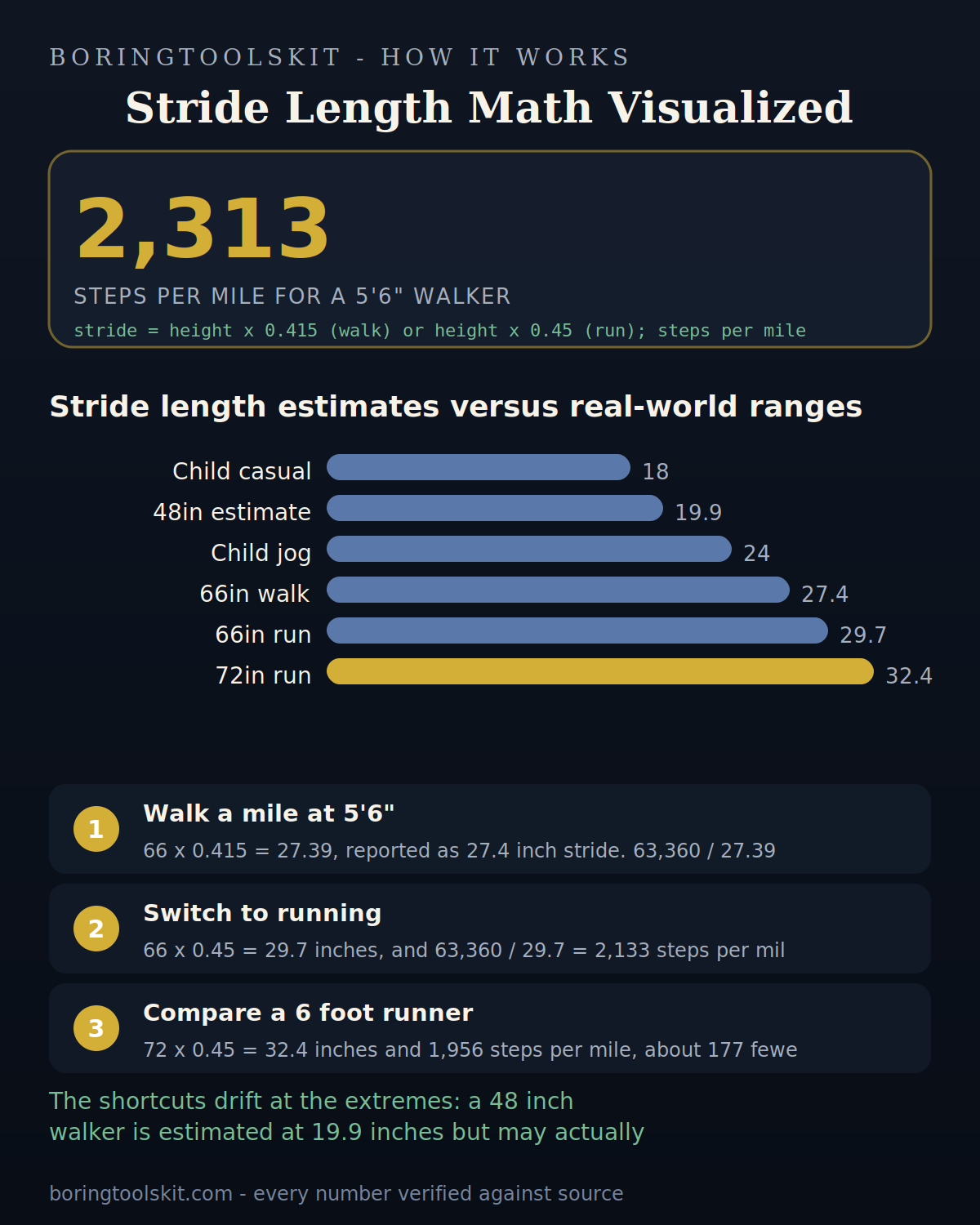
A 5-foot-6 walker takes about 2,313 steps per mile.
Method & verification

How This Tool Works

fact-checked against our calculation methodology

Calculation Method

Computes Stride length from Height and Mode.

Site methodology

No unrelated authority link is added merely to make this page look sourced. Tool-specific external sources are shown only when they directly support the method, rate, or rule.

Assumptions to Verify

  • These tools provide general estimates for planning and education only.
  • They are not medical advice and not a substitute for a qualified healthcare professional.
  • Always consult your doctor or another healthcare provider about your specific situation.

Privacy: The calculation runs in this browser. Shared links contain the page address only, not your inputs or results.

Worked example: a 5-foot-6 walker and runner

Take height = 66 inches. Walking mode multiplies by 0.415: 66 x 0.415 = 27.39, so the page reports a 27.4 inch stride. One mile is 63,360 inches, so steps per mile = 63,360 / 27.39 = 2,313 steps. At a typical 3 mph, that is about 2,313 steps over 20 minutes, or roughly 116 steps per minute.

Switch the same person to running mode (x0.45): 66 x 0.45 = 29.7 inches, and 63,360 / 29.7 = 2,133 steps per mile. The 2.3 inch stride increase removes about 180 steps per mile, which is why runners burn slightly less energy per mile at the same pace than beginners whose stride is shorter. A 72 inch (6 foot) runner gets 72 x 0.45 = 32.4 inches and 63,360 / 32.4 = 1,956 steps per mile, about 177 fewer steps than the 5-foot-6 runner over the same distance.

Where the 0.415 and 0.45 shortcuts break down

These multipliers come from group averages, so they drift most at the extremes. A 48 inch walker gets 48 x 0.415 = 19.9 inches, but published pediatric gait data shows children near this height often stride closer to 18 inches at casual pace and 24 inches at a jog, an error of 10 to 20 percent. Over a 10,000 step day that miscounts by 1,000 to 2,000 steps if you convert from GPS miles.

Terrain shifts the number too: uphill running shortens stride by roughly 5 to 15 percent at grades above 5 percent, and treadmill running tends to run 2 to 3 percent shorter than overground at the same speed. Fatigue matters as well; in marathon studies stride length shrinks about 4 percent from mile 18 to the finish at constant effort. If precision matters, measure your own stride directly: walk 10 steps, measure heel-to-heel start to finish, divide by 10, and use that instead of the height estimate. For most people the measured value lands within 2 inches of the estimate, but about 1 in 5 differs by more than 3 inches.