Vitamin D Calculator

Vitamin D calculator: convert IU doses to daily or weekly amounts and estimate levels from your inputs. Free, runs locally, editable defaults, no signup.

Updates automatically as you type.

Calculated in your browser; your inputs are not sent to us. Privacy

Results will appear here.

General estimate for planning only — not medical advice. Consult a doctor about your specific situation.

Calculation details
Every figure above is calculated locally in your browser from the assumptions shown. No inputs are sent anywhere. See the methodology section below for the formulas used.
Use this resultShare the current inputs, or ask ChatGPT to explain the calculation in context.
Ask an AI to explain this result
Share this result

Review the generated output before relying on it.

This tool runs in your browser. Your calculator inputs and results are never transmitted to us or to ad/affiliate partners. Ads and sponsored links may set third-party cookies to serve and measure them, but they never receive your calculation values. If you explicitly save a scenario, its permitted fields stay in local browser storage until you clear them. See our Privacy Policy.

Use this result

Share the current inputs or ask ChatGPT to explain the calculation in context.

More options
Report a calculation issue
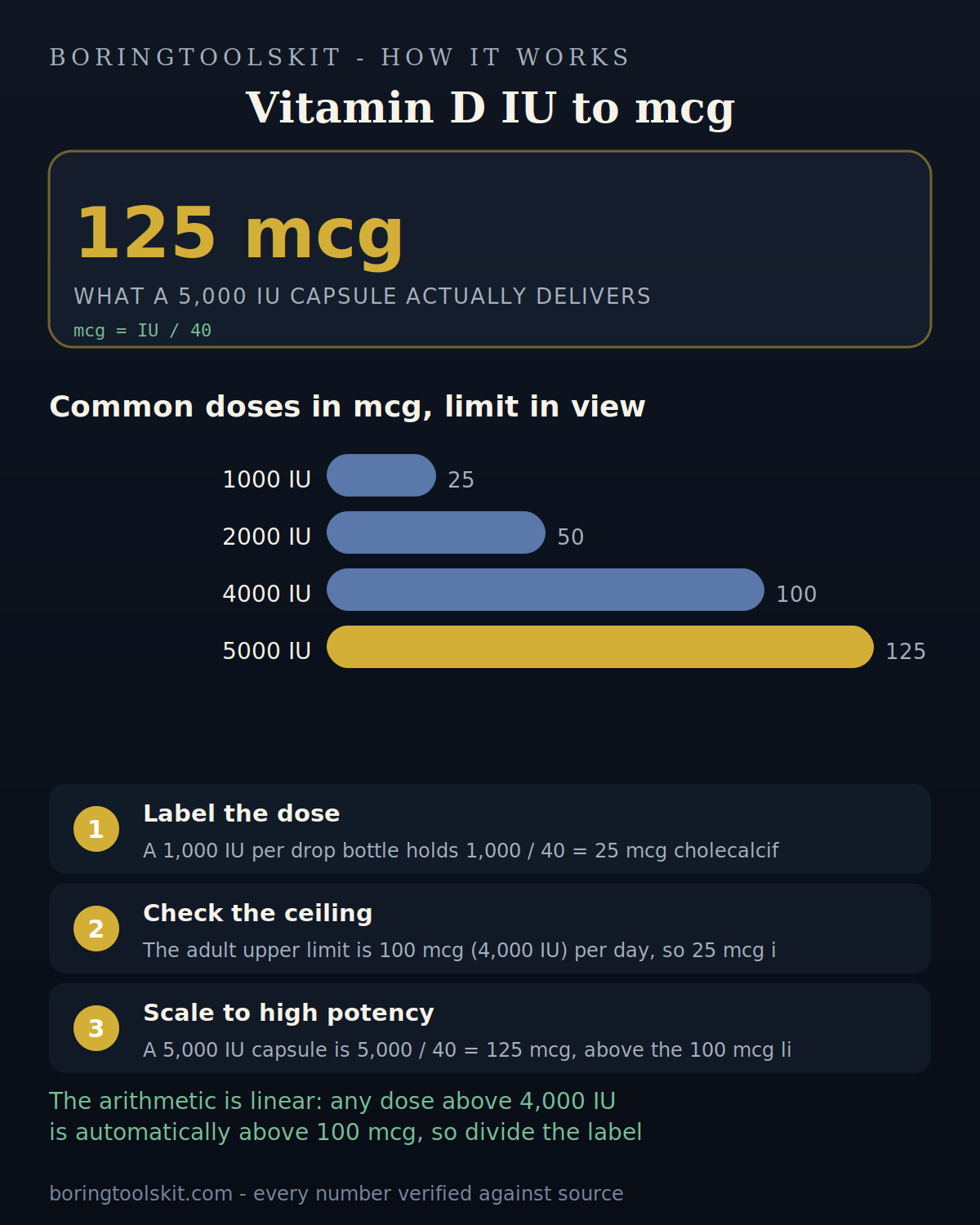
Bar chart comparing vitamin D doses in mcg against the 100 mcg upper limit
A 5,000 IU capsule delivers 125 mcg, past the 100 mcg ceiling.
Method & verification

How This Tool Works

fact-checked against our calculation methodology

Calculation Method

Vitamin D = IU per day ÷ 40

Site methodology

No unrelated authority link is added merely to make this page look sourced. Tool-specific external sources are shown only when they directly support the method, rate, or rule.

Assumptions to Verify

  • These tools provide general estimates for planning and education only.
  • They are not medical advice and not a substitute for a qualified healthcare professional.
  • Always consult your doctor or another healthcare provider about your specific situation.

Privacy: The calculation runs in this browser. Shared links contain the page address only, not your inputs or results.

Worked example: converting a 1,000 IU drop

A bottle of vitamin D drops labeled '1,000 IU per drop' contains 1,000 / 40 = 25 mcg of cholecalciferol per drop. Take one drop daily for a year and you consume 365,000 IU, which is 365,000 / 40 = 9,125 mcg, or about 9.1 mg total. That sounds large until you compare it with the adult tolerable upper intake level of 100 mcg (4,000 IU) per day: your daily 25 mcg sits at a quarter of that ceiling.

Now check a 5,000 IU capsule, the common high-potency strength. 5,000 / 40 = 125 mcg, which is 125 / 25 = 5 times the 25 mcg RDA unit for a 70-year-old and above the 100 mcg upper limit. That is why high-strength bottles carry supervision warnings: the arithmetic is linear, so any dose above 4,000 IU is automatically above 100 mcg. The calculator flags this same threshold, and the label math lets you verify it by hand in one division.

Where the single conversion breaks down

The 1:40 IU-to-mcg ratio applies only to cholecalciferol (D3) and ergocalciferol (D2). Other compounds have different factors, and megadose products occasionally list both units with rounding errors: a '50,000 IU weekly' prescription capsule is exactly 1,250 mcg (50,000 / 40), but some labels round to 1.25 mg only after converting with 40, so always divide yourself rather than trusting a pre-rounded number.

The bigger gap is that identical intake does not produce identical blood levels. Trials using 1,000 to 2,000 IU daily typically raise serum 25(OH)D by roughly 6 to 12 ng/mL, but individual response varies with baseline level, body weight (fat tissue sequesters D3), and sun exposure. Someone at 12 ng/mL taking 2,000 IU (50 mcg) daily may reach the 20 to 30 ng/mL range in 2 to 3 months, while an obese person at the same baseline may land several points lower on the same dose. The IU count tells you what you swallowed, not what your blood did with it, which is why retesting 25(OH)D after about 3 months at a new dose beats adjusting by label arithmetic.