Sleep Cycle Calculator

Sleep cycle calculator finds the best bedtime or wake time based on 90-minute sleep cycles so you wake up feeling rested. Free, private, runs locally, no signup.

Updates automatically as you type.

Calculated in your browser; your inputs are not sent to us. Privacy

Results will appear here.

General estimate for planning only — not medical advice. Consult a doctor about your specific situation.

Calculation details
Every figure above is calculated locally in your browser from the assumptions shown. No inputs are sent anywhere. See the methodology section below for how this tool works.
Use this resultShare the current inputs, or ask ChatGPT to explain the calculation in context.
Ask an AI to explain this result
Share this result

Review the generated output before relying on it.

This tool runs in your browser. Your calculator inputs and results are never transmitted to us or to ad/affiliate partners. Ads and sponsored links may set third-party cookies to serve and measure them, but they never receive your calculation values. If you explicitly save a scenario, its permitted fields stay in local browser storage until you clear them. See our Privacy Policy.

Use this result

Share the current inputs or ask ChatGPT to explain the calculation in context.

More options
Report a calculation issue
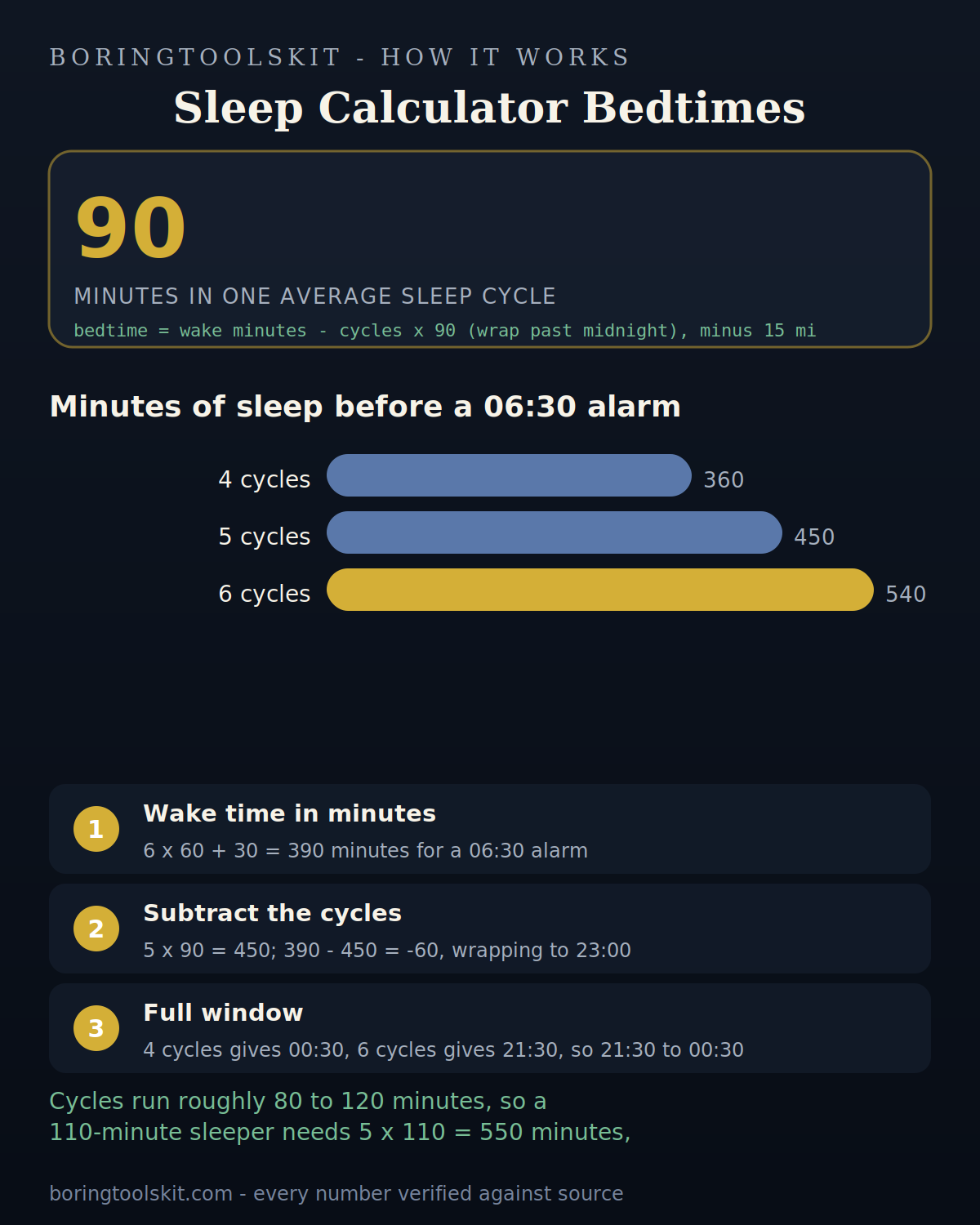
Bedtimes for 4 to 6 sleep cycles before a 06:30 alarm
A 06:30 alarm puts the bedtime window at 21:30 to 00:30.
Method & verification

How This Tool Works

fact-checked against our calculation methodology

Calculation Method

Computes Wake at from Wake hour, Wake minute and Cycles.

Site methodology

No unrelated authority link is added merely to make this page look sourced. Tool-specific external sources are shown only when they directly support the method, rate, or rule.

Assumptions to Verify

  • These tools provide general estimates for planning and education only.
  • They are not medical advice and not a substitute for a qualified healthcare professional.
  • Always consult your doctor or another healthcare provider about your specific situation.

Privacy: The calculation runs in this browser. Shared links contain the page address only, not your inputs or results.

Worked example: waking at 06:30

Say you must wake at 06:30 and want 5 cycles. Convert to minutes: 6 x 60 + 30 = 390 minutes. One cycle is 90 minutes, so subtract 5 x 90 = 450. Bedtime = 390 - 450 = -60, which wraps past midnight to 23:00. The 15-minute fall-asleep estimate means lights out around 22:45.

The other rows come from the same subtraction. 4 cycles removes 360 minutes: 390 - 360 = 30, or 00:30. 6 cycles removes 540: 390 - 540 = -150, which wraps to 21:30. So a 06:30 alarm puts the full window at 21:30 to 00:30, and 23:00 sits in the middle if you are unsure how many cycles you usually get.

Where the 90-minute assumption breaks

Cycle length is an average, not a constant. Measured adult cycles run roughly 80 to 120 minutes; a person with 110-minute cycles who uses the 5-cycle row actually needs about 9.2 hours (5 x 110 = 550 minutes), nearly 100 minutes more than the table shows. The calculator cannot know your number, so treat the rows as a center of a range, not a target.

The 15-minute sleep latency is also optimistic. Sleep studies put average latency near 10 to 20 minutes for healthy adults, but caffeine, screens, or a late meal can push it past 30. If you usually take 30 minutes to fall asleep, subtract that instead of 15: the 23:00 bedtime for a 06:30 wake becomes 22:45 only for fast sleepers, and more realistically around 22:30.

The table also ignores REM-heavy morning cycles, which run longer than early-night deep-sleep cycles. If you wake groggy despite hitting a listed bedtime, shift by 20 to 30 minutes rather than assuming the whole model is wrong.