This tool runs locally in your browser.
Results are estimates based on your input only; entered values and result contents are not stored by BoringToolsKit.
Your inputs and results stay in this browser. This page may send privacy-bounded aggregate interaction events described in Privacy; it does not send your entered values or result contents.
Use this result
Share the current inputs or ask ChatGPT to explain the calculation in context.
More options
What does this tool show?
Everyday sentences of short words score high: three plain sentences, 16 words in 3 sentences at 1.0 syllable per word, reach 116.8, very easy. A dense industrial sentence, 11 words at 1.8 syllables per word, drops to 41.9, and formal contract language at 16 words per sentence sits at 42.5. Each extra syllable per word costs 84.6 points; an extra word per sentence costs only 1.0. Paste any text above to see its score.
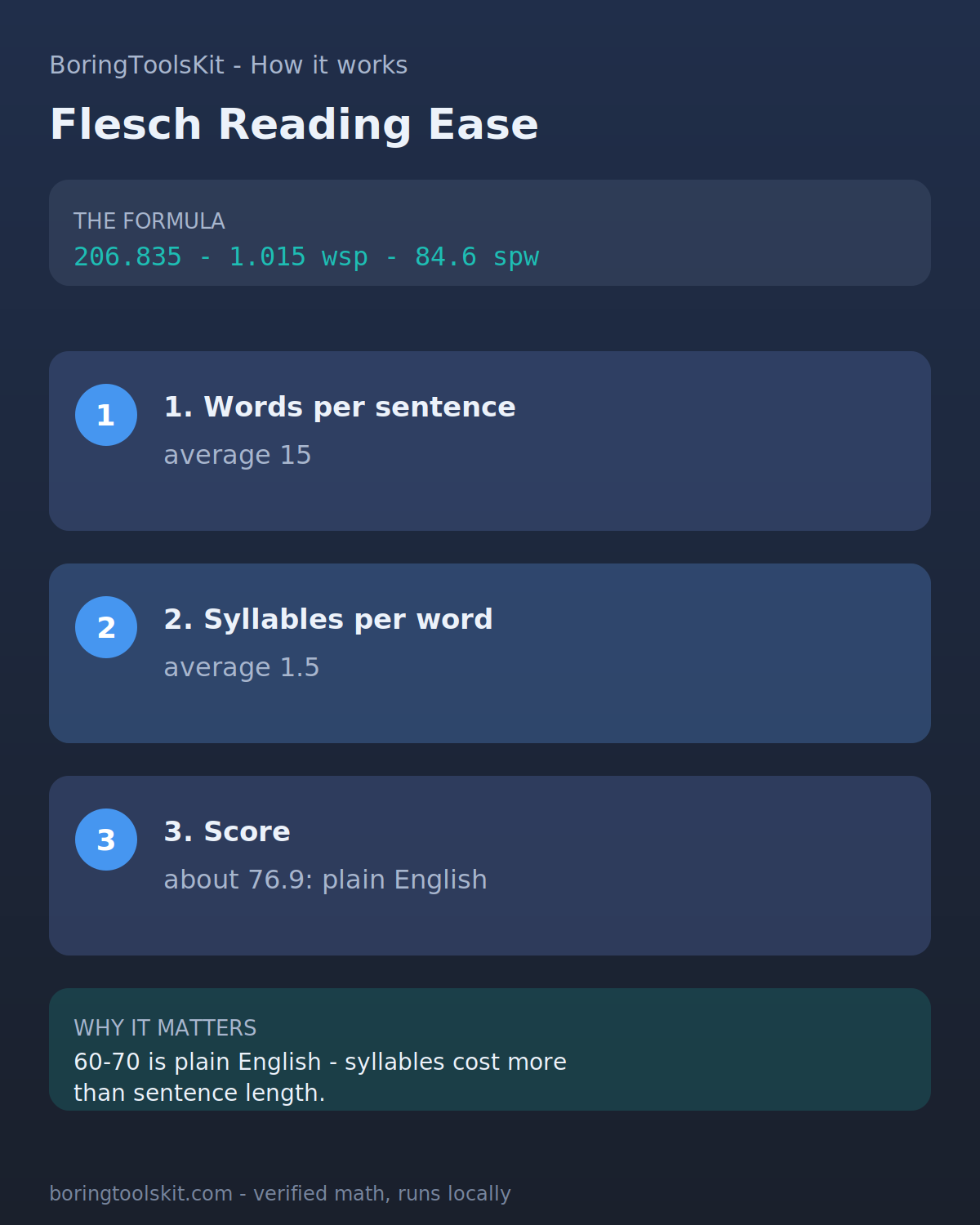
- Flesch Reading Ease = 206.835 minus 1.015 x (words per sentence) minus 84.6 x (syllables per word); higher is easier to read. (Source: Wikipedia, Flesch-Kincaid readability tests)
- Syllable density costs 84.6 points per extra syllable per word, about 83 times the 1.015-point hit of an extra word per sentence. (Source: Wikipedia, Flesch-Kincaid readability tests)
- An average sixth-grade student's writing scores 60 to 70, and the Harvard Law Review sits in the low 30s. (Source: Wikipedia, Flesch-Kincaid readability tests)
- The page also reports a Flesch-Kincaid Grade Level from 0.39 x (words per sentence) + 11.8 x (syllables per word) - 15.59. (Source: Wikipedia, Flesch-Kincaid readability tests)
- The heuristic counts every fragment as at least one syllable and one sentence, so numbers, abbreviations, and symbol runs distort both terms. (Source: BoringToolsKit calculation methodology)
How readable is real text? Scores by audience and purpose
The table below mixes two kinds of rows. Published benchmark rows come from the standard reference description of the scale, quoted in readability research since Flesch's 1948 paper introduced the formula. Sample rows were scored exactly the way this calculator scores text: words split on whitespace, sentences on terminal punctuation, syllables by the vowel-group heuristic with one silent-e removal per word.
Reading the scale: it is monotone but not linear-feeling. Moving from 95 down to 65 usually means heavier vocabulary at the same sentence length, while moving from 65 down to 35 usually means long sentences AND heavy vocabulary at once. The label column gives the band names the tool prints next to the score.
| Text example | Words per sentence | Syllables per word | Score |
|---|---|---|---|
| Very short sentences, 'I see a cat.' | 4.0 | 1.0 | 118.2, extremely easy |
| Children's beginner copy, 'Dad went to the store. He got some milk and eggs. Then he went back home.' | 5.3 | 1.0 | 116.8, very easy (grade below 1) |
| Simple how-to copy, 'Check the weather before you take out the rain gauge.' | 10.0 | 1.2 | 95.2, easy (grade 2.5) |
| Reader's Digest magazine (published benchmark) | about 13 | about 1.4 | about 65, plain English |
| Average sixth-grade student's written assignment (published benchmark) | varies | varies | 60 to 70 |
| Elementary science writing, 'Photosynthesis is the process plants use to make their own food.' | 11.0 | 1.5 | 72.6, standard (grade 5.9) |
| Time magazine (published benchmark) | about 20 | about 1.6 | about 52, fairly difficult |
| Consumer health copy, 'Heart disease affects many Americans. Eating well and walking daily helps lower risk. Doctors advise checking blood pressure often.' | 6.3 | 1.8 | 49.0, fairly difficult (grade 8.0) |
| Industrial specification, 'The passing storm required tight fastening of every conveyor anchor point.' | 11.0 | 1.8 | 41.9, difficult (grade 10.2) |
| Formal contract language, 'The parties acknowledge the terms and conditions set forth herein constitute the entire agreement between them.' | 16.0 | 1.8 | 42.5, difficult (grade 11.3) |
| Harvard Law Review (published benchmark) | about 29 | about 2.0 | low 30s, very difficult |
A worked example, number by number
Take the three sentences 'Dad went to the store. He got some milk and eggs. Then he went back home.' The text holds 16 words, 3 sentences, and 16 syllables, so words per sentence is 16 / 3 = 5.33 and syllables per word is 16 / 16 = 1.0. Flesch Reading Ease is 206.835 - 1.015 x 5.33 - 84.6 x 1.0 = 206.835 - 5.41 - 84.6 = 116.8. The tool rounds to 116.8 and labels it very easy (4th grade); the Flesch-Kincaid grade level is 0.39 x 5.33 + 11.8 x 1.0 - 15.59 = 2.08 + 11.8 - 15.59 = -1.7. A negative grade is what the formula produces for text far simpler than the grade scale's floor, not an error.
One dense sentence scores very differently: 'The passing storm required tight fastening of every conveyor anchor point.' counts 11 words, 1 sentence, and 20 syllables, so words per sentence is 11 and syllables per word is 20 / 11 = 1.8. Flesch Reading Ease is 206.835 - 11.165 - 84.6 x 1.8 = 206.835 - 11.165 - 153.8 = 41.9, difficult, grade 10.2. Same tool, same arithmetic: only sentence composition changed.
Also verify the sensitivity claims the answer block makes. At 15 words per sentence and 1.5 syllables per word, the score is 206.835 - 15.2 - 126.9 = 64.7. Add one syllable of vocabulary weight everywhere (2.5 syllables per word) and the score drops 84.6 points to -19.9; instead add one word to every sentence (16 words per sentence) and it drops only 1.0 point to 63.7. That asymmetry is the design insight of the Flesch scale: syllable weight dominates.
How this calculator works
Formula
Flesch Reading Ease = 206.835 - 1.015 x (words per sentence) - 84.6 x (syllables per word); Flesch-Kincaid Grade = 0.39 x (words per sentence) + 11.8 x (syllables per word) - 15.59.
Worked example
16 plain words in 3 sentences with 16 syllables: 206.835 - 1.015 x (16/3) - 84.6 x 1.0 = 116.8, very easy. One dense 11-word industrial sentence at 1.8 syllables per word scores 41.9.
Assumptions to verify
- Syllable counts come from a vowel-group heuristic with one silent-e removal per word, not a dictionary, so unusual spellings can differ by a syllable from human judgment.
- Sentences are split on . ! ? and every nonempty fragment counts: abbreviations like 'Mr.' split a sentence and raise the words-per-sentence figure slightly.
- Flesch Reading Ease measures only structural difficulty, sentence length and word length, not quality or clarity of the underlying ideas.
- Published benchmark rows describe the historical reference examples of the scale (Reader's Digest, Time, Harvard Law Review), not fresh measurements of current issues.
Frequently asked questions
What is a readability calculator and how does it work?
A readability calculator counts words, sentences, and syllables in your text and returns two scores: Flesch Reading Ease (0 to 100 in practice, higher is easier) and the Flesch-Kincaid Grade Level (roughly the US school grade needed to read the text).
Do I need to create an account or sign up to use this readability calculator?
No, this readability calculator is a no-signup, browser-based tool that processes your text locally on your device without storing any data.
Why should I use a readability calculator for my writing?
You should use a readability calculator to ensure your content is accessible to your target audience by identifying overly complex sentences and vocabulary.
What is a good Flesch Reading Ease score?
For a general adult audience, aim for 60 to 70, the band an average sixth-grade student's writing occupies. Scores below 50 read as fairly difficult, and below 30 is very difficult, graduate-level material.
Why is my score negative, or above 100?
The formula has no bounds. A one-syllable word in a short sentence scores above 116, and text packed with polysyllabic words can go negative. Both are expected for extreme inputs, not errors.
How accurate is the syllable counting?
It is a heuristic: vowel groups per word with one silent-e removal per word, and every word contributes at least one syllable. Dictionary-perfect counting can differ by a syllable on unusual spellings, but the score's ranking behavior is stable.
Cite this tool
BoringToolsKit. “Readability Calculator.” boringtoolskit.com/readability/ (reviewed October 2026). Free to reference in articles, syllabi, and answer posts with a link.
Privacy: Inputs and results stay in this browser. Any future sponsored recommendation or advertisement will be clearly labeled and kept separate from the calculation.
A worked example, number by number
Take the sentence 'The cat sat.' It has 3 words and 1 sentence, and the syllable heuristic counts 1 syllable for each word, giving 3 syllables total. Flesch Reading Ease is 206.835 minus 1.015 times (words per sentence) minus 84.6 times (syllables per word). Plugging in: 206.835 - 1.015 x 3 - 84.6 x (3/3) = 206.835 - 3.045 - 84.6 = 119.19. The tool rounds that to 119.2 and labels it very easy (4th grade). The Flesch-Kincaid grade formula is 0.39 x (words per sentence) + 11.8 x (syllables per word) - 15.59, so 0.39 x 3 + 11.8 x 1 - 15.59 = 1.17 + 11.8 - 15.59 = -2.62. A negative grade looks strange, but it is what the formula produces for text far simpler than the grade scale's floor.
A slightly longer sentence, 'The quick brown fox jumps over the lazy dog.', scores 9 words and 11 syllables (over and lazy count as 2 each). That gives 206.835 - 1.015 x 9 - 84.6 x (11/9) = 206.835 - 9.135 - 103.4 = 94.3, easy (6th grade), and a grade level of 0.39 x 9 + 11.8 x (11/9) - 15.59 = 3.51 + 14.42 - 15.59 = 2.3. One more data point: a single 10-word sentence packed with long words ('The implementation of regulatory compliance frameworks necessitates comprehensive organizational restructuring.') yields 36 syllables in 10 words, for an FRE of 206.835 - 10.15 - 84.6 x 3.6 = -107.88. Scores below 30 are difficult; text this dense can go negative without error.
Where the score breaks down
The scale is not open-ended. Flesch originally designed 0 to 100 as the practical range, but nothing clamps the score here, so you can see values above 121 (a one-syllable sentence like 'I see a cat.') and negative values like the -107.9 example above. A list of short fragments separated by periods can beat a genuinely well-written paragraph simply because periods lower the words-per-sentence term. Conversely, dialogue, poetry, and legal text get misread: Hemingway-style prose scores high by design, and a phrase like 'WebMD says fluoride helps' scores low partly because uncounted digits and abbreviations distort the averages.
Other mechanics are worth knowing. Every word is forced to contribute at least 1 syllable, so 'hh', 'hmm', or numbers like '2024' each add 1, slightly inflating syllable density. The silent-e rule only fires once per word: 'complete' counts as 2, but 'variable' keeps its trailing 'e' fully counted. Sentence counting is regex-based: 'Mr. Smith' ends a sentence at the period after 'Mr', and an ellipsis or exclamation inside a quote breaks one sentence into two. Practical thresholds: most general-audience web writing aims for 60 to 70 (8th to 9th grade), plain-language standards such as those used in US government guidance target about 70, and dense academic prose routinely lands between 20 and 40. The score measures structure, not quality: a document can score 80 and still be confusing, so use it as a floor check on word and sentence length rather than a verdict.