Pulse Pressure Calculator

Pulse pressure calculator: subtract diastolic from systolic blood pressure and flag wide or narrow pulse ranges. Free, private, runs locally, no signup.

Updates automatically as you type.

Calculated in your browser; your inputs are not sent to us. Privacy

Results will appear here.

General estimate for planning only — not medical advice. Consult a doctor about your specific situation.

Calculation details
Every figure above is calculated locally in your browser from the assumptions shown. No inputs are sent anywhere. See the methodology section below for how this tool works.
Use this resultShare the current inputs, or ask ChatGPT to explain the calculation in context.
Ask an AI to explain this result
Share this result

Review the generated output before relying on it.

This tool runs in your browser. Your calculator inputs and results are never transmitted to us or to ad/affiliate partners. Ads and sponsored links may set third-party cookies to serve and measure them, but they never receive your calculation values. If you explicitly save a scenario, its permitted fields stay in local browser storage until you clear them. See our Privacy Policy.

Use this result

Share the current inputs or ask ChatGPT to explain the calculation in context.

More options
Report a calculation issue
Pulse pressure examples at rest, after walking, and across different readings
Resting 118/76 gives a 42 mmHg pulse pressure.
Method & verification

How This Tool Works

fact-checked against our calculation methodology

Calculation Method

Pulse pressure = Systolic - Diastolic

Site methodology

No unrelated authority link is added merely to make this page look sourced. Tool-specific external sources are shown only when they directly support the method, rate, or rule.

Assumptions to Verify

  • These tools provide general estimates for planning and education only.
  • They are not medical advice and not a substitute for a qualified healthcare professional.
  • Always consult your doctor or another healthcare provider about your specific situation.

Privacy: The calculation runs in this browser. Shared links contain the page address only, not your inputs or results.

A worked example, digit by digit

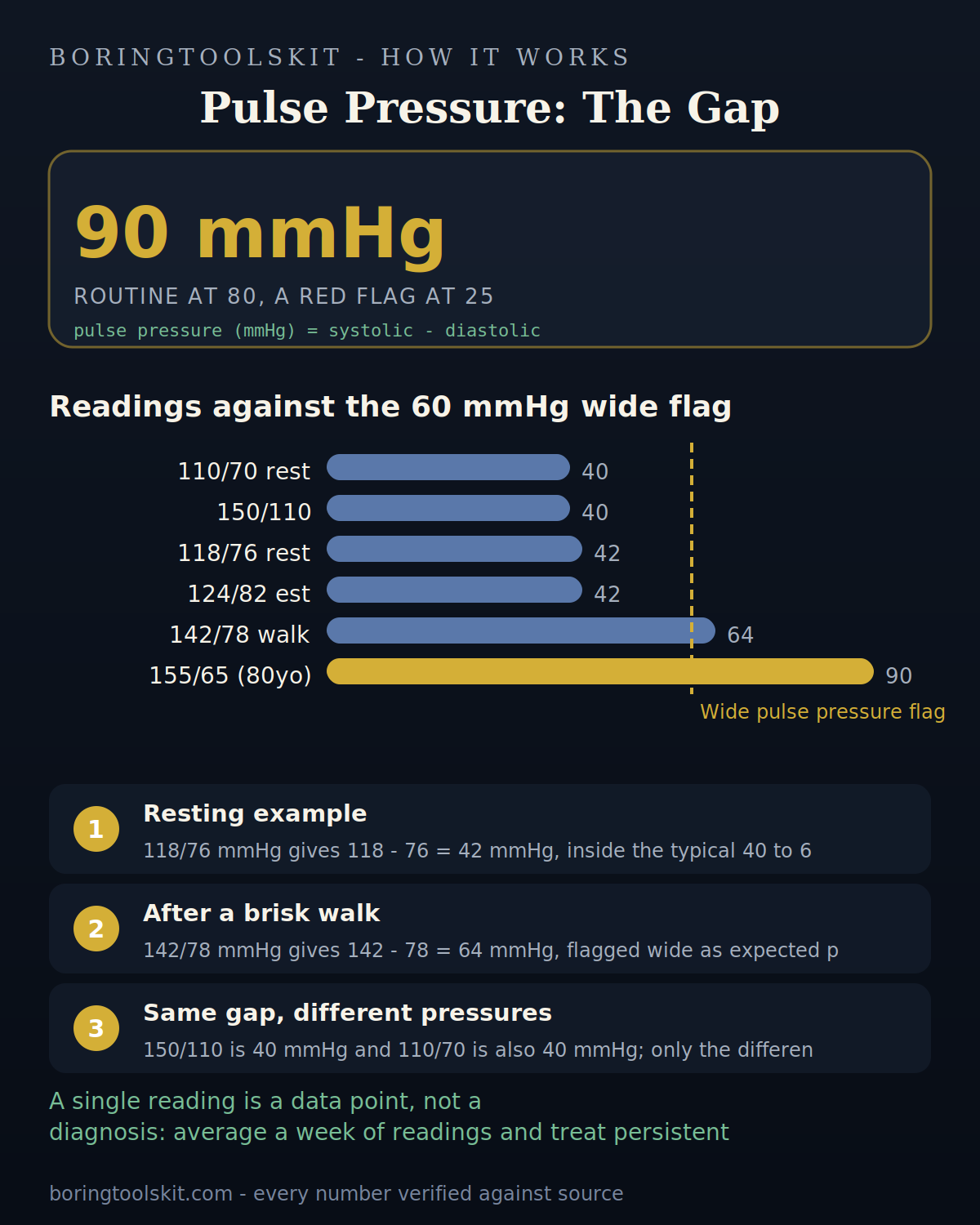
Take a reading of 118 over 76 mmHg. Pulse pressure is systolic minus diastolic: 118 - 76 = 42 mmHg. That lands in the 40 to 60 mmHg band the calculator treats as typical at rest, so the note stays neutral.

Now the same person after a brisk walk: 142 over 78 mmHg. The arithmetic is 142 - 78 = 64 mmHg. The systolic number rose 24 mmHg while the diastolic barely moved, because the heart is pushing more blood per beat and the arteries briefly stretch to absorb it. The calculator flags 64 as wide, which is expected after exercise and not by itself a concern.

The gap is what matters, not the size of either number. A 150/110 reading has pulse pressure of just 40 mmHg (150 - 110), while a 110/70 reading has 40 mmHg too (110 - 70). Two very different blood pressures, one identical pulse pressure, because the formula only sees the difference.

Where a single reading misleads

Home cuff error runs about plus or minus 5 to 8 mmHg, and it hits both numbers. A measured 124 over 82 could truly be 118 over 88, swinging pulse pressure from 42 to 30 mmHg with no change in the person. The validation window in the tool (systolic 50 to 300, diastolic 30 to 200) is generous for that reason, but it cannot fix a sloppy cuff: wrong cuff size alone shifts readings by 5 to 15 mmHg.

Width has opposite meanings at different ages. In a 30 year old, resting pulse pressure above 60 mmHg is uncommon and worth investigating. In an 80 year old, arteries stiffen and a reading of 155 over 65 (pulse pressure 90 mmHg) is routine; the same 90 mmHg in a 25 year old would be a genuine red flag. The tool applies one threshold to everyone, so age context is on you.

Practical rule: a single reading is a data point, not a diagnosis. Average morning and evening readings across a week, and treat a persistent pattern, not one number, as the thing to raise with a doctor.