Updates automatically as you type.
Calculated in your browser; your inputs are not sent to us. Privacy
Calculation details
Review the generated output before relying on it.
This tool runs in your browser. Your calculator inputs and results are never transmitted to us or to ad/affiliate partners. Ads and sponsored links may set third-party cookies to serve and measure them, but they never receive your calculation values. If you explicitly save a scenario, its permitted fields stay in local browser storage until you clear them. See our Privacy Policy.
Use this result
Share the current inputs or ask ChatGPT to explain the calculation in context.
More options
What does this calculator estimate?
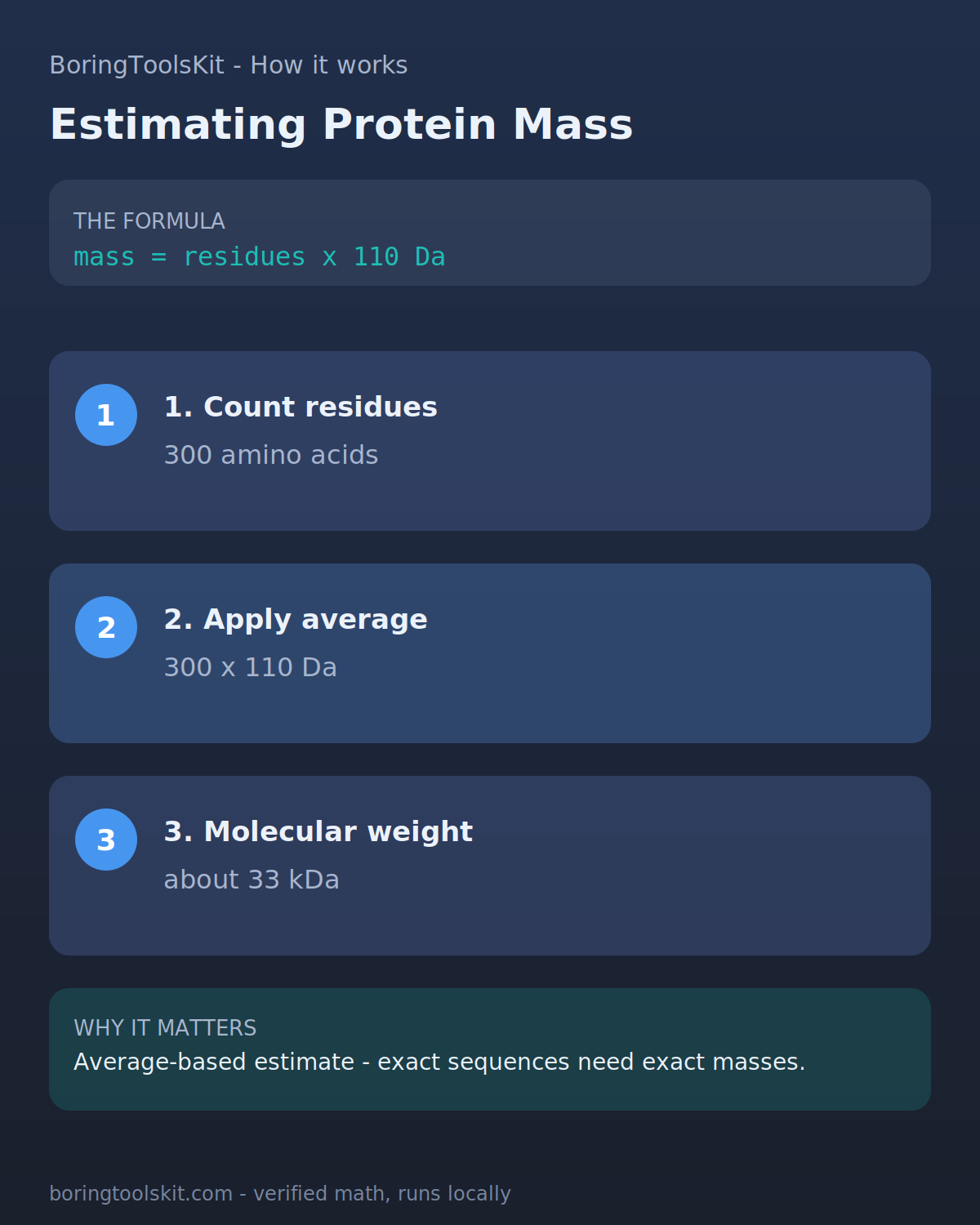
A 300-residue protein weighs about 33,000 Da (33 kDa) using the standard 110 Da average per amino acid. For precise work, sum the exact masses of the actual sequence. Enter chain length in the BoringToolsKit protein molecular weight calculator for a fast estimate.
- The average amino acid residue contributes about 110 Da after peptide bond formation. (Source: UniProt)
- Exact mass requires the actual sequence: residue masses range from 57 Da (Gly) to 186 Da (Trp). (Source: UniProt)
- 1 kDa equals 1,000 Da; proteins are commonly described in kDa. (Source: UniProt)
How this calculator works
Formula
Weight (Da) = chain length (residues) x average residue mass (about 110 Da).
Worked example
A 300-residue protein has an estimated molecular weight of about 33,000 Da (33 kDa) using the 110 Da average.
Assumptions to verify
- The 110 Da average ignores the water lost in each peptide bond (about 18 Da per bond).
- For exact mass, sum the actual residue sequence masses.
Frequently asked questions
Why 110 Da per residue?
It is the average mass of the 20 amino acids minus the water lost in peptide bonding.
How accurate is the estimate?
Within about 10% of the true mass for typical sequences; use the exact sequence for precise work.
Cite this tool
BoringToolsKit. “Protein Molecular Weight Calculator.” boringtoolskit.com/protein-molecular-weight-calculator/. Free to reference in articles, syllabi, and answer posts with a link.
Privacy: Inputs and results stay in this browser. Any future sponsored recommendation or advertisement will be clearly labeled and kept separate from the calculation.
Worked example: a 220-residue chain at 110 Da per residue
Set chain length to 220 and average residue mass to 110 Da (a reasonable midpoint between glycine-heavy low-mass proteins and tryptophan-heavy high-mass ones). The calculator multiplies 220 x 110 = 24,200 Da, displayed as 24.2 kDa. That single multiplication is the whole mechanism: kDa is just Da divided by 1,000, so the display converts 24,200 to 24.2 without changing the underlying number.
The residue count also drives the peptide-bond figure: a chain of 220 residues has 219 bonds, because each bond connects two neighbours and the last residue has no partner after it. The formula is always length minus 1, so a 100-residue chain shows 99 bonds and a 1-residue chain shows 0. If you double the chain to 440 residues at the same 110 Da average, mass doubles exactly to 48,400 Da (48.4 kDa) and bonds rise to 439 - mass scales linearly with length because the average is held constant.
To sanity-check the average itself: actual residue masses in a chain run from about 57 Da (glycine, minus water on incorporation) to 186 Da (tryptophan), so 110 Da sits mid-range. A glycine-rich peptide of the same 220 residues would land near 220 x 70 = 15,400 Da, while a tryptophan-rich one could exceed 220 x 140 = 30,800 Da. That is why the input is an average, not a per-residue table: it compresses composition variation into one number.
Boundary cases the input validation handles
Chain length must be an integer between 1 and 100,000, and the check is strict. A value of 0, a negative number, or a decimal such as 220.5 all fail the Number.isInteger test or the range check and produce an error card instead of a result - fractional residues are not meaningful, so no rounding happens silently. Non-numeric text also reads as 0 and fails the same way.
At the top of the range, 100,000 residues is the largest accepted input. At the default 110 Da average that gives 11,000,000 Da, displayed as 11,000.0 kDa (11 MDa). Values beyond the cap are rejected rather than extrapolated, because averaging residue masses loses accuracy in ultra-large proteins where non-amino-acid modifications dominate. The smallest accepted case, 1 residue, returns 0.0 kDa (about 110 Da) with 0 peptide bonds - a single residue forms no bond, which is why the length-minus-1 rule matters at that edge.
The calculator does not model what a real chain actually weighs beyond the simple average. It ignores the N-terminal hydrogen and C-terminal hydroxyl that restore water ends (roughly an 18 Da correction on small peptides, which is under 0.1 percent at 24,200 Da but visible on a 10-residue peptide), disulfide bonds, cofactors, prosthetic groups, glycosylation, and phosphorylation, each of which can add tens to thousands of Da. It also cannot recover the true sequence mass from an average, so it is an estimate tool for scale, not a substitute for computing from a known sequence.