Lean Body Mass Calculator

Lean body mass calculator estimates fat-free mass from your weight, height, gender and body fat. Free, private, runs in your browser, no signup required.

Updates automatically as you type.

Calculated in your browser; your inputs are not sent to us. Privacy

Results will appear here.

General estimate for planning only — not medical advice. Consult a doctor about your specific situation.

Calculation details
Every figure above is calculated locally in your browser from the assumptions shown. No inputs are sent anywhere. See the methodology section below for how this tool works.
Use this resultShare the current inputs, or ask ChatGPT to explain the calculation in context.
Ask an AI to explain this result
Share this result

Review the generated output before relying on it.

This tool runs in your browser. Your calculator inputs and results are never transmitted to us or to ad/affiliate partners. Ads and sponsored links may set third-party cookies to serve and measure them, but they never receive your calculation values. If you explicitly save a scenario, its permitted fields stay in local browser storage until you clear them. See our Privacy Policy.

Use this result

Share the current inputs or ask ChatGPT to explain the calculation in context.

More options
Report a calculation issue
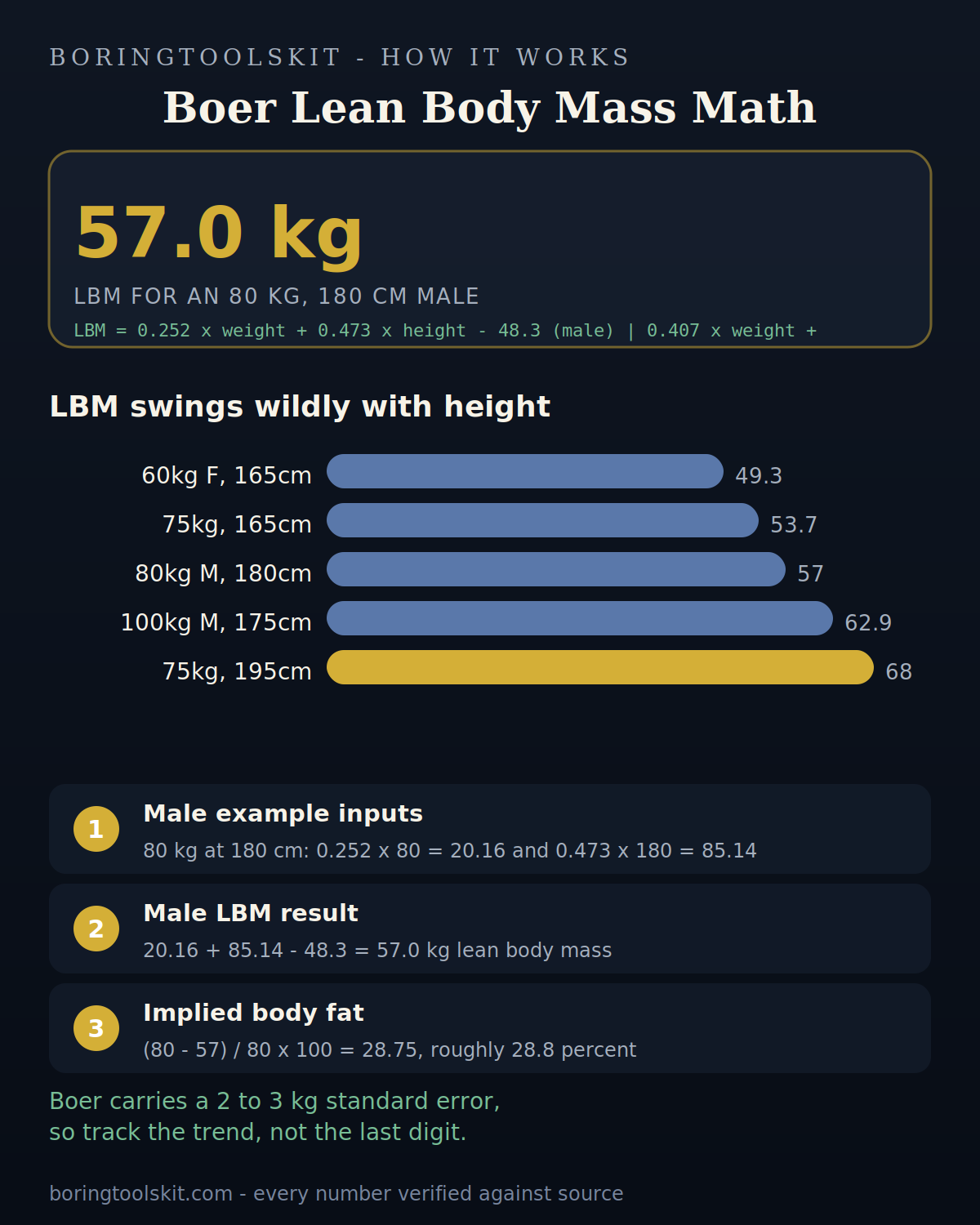
Boer formula LBM calculations for five body sizes
Height alone moves LBM by 14.3 kg between two 75 kg people.
Method & verification

How This Tool Works

fact-checked against our calculation methodology

Calculation Method

Computes Lean body mass from Weight, Height and Gender.

Site methodology

No unrelated authority link is added merely to make this page look sourced. Tool-specific external sources are shown only when they directly support the method, rate, or rule.

Assumptions to Verify

  • These tools provide general estimates for planning and education only.
  • They are not medical advice and not a substitute for a qualified healthcare professional.
  • Always consult your doctor or another healthcare provider about your specific situation.

Privacy: The calculation runs in this browser. Shared links contain the page address only, not your inputs or results.

Worked example: the Boer arithmetic line by line

Take a 80 kg, 180 cm male. The Boer formula is 0.252 x weight + 0.473 x height - 48.3. Step 1: 0.252 x 80 = 20.16. Step 2: 0.473 x 180 = 85.14. Step 3: 20.16 + 85.14 - 48.3 = 57.0 kg of lean body mass. The implied body fat is (80 - 57) / 80 x 100 = 28.75 percent, so roughly 28.8 percent. That is plausible for an untrained adult male but high for an athlete, which is the right instinct to have when a single-input formula spits out a number.

Compare a 60 kg, 165 cm female: 0.407 x 60 = 24.42, 0.267 x 165 = 44.06, sum minus 19.2 gives 49.3 kg LBM and (60 - 49.3) / 60 x 100 = 17.9 percent implied body fat. Notice the male example carries about 15.7 kg of LBM per 100 kg of bodyweight at 180 cm, the female about 82.1 kg per 100 kg at 165 cm, yet the female ends up leaner on paper. That inversion is why the gender input exists: the coefficients encode real average differences in bone mass and water fraction, not a cosmetic adjustment. If you cut 5 kg from the male example while holding height constant, LBM falls only 1.26 kg, so the tool implicitly assumes losses are about 75 percent fat.

Where the number goes wrong

The Boer equation was fitted on a small hospital sample and its stated standard error is around 2 to 3 kg, so treat the last digit as decoration. The error grows at the extremes the input validation allows: a 130 kg, 150 cm body sits far outside the population the equation was derived from, and estimates for very short users near the 120 cm floor or very tall users above 200 cm drift by several kilograms versus DEXA. Height dominates through the coefficient, so two 75 kg people at 165 cm versus 195 cm get 53.7 kg versus 68.0 kg of LBM, an 14.3 kg spread from height alone.

It also cannot see composition history. A strength-trained person and a sedentary person with identical weight, height, and gender get the identical LBM, because the formula has no training, age, or body-fat input. For a 100 kg male at 175 cm it reports 62.9 kg LBM and 37.1 percent fat, but a competitive powerlifter of those exact stats might measure 20 percent fat on a real scan. Use the output as a consistent baseline for tracking change, not as a body-fat verdict: a 2 kg drop in the estimate after six weeks of dieting is meaningful trend data even when the absolute number is off by 3 kg.