Calculation details
Planning estimate only. Verify dimensions, waste, coverage, product specifications, and local requirements before purchasing materials.
This tool runs in your browser. Your calculator inputs and results are never transmitted to us or to ad/affiliate partners. Ads and sponsored links may set third-party cookies to serve and measure them, but they never receive your calculation values. If you explicitly save a scenario, its permitted fields stay in local browser storage until you clear them. See our Privacy Policy.
Use this result
Share the current inputs or ask ChatGPT to explain the calculation in context.
What does this calculator estimate?
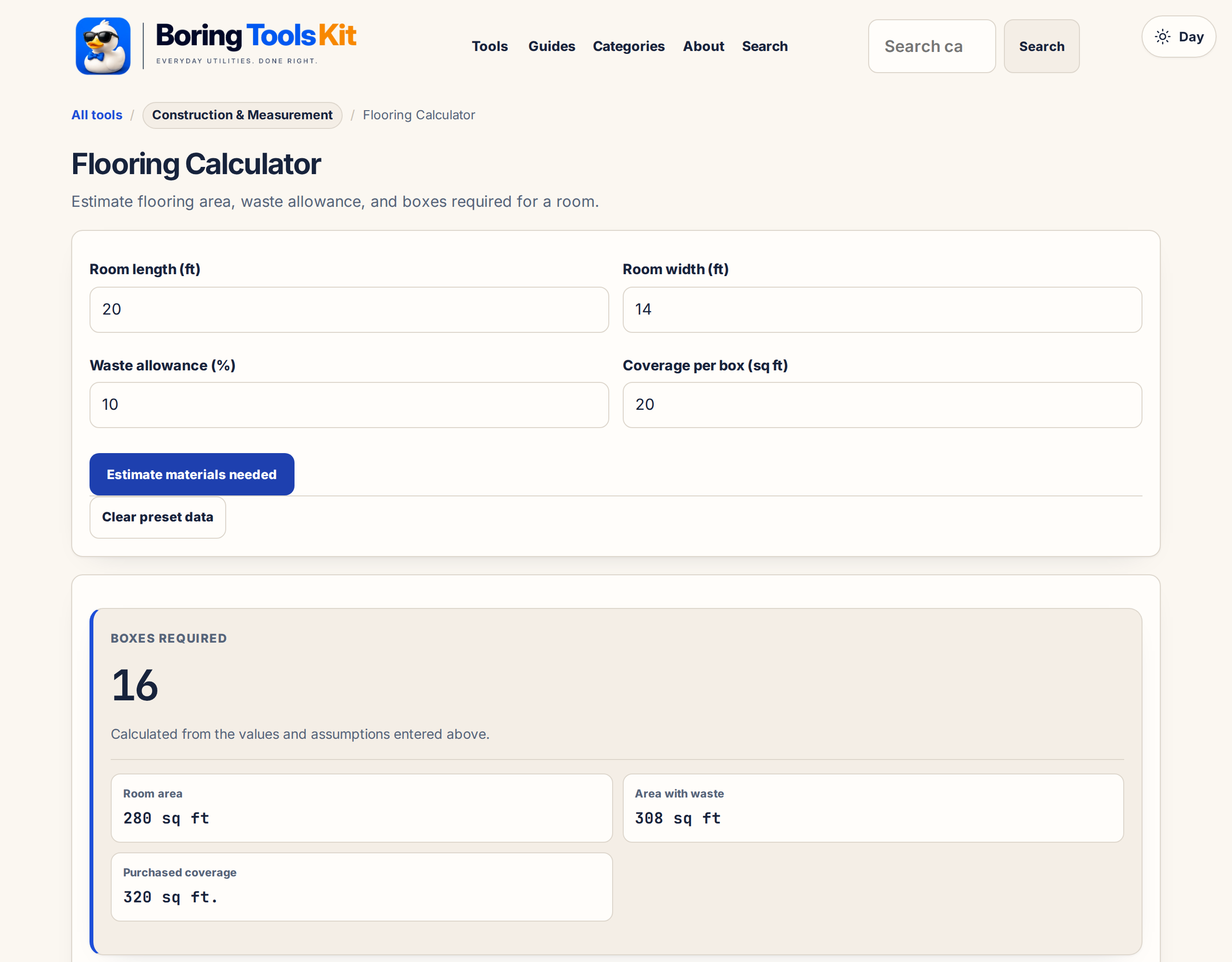
A flooring calculator estimates how much flooring material you need for a room. Enter the room length and width, the waste percentage, and the coverage per box to get the total area and boxes required.
- Area = length × width
- Add 10% waste for cuts and mistakes
- Boxes = ceil(area with waste ÷ box coverage)
How flooring quantity is estimated
Flooring is sold by area coverage. The room's length × width gives the base area; a waste allowance (typically 10%) covers cuts, seams, and damaged boards; then you round up to whole boxes of the coverage you're buying.
Limitations to watch for
Waste needs vary with layout: diagonal installations, complex rooms, and patterned planks waste more. The estimate assumes a rectangular space — irregular shapes need to be split into rectangles. Actual box coverage and board sizes vary by product.
How to use it in practice
Measure the room in feet (or convert). Add at least 10% waste, more for diagonal or patterned layouts. Round up to whole boxes — you can't buy a fraction of a box. Keep a few spare planks for future repairs.
['Measure the room length and width.', 'Enter the waste percentage (10% is standard).', 'Enter the coverage per box; the tool computes boxes and purchased coverage.']
How flooring is estimated
Flooring need = room area ÷ coverage per box, plus waste. A 12×14-foot room is 168 sq ft; a box of flooring covering 20 sq ft needs 8.4 boxes — with 10 percent waste, about 10 boxes. The calculator runs the math for any room.
Waste by layout
Straight plank layouts waste 5–10 percent; diagonal, herringbone, and rooms with many cuts waste 10–15 percent. The calculator's waste input adjusts the box count to the layout.
Box coverage varies
Laminate and vinyl boxes cover 15–25 sq ft; tile is sold per square foot or per box; hardwood by the carton. Enter the actual coverage per box from the product label.
A worked example
A 200 sq ft room with 10 percent waste needs 220 sq ft — 11 boxes at 20 sq ft each. The calculator returns the box count and the leftover.
Subfloor and underlayment
Most flooring needs underlayment or subfloor prep on top of the material cost. Budget those separately — the calculator handles the surface; the prep is the hidden line.
How this calculator works
Formula
Room area = length × width. Area with waste = room area × (1 + waste%). Boxes required = ceil(area with waste ÷ box coverage). Purchased coverage = boxes × box coverage.
Worked example
A 12 × 15 ft room is 180 sq ft. At 10% waste that's 198 sq ft. With 20 sq ft per box, you need ceil(198 ÷ 20) = 10 boxes, covering 200 sq ft.
Assumptions to verify
- The room is rectangular.
- Waste percentage is entered by the user.
- Boxes are rounded up to whole numbers.
Frequently asked questions
How do I calculate flooring for a room?
Multiply the room length by the width to get square feet, add a waste allowance (usually 10%), then divide by the coverage per box and round up.
How much waste should I add?
10% is standard for rectangular rooms with straight layouts. Diagonal patterns, herringbone, or rooms with many cuts can need 15–20%.
What is box coverage?
The square footage a box of flooring covers, printed on the product. Divide your total area by it to find how many boxes to buy.
Can I buy less than a full box?
No — flooring comes in whole boxes. Always round up, and keep spare planks for future repairs.
What about closets and alcoves?
Measure them separately and add their area to the room total. The calculator assumes one rectangle; split irregular layouts into rectangles.
Should I measure in feet or inches?
Feet with decimals works best (12 ft 6 in = 12.5 ft). Convert inches to feet by dividing by 12.
Why is my estimate different from the store's?
Different waste assumptions, box coverages, or measuring conventions. Confirm the product's exact coverage and add your own waste factor.
How much flooring do I need?
Room area ÷ coverage per box, plus 5–15% waste by layout.
How many square feet in a box?
Laminate/vinyl commonly 15–25 sq ft; check the product label.
Do I need underlayment?
Usually yes — budget it separately from the flooring.
Cite this tool
BoringToolsKit. “Flooring Calculator.” boringtoolskit.com/flooring-calculator/ (reviewed 2026-08-25). Free to reference in articles, syllabi, and answer posts with a link.
Privacy: Inputs and results stay in this browser. Any future sponsored recommendation or advertisement will be clearly labeled and kept separate from the calculation.