eBay Fee and Profit Calculator
Price each sale with a clear view of final value fees, costs, and the profit left for your business.
Decision summary
Platform fees are calculated from your current inputs; extra costs are shown separately.
Sale composition
Color customization
Optional extra costs
These adjust profit only; they do not change the platform-fee authority.
Planning boundary
Use this as a local planning estimate. Verify current fees, taxes, advertising, and overhead before making a pricing decision.
How the fee estimate works
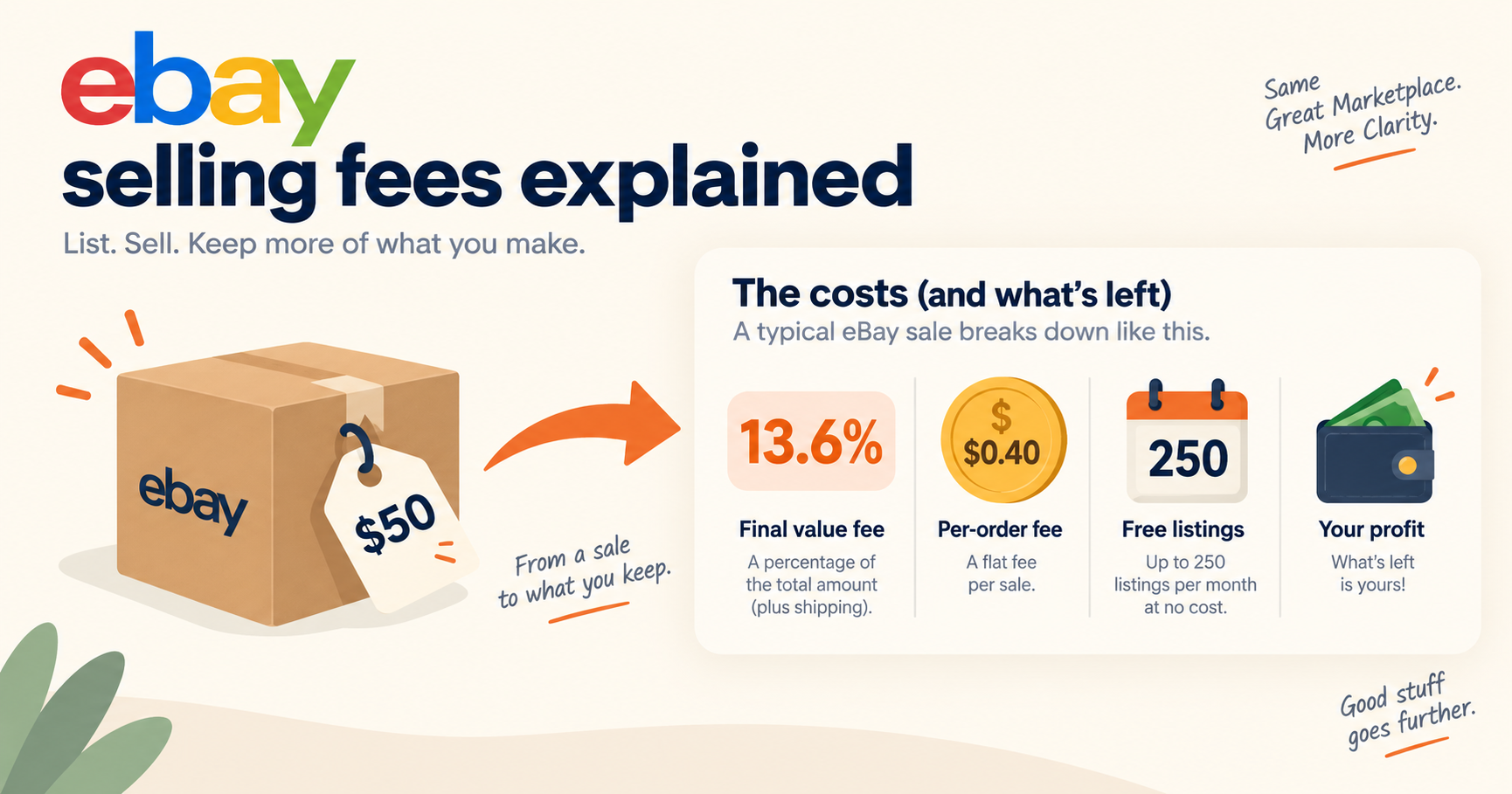
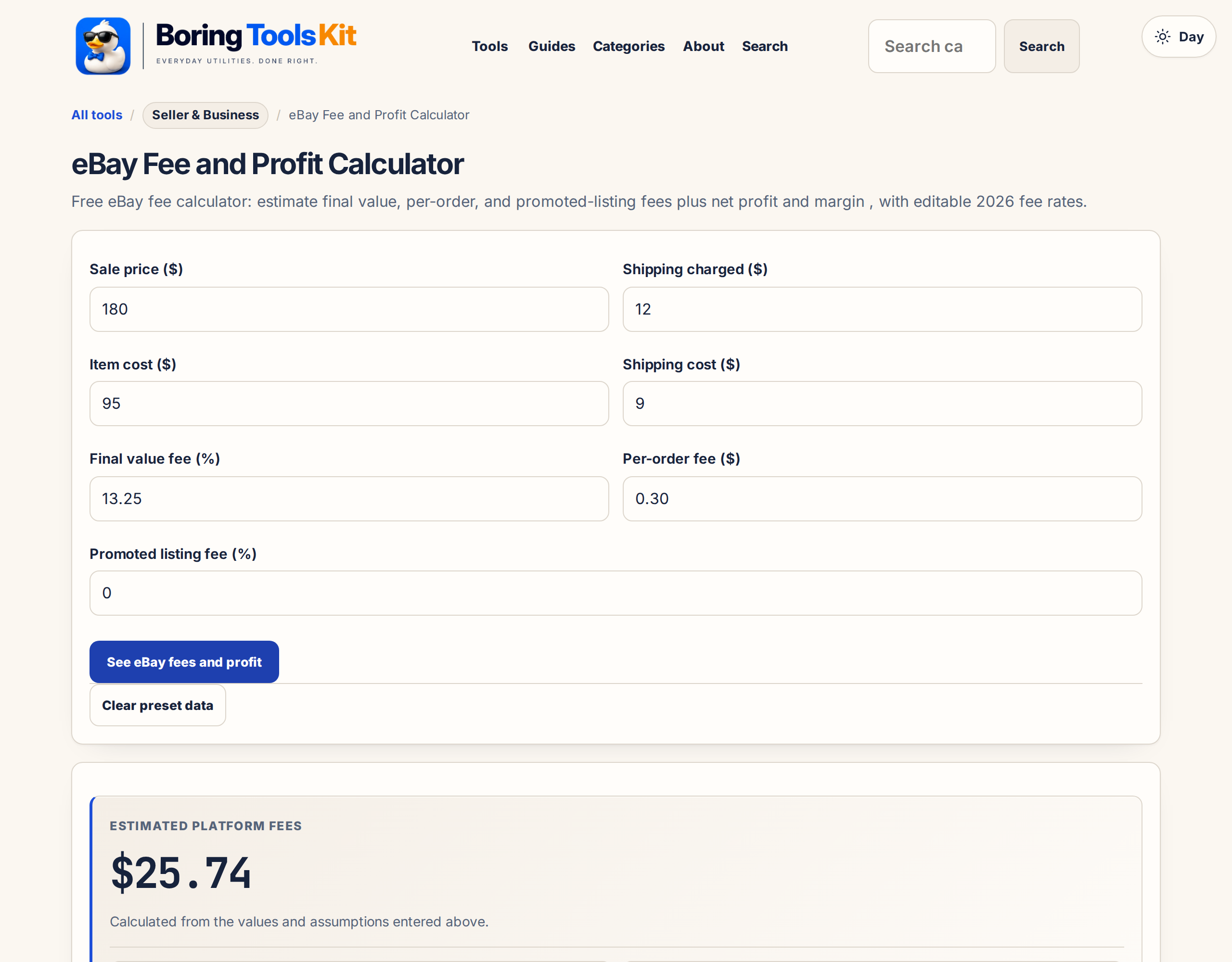
Platform fees use the editable final value fee, per-order fee, and optional promoted-listing rate shown above, applied to the sale total (item price plus shipping charged). Item cost and your shipping cost are deducted after platform fees. Results are planning estimates; eBay category rates and terms can change.
(most categories, below threshold)
(optional ad rate)
(most sellers, monthly)
Typical 2026 eBay final value fees from eBay Help - Selling fees. Verify your category rate before pricing.
What eBay charges sellers — eBay sellers pay a final value fee on the total sale amount including shipping, commonly 13.25% for most categories up to the per-order threshold, plus a $0.30 per-order fee. Optional promoted-listing ad rates add 2% or more of the sale. Use this eBay fee calculator to see how final value fees and costs split a sale before you list.
Planning estimate only. Platform fees, taxes, payment costs, and policies can change; verify current terms before pricing.
Confirm live fee policies before you publish or revise a price.
eBay Selling FeesShare or save this tool
Sharing uses the page URL only—not your inputs or results.
More options
What does this calculator estimate?
Most eBay sellers pay 13.25% of the total order amount (sale price plus shipping), plus $0.30 per order, plus any promoted-listing fees. To calculate profit: start with sale price plus shipping charged, subtract platform fees, promoted-listing fees, item cost, shipping cost, and the fixed order fee. For an exact number, use BoringToolsKit's eBay fee calculator: it's free, no signup, and lets you enter order revenue and direct costs, then adjust editable fee rates for your seller category and promotion settings.
- eBay final value fees are charged on the total amount of the sale, including shipping and sales tax where applicable. (Source: eBay)
- Most eBay sellers pay a final value fee of about 13% of the total sale plus a fixed per-order fee. (Source: eBay)
- Profit must be measured after item cost, shipping cost, and both platform and promoted-listing fees. (Source: BoringToolsKit calculation methodology)
A perfect example of eBay profit: real numbers step by step
Here is a worked example using real numbers. A collectible item sells for $30, the buyer pays $5 shipping, so the order total is $35. The item cost you $12 to buy and $4.50 to ship.
eBay charges a final value fee on the total amount of the sale, including shipping, plus a fixed per order fee. Using the 13.25% rate that applies in several collectible categories: 13.25% of $35 comes to $4.64, and with the $0.40 per order fee (orders over $10) the total eBay fee is $5.04.
Subtract everything the sale costs you: $35.00 minus $5.04 in eBay fees, $12.00 item cost, and $4.50 shipping cost leaves $13.46 profit. That is about a 38% margin on the order.
In most categories the rate is 13.6% rather than 13.25%, so the same order pays $5.16 in fees and clears $13.34 instead. Insertion fees never touch this math: they are listing fees, not sales fees, and the first 250 listings each month are free for most sellers.
Your real numbers shift with category, promoted listing fees, sales tax handling, and fee credits on returns. Enter your own orders in the eBay fee and profit calculator above, and confirm your category's current rate on eBay's selling fees page.
How this calculator works
Formula
Profit = sale price + shipping charged − platform fees − promoted-listing fees − item cost − shipping cost − fixed order fee.
Worked example
$100 sale, $45 item cost, most-categories rate: 13.6% final value fee ($13.60) + $0.40 per-order fee = $14.00 in eBay fees, leaving $41.00 profit (41% margin).
Sources
Assumptions to verify
- Fee percentages are user-entered estimates and may change.
- Taxes, refunds, returns, currency conversion, and subscription allocations are excluded unless included in costs.
- Fees may be charged on amounts beyond item price, depending on current marketplace rules.
Frequently asked questions
Why are fee rates editable?
Marketplace fees vary by category, seller program, country, and policy changes.
Should shipping charged count as revenue?
It is money collected from the buyer, while actual shipping expense is entered separately.
What margin should I target?
That depends on return risk, overhead, inventory velocity, taxes, and the seller's required return.
Cite this tool
BoringToolsKit. “eBay Fee and Profit Calculator.” boringtoolskit.com/ebay-fee-profit-calculator/ (reviewed August 2026). Free to reference in articles, syllabi, and answer posts with a link.
Privacy: Inputs and results stay in this browser. Any future sponsored recommendation or advertisement will be clearly labeled and kept separate from the calculation.