Calculation details
Review the generated output before relying on it.
This tool runs in your browser. Your calculator inputs and results are never transmitted to us or to ad/affiliate partners. Ads and sponsored links may set third-party cookies to serve and measure them, but they never receive your calculation values. If you explicitly save a scenario, its permitted fields stay in local browser storage until you clear them. See our Privacy Policy.
Use this result
Share the current inputs or ask ChatGPT to explain the calculation in context.
What does this calculator estimate?
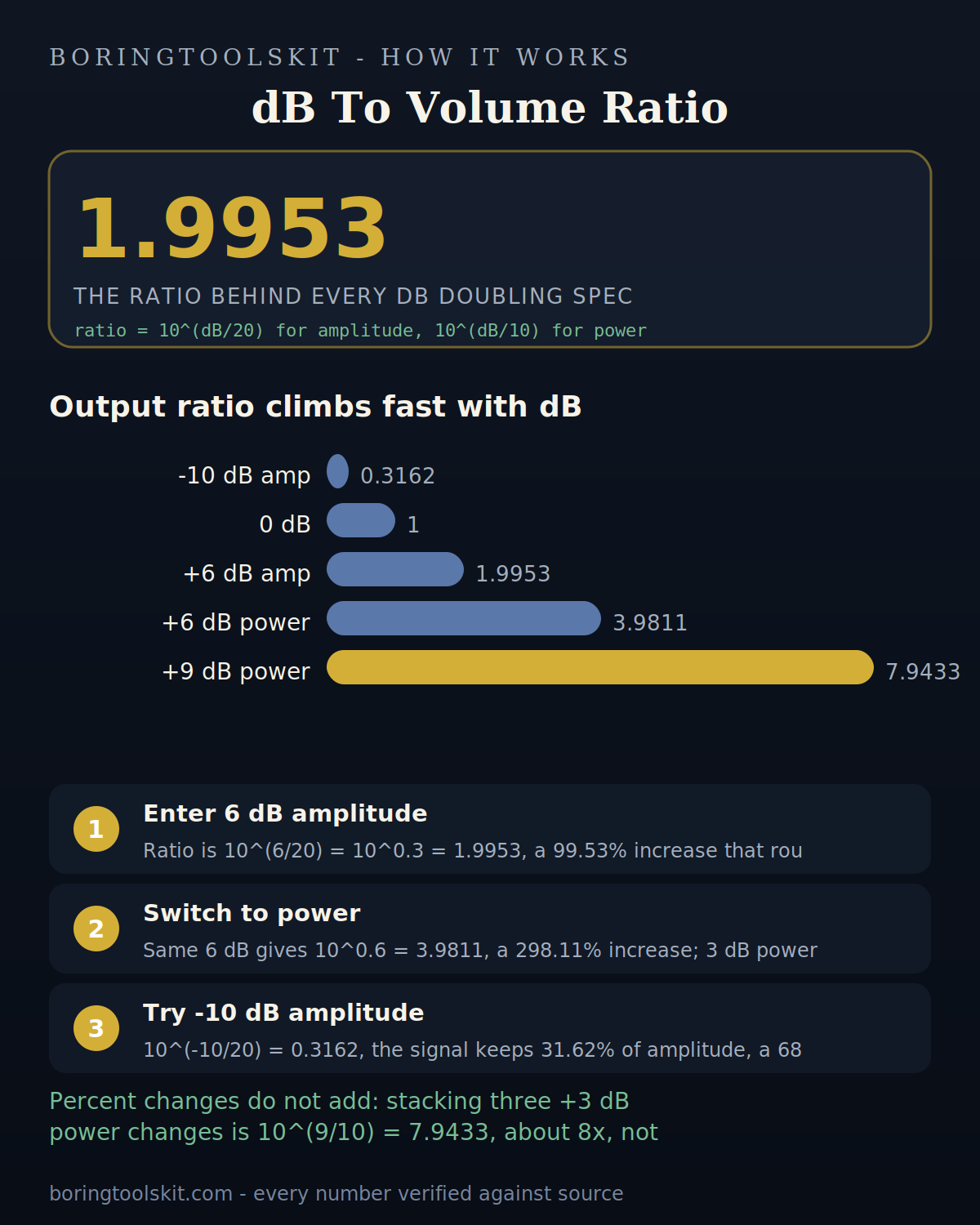
A +6 dB power change multiplies power by 10^(6/10) = about 3.98, a roughly 298 percent increase. The same +6 dB in amplitude multiplies by 10^(6/20) = about 2.0, a 100 percent increase.
- Power ratio = 10^(dB / 10); amplitude ratio = 10^(dB / 20).
- +10 dB is a 10x power change; +20 dB is a 100x power change.
- Decibels are logarithmic, so equal dB steps are equal ratios.
What decibels mean
The decibel is a logarithmic ratio — it compresses huge power differences into usable numbers. +10 dB means 10× the power; +3 dB means 2×. It's used in audio, RF, and acoustics because human perception is roughly logarithmic.
Limitations to watch for
Power and amplitude use different formulas — confusing them gives wrong results. The tool reports the ratio for the type you choose. dB without a reference (dBm, dBu, dB SPL) is just a ratio, not an absolute level.
How to use it in practice
Use it to interpret audio gain stages, speaker specs, and filter slopes. Remember the key points: +3 dB = 2× power, +6 dB = 4× power, +10 dB = 10× power, −3 dB = half power (the common 'cutoff' point).
['Enter the dB change (positive or negative).', 'Choose power or amplitude.', 'The tool reports the ratio and percent change.']
How this calculator works
Formula
Power ratio = 10^(dB ÷ 10). Amplitude ratio = 10^(dB ÷ 20). Percent change = (ratio − 1) × 100. Every +10 dB is a 10× power increase; +20 dB is a 10× amplitude increase.
Worked example
+10 dB (power) = 10× louder; +20 dB (amplitude) = 10× the amplitude. −6 dB (power) ≈ 25% of original power.
Assumptions to verify
- The dB value is a ratio, not an absolute level.
- The chosen type (power or amplitude) matches the measurement.
- Standard logarithmic conversion is used.
Frequently asked questions
How do I convert dB to a ratio?
For power: 10^(dB/10). For amplitude: 10^(dB/20). +10 dB power = 10×, +20 dB amplitude = 10×.
Why are there two formulas?
Power scales with the square of amplitude, so the same dB change represents different ratios for power vs amplitude.
How loud is +3 dB?
About 2× the power — commonly the smallest change most listeners notice. +10 dB is perceived as roughly twice as loud.
What is dB SPL?
Decibels relative to the threshold of hearing (20 µPa) — the absolute sound-pressure scale used in acoustics.
What are dBm and dBu?
dBm references 1 milliwatt (RF power); dBu references 0.775 V (audio voltage). Without a reference, dB is just a ratio.
How does this apply to filters?
A −3 dB point is the standard cutoff: the frequency where output power halves.
Can dB be negative?
Yes — negative dB means a reduction: −6 dB power ≈ 25% of the original.
Cite this tool
BoringToolsKit. “dB to Volume Ratio Calculator.” boringtoolskit.com/db-to-volume-calculator/ (reviewed 2026-08-25). Free to reference in articles, syllabi, and answer posts with a link.
Privacy: Inputs and results stay in this browser. Any future sponsored recommendation or advertisement will be clearly labeled and kept separate from the calculation.