Live prices are fetched from CoinGecko (public API) only when you press the button. No data is stored.
Updates automatically as you type.
Calculated in your browser; your inputs are not sent to us. Privacy
Calculation details
Planning estimate only, not financial, tax, or legal advice. Verify assumptions and current rules before making decisions.
This tool runs in your browser. Your calculator inputs and results are never transmitted to us or to ad/affiliate partners. Ads and sponsored links may set third-party cookies to serve and measure them, but they never receive your calculation values. If you explicitly save a scenario, its permitted fields stay in local browser storage until you clear them. See our Privacy Policy.
Use this result
Share the current inputs or ask ChatGPT to explain the calculation in context.
More options
What does this calculator estimate?
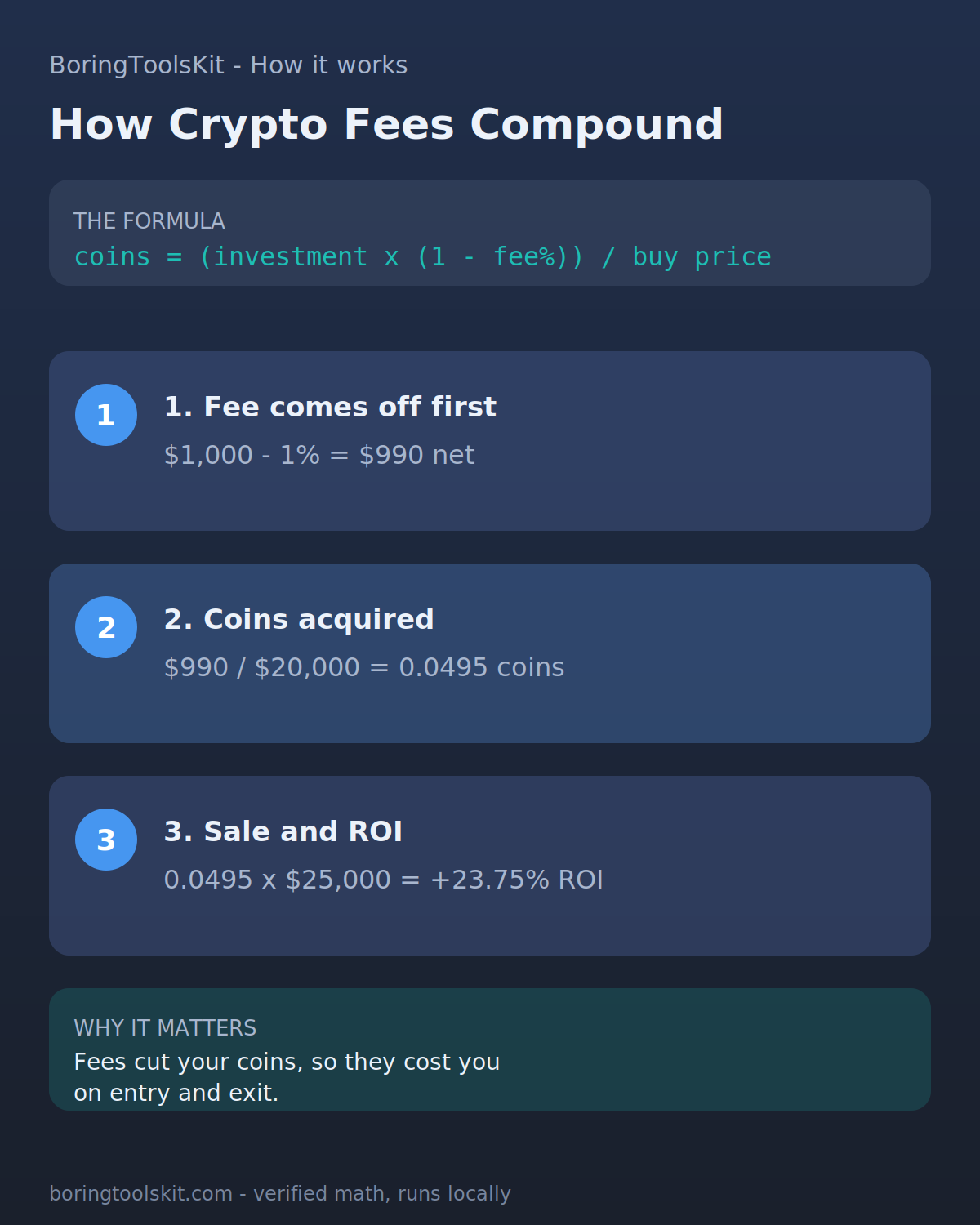
A $1,000 crypto purchase with a 1% fee leaves $990 net; at a $20,000 buy price that is 0.0495 coins, and selling at $25,000 returns $1,237.50: a $237.50 profit, a 23.75% ROI on the original $1,000. Fees reduce the coins you acquire, so they compound against you twice. Run your own numbers in the BoringToolsKit crypto fee and profit calculator.
- A 1% exchange fee on a $1,000 purchase cuts the coins acquired to 99% of the fee-free amount. (Source: BoringToolsKit calculation methodology)
- Crypto sales are generally taxable events; profit is measured against your cost basis. (Source: IRS)
- The example's 23.75% ROI divides the $237.50 gain by the original $1,000 invested, not the $990 net amount. (Source: BoringToolsKit calculation methodology)
How is ROI different from profit here?
Profit is the dollar difference between proceeds and cost; ROI scales it by what you put in, so a $500 gain on $1,000 (50%) outranks a $900 gain on $9,000 (10%). Comparing positions by ROI exposes which trades worked per dollar risked, which raw profit hides, especially when position sizes differ widely.
What fees belong in the calculation?
Exchange trading fees, spread, and any withdrawal costs all reduce real proceeds, and they compound across buys and sells. A position that looks profitable at the screen price can be flat after round-trip fees, particularly on small trades where fixed fees weigh heaviest. Include every fee you actually paid rather than the advertised maker rate.
How this calculator works
Formula
Fee amount = investment × fee percentage ÷ 100. Net amount = investment − fee amount. Coins acquired = net amount ÷ buy price. Sale value = coins acquired × sell price. Profit/loss = sale value − original investment. ROI = profit/loss ÷ original investment × 100.
Worked example
A $1,000 purchase with a 1% fee leaves $990 net. At a $20,000 buy price that acquires 0.0495 coins; selling at $25,000 gives a $1,237.50 sale value, $237.50 profit, and 23.75% ROI on the original $1,000.
Assumptions to verify
- Buy and sell prices are manual planning inputs, not live market data.
- The fee is modeled as a percentage deducted before purchase; network, spread, withdrawal, and tax costs are not included.
- Crypto prices are volatile; use the result as scenario arithmetic, not a prediction.
Frequently asked questions
Why is ROI measured against the original investment?
The tool compares final sale value with the total cash committed, including the fee, so the fee is not hidden from the return.
Does it fetch live crypto prices?
No. Enter your own buy and sell prices so the page stays private and works without an external market-data request.
Can the result be negative?
Yes. If the sale value is below the original investment, the page shows a loss and negative ROI.
Cite this tool
BoringToolsKit. “Crypto Profit Calculator.” boringtoolskit.com/crypto-calc/. Free to reference in articles, syllabi, and answer posts with a link.
Privacy: Inputs and results stay in this browser. Any future sponsored recommendation or advertisement will be clearly labeled and kept separate from the calculation.