Updates automatically as you type.
Calculated in your browser; your inputs are not sent to us. Privacy
Calculation details
Planning estimate only, not financial, tax, or legal advice. Verify assumptions and current rules before making decisions.
This tool runs in your browser. Your calculator inputs and results are never transmitted to us or to ad/affiliate partners. Ads and sponsored links may set third-party cookies to serve and measure them, but they never receive your calculation values. If you explicitly save a scenario, its permitted fields stay in local browser storage until you clear them. See our Privacy Policy.
Use this result
Share the current inputs or ask ChatGPT to explain the calculation in context.
More options
What does this calculator estimate?
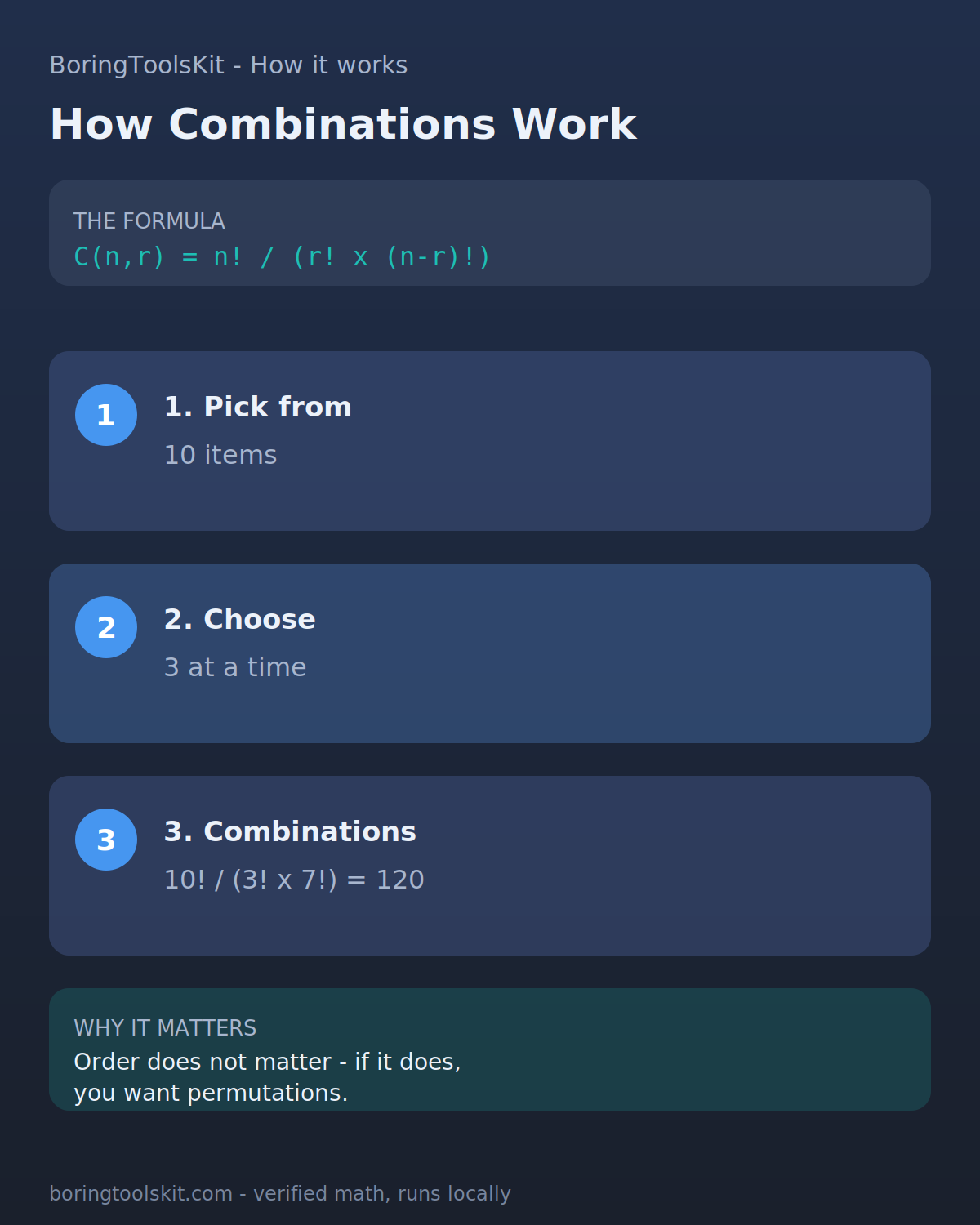
There are 120 ways to choose 3 items from 10: C(10,3) = 10! / (3! x 7!) = 120. Order does not matter in combinations. Enter any n and r in the BoringToolsKit combinations calculator.
- Combinations count unordered selections; permutations count ordered ones. (Source: BoringToolsKit calculation methodology)
- C(10,3) = 120, but the same picks in order would give 10 x 9 x 8 = 720 permutations. (Source: BoringToolsKit calculation methodology)
- C(n, n) = 1 and C(n, 0) = 1 for any n. (Source: BoringToolsKit calculation methodology)
How this calculator works
Formula
C(n, r) = n! / (r! x (n - r)!).
Worked example
Choosing 3 items from 10 gives C(10, 3) = 120 distinct combinations.
Assumptions to verify
- Order does not matter; for ordered selections use permutations.
- n and r are whole numbers with 0 <= r <= n.
Cite this tool
BoringToolsKit. “Combinations Calculator (nCr).” boringtoolskit.com/combinations-calculator/. Free to reference in articles, syllabi, and answer posts with a link.
Privacy: Inputs and results stay in this browser. Any future sponsored recommendation or advertisement will be clearly labeled and kept separate from the calculation.
Worked example: 8 choose 3, step by step
Set n = 8 and r = 3, then run the multiplicative form of the formula: start with c = 1 and multiply by (n - r + i) / i for i from 1 to r. For i = 1 the factor is (8 - 3 + 1) / 1 = 6, so c = 6. For i = 2 the factor is 7 / 2, so c = 6 x 7 / 2 = 21. For i = 3 the factor is 8 / 3, so c = 21 x 8 / 3 = 56.
The answer is 56: there are 56 distinct 3-person committees you can form from 8 people. Notice the running value stays small at every step: it never computes 8! = 40,320 or 3! = 6 as separate factorials, it just divides 6, then 21, then 56. Each intermediate value is itself an integer because after i steps the running product is exactly (n choose i), which is always a whole number. That is why the calculator can handle inputs like 67 choose 5 (12,172,308) without the overflow you would get from computing 67! directly, which would exceed the 2^53 safe integer range well before the final division.
A quick sanity check on the same inputs: 8 choose 3 must equal 8 choose 5 by symmetry (choosing 3 to keep is the same as choosing 5 to leave behind), and running the loop with r = 5 gives the same 56. If an input change ever produces a result that breaks that mirror property, that is a signal the arithmetic, not the math, has gone wrong.
Boundary cases and honest limits
The calculator rounds n and r to whole numbers before computing, so entering n = 10.4 or r = 2.7 is treated as n = 10, r = 3 rather than rejected. Combinations of fractional items have no standard meaning, so do not rely on the rounding for anything but cleaning up stray decimals. Inputs below the valid range are refused outright: r = 0 with n = 0 fails because n must be at least 1, and any r larger than n (say 10 choose 12) returns the check-inputs message instead of a number.
Two boundary values are worth knowing. At r = 0 the loop never runs and the result is 1, since there is exactly one way to choose nothing: the empty set. At r = n the same loop yields 1 as well, because every one of the n items must be taken. Between those poles the numbers explode fast: 20 choose 10 is 184,756, but 52 choose 5 is 2,598,960 and 69 choose 5 (a lottery main draw) is 11,238,513. Below roughly 2^53 (about 9,007,199,254,740,992) results are exact; beyond that, JavaScript floating-point arithmetic can lose low-order digits, so for very large n and r treat distant trailing digits as approximate.
Finally, the tool counts selections, not arrangements. If you need ordered outcomes (locks, rankings, race podiums) you want permutations, which are larger by a factor of r!: 8 choose 3 is 56, but 8 permute 3 is 336. The calculator will not flag that distinction for you, so confirm order genuinely does not matter before trusting the count.