Caffeine Half-Life Calculator

Caffeine half-life calculator: track how much caffeine remains in your body hour by hour so you can time your last coffee and protect your sleep. Free, no signup.

Updates automatically as you type.

Calculated in your browser; your inputs are not sent to us. Privacy

Results will appear here.

General estimate for planning only — not medical advice. Consult a doctor about your specific situation.

Calculation details
Every figure above is calculated locally in your browser from the assumptions shown. No inputs are sent anywhere. See the methodology section below for how this tool works.
Use this resultShare the current inputs, or ask ChatGPT to explain the calculation in context.
Ask an AI to explain this result
Share this result

Review the generated output before relying on it.

This tool runs in your browser. Your calculator inputs and results are never transmitted to us or to ad/affiliate partners. Ads and sponsored links may set third-party cookies to serve and measure them, but they never receive your calculation values. If you explicitly save a scenario, its permitted fields stay in local browser storage until you clear them. See our Privacy Policy.

Use this result

Share the current inputs or ask ChatGPT to explain the calculation in context.

More options
Report a calculation issue
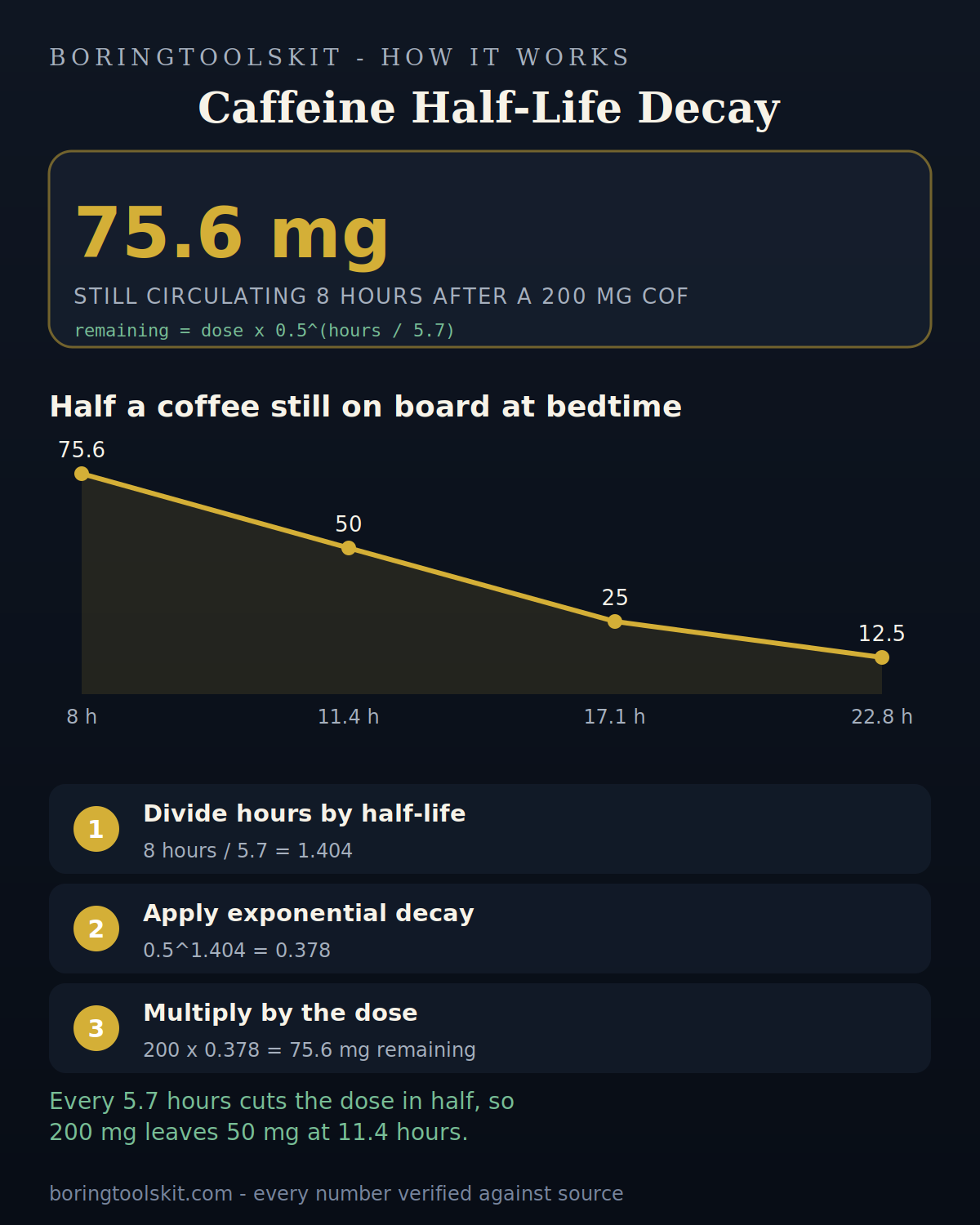
Caffeine remaining over four half-lives from 200 mg dose
A 200 mg dose drops to 75.6 mg after 8 hours.
Method & verification

How This Tool Works

fact-checked against our calculation methodology

Calculation Method

Computes Remaining from Caffeine dose and Hours since consumption.

Site methodology

No unrelated authority link is added merely to make this page look sourced. Tool-specific external sources are shown only when they directly support the method, rate, or rule.

Assumptions to Verify

  • These tools provide general estimates for planning and education only.
  • They are not medical advice and not a substitute for a qualified healthcare professional.
  • Always consult your doctor or another healthcare provider about your specific situation.

Privacy: The calculation runs in this browser. Shared links contain the page address only, not your inputs or results.

Worked example: a 200 mg dose, 8 hours later

Take a common case: one strong coffee, roughly 200 mg, at 2 pm, and you want to know what is still circulating at 10 pm. The formula is remaining = dose x 0.5^(hours / 5.7). Plug in 200 mg and 8 hours: 8 / 5.7 = 1.404, and 0.5^1.404 = 0.378. Multiply 200 x 0.378 and you get 75.6 mg, which is what the calculator returns.

The doubling down is easy to sanity-check by hand. Every 5.7 hours cuts the amount in half, so at 8 hours you are a bit past one half-life, and 75.6 mg is a bit under 100 mg. At 11.4 hours (two half-lives) exactly 50 mg remains, at 17.1 hours (three) 25 mg, and at 22.8 hours (four) 12.5 mg. That is why the evening coffee you had at 6 pm still leaves a quarter of the dose in your blood when you lie down near midnight.

Why your personal number may not be 5.7 hours

The 5.7 hour value is an adult average, and it moves a lot between people. Regular smokers clear caffeine in roughly 3 to 4 hours because smoking induces liver enzymes, while hormonal contraceptives can stretch the half-life to 8 hours or more. Pregnancy is the biggest shift: by the third trimester the half-life can exceed 15 hours, so a 200 mg morning coffee may still have over 100 mg on board at bedtime.

This also means the model is a population curve, not a clock for your body. It assumes a single dose absorbed at one moment, when in reality a large mug sipped over an hour behaves like several staggered doses, keeping early evening levels higher than the single-point calculation suggests. Tolerance does not speed clearance either; a daily espresso drinker has the same average half-life as a once-a-week drinker, they just feel it less. If you are sensitive, small doses late in the day beat the math: 100 mg at 3 pm leaves about 50 mg at 8:40 pm, which many light sleepers still notice.