1031 Exchange Calculator

1031 exchange calculator: estimate deferred capital gains tax, boot and replacement property value for like-kind exchanges. Free, runs in your browser.

Updates automatically as you type.

Calculated in your browser; your inputs are not sent to us. Privacy

Results will appear here.
Calculation details
Every figure above is calculated locally in your browser from the assumptions shown. No inputs are sent anywhere. See the methodology section below for the formulas used.
Use this resultShare the current inputs, or ask ChatGPT to explain the calculation in context.
Ask an AI to explain this result
Share this result

Review the generated output before relying on it.

This tool runs in your browser. Your calculator inputs and results are never transmitted to us or to ad/affiliate partners. Ads and sponsored links may set third-party cookies to serve and measure them, but they never receive your calculation values. If you explicitly save a scenario, its permitted fields stay in local browser storage until you clear them. See our Privacy Policy.

Use this result

Share the current inputs or ask ChatGPT to explain the calculation in context.

More options
Report a calculation issue
Direct answer

What does this calculator estimate?

Sell a $500,000 rental with a $300,000 basis and reinvest all $500,000 into a $550,000 replacement, and the entire $200,000 gain defers: $40,000 of tax postponed at a 20% rate. Cash taken out (boot) is taxed now, proportionally. Model your swap in the BoringToolsKit 1031 exchange calculator.

  • A 1031 exchange defers capital gains tax on investment property sold and replaced with like-kind property. (Source: IRS)
  • Cash or debt reduction received in the exchange is boot and is taxed immediately. (Source: IRS)
  • Identification (45 days) and closing (180 days) deadlines are strict. (Source: IRS)
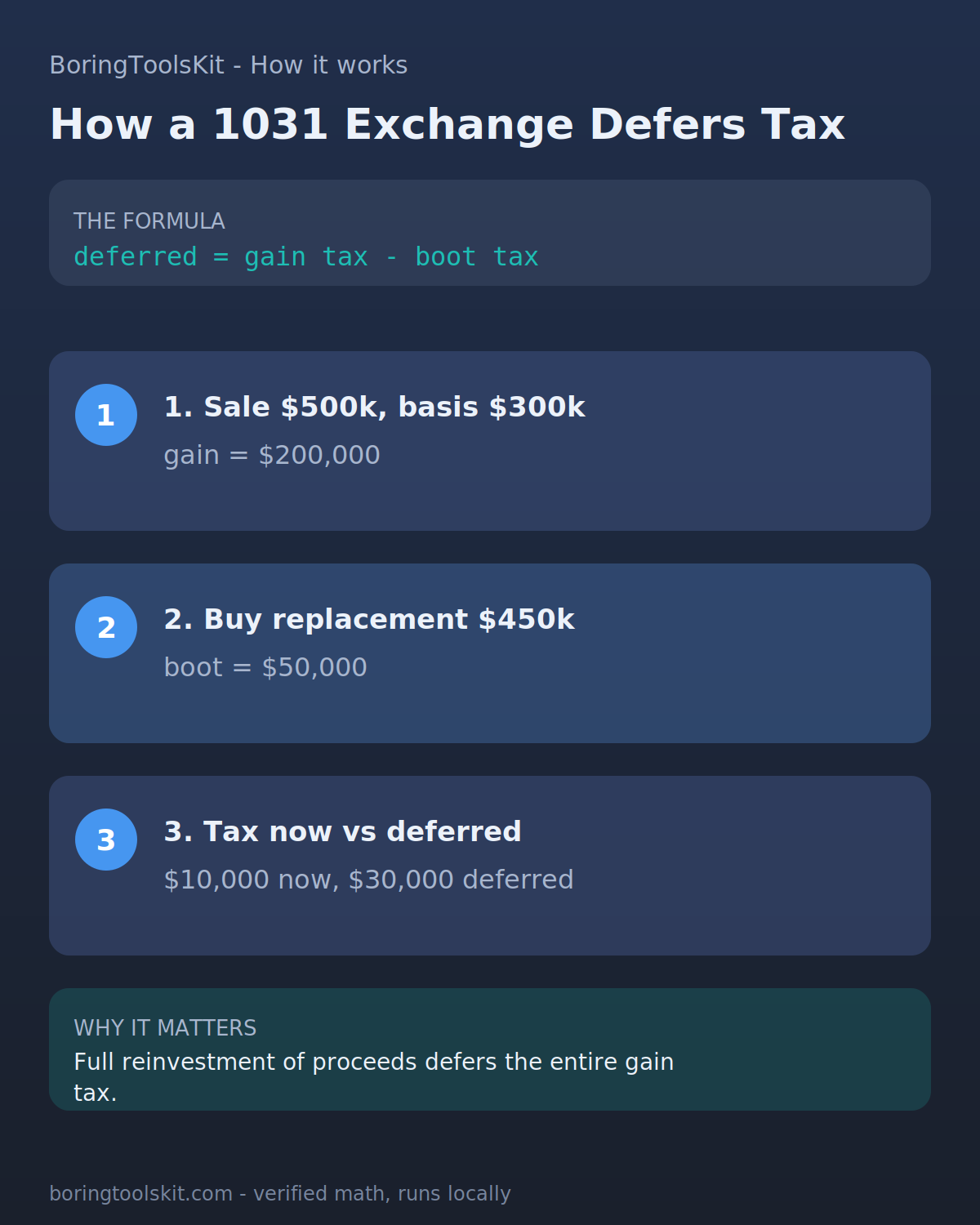
How a 1031 exchange defers capital gains tax
The $500k example: $40,000 of tax fully deferred on reinvestment.
Tax due now at three replacement price scenarios
A $20,000 shortfall taxes only $4,000 of a $30,000 bill.
Transparent methodology

How this calculator works

fact-checked against IRS

Formula

Gain = sale price - adjusted basis; tax deferred = gain x (1 - boot / realized gain); taxable boot is the portion of gain received in cash or property.

Worked example

Selling a $500,000 property with a $300,000 basis and reinvesting in a $550,000 replacement defers the full $200,000 gain: $40,000 of tax deferred at a 20% rate.

Assumptions to verify

  • The replacement property is qualifying like-kind real property.
  • Closing costs, depreciation recapture, and state taxes are not modeled.

Frequently asked questions

What counts as boot in a 1031 exchange?

Cash or debt reduction received in the swap; it is taxed immediately, proportionally to your gain.

How long do I have to complete a 1031 exchange?

Identify the replacement within 45 days and close within 180 days of the sale.

Cite this tool

BoringToolsKit. “1031 Exchange Calculator.” boringtoolskit.com/1031-exchange-calculator/. Free to reference in articles, syllabi, and answer posts with a link.

Privacy: Inputs and results stay in this browser. Any future sponsored recommendation or advertisement will be clearly labeled and kept separate from the calculation.

$500k sale, fully reinvested

Deferred tax$42,750.00Tax if no exchange$42,750.00

What this means for your numbers: Fully reinvested, the worked example defers $42,750. Reinvested for 20 years at 5%, that deferral compounds to ~$113,400 of extra working capital. The deferral IS the return.

Illustrative breakdown using the worked example above. The calculator computes your own numbers with the same formula.

Worked example: a 20 percent rate with partial boot

Say you sell a rental for $400,000 with an adjusted basis of $250,000, buy a replacement for $380,000, and use a 20 percent rate. Gain is $400,000 minus $250,000, or $150,000. Boot is what you kept: $400,000 minus $380,000, or $20,000 in cash.

Total tax if you had paid now would be $150,000 x 0.20 = $30,000. The taxable fraction is boot divided by gain: $20,000 / $150,000 = 0.1333. Tax due now is $30,000 x 0.1333 = $4,000, so the calculator shows $26,000 deferred. The fraction matters: if the replacement were $400,000, boot is zero, the fraction is 0, and all $30,000 defers. If the replacement were $350,000, boot is $50,000, the fraction is 0.3333, and $10,000 is taxable this year.

Notice the ratio, not the dollar amount, drives the split. A $10,000 shortfall on a $150,000 gain taxes only about $2,000 now, while the same $10,000 shortfall on a $30,000 gain taxes $10,000, because boot can never exceed the whole gain in the ratio.

Where the real numbers drift from this estimate

The single biggest gap is depreciation recapture. If you claimed $60,000 of depreciation over the years, that portion of gain is taxed at up to 25 percent when you eventually sell, not at your 20 percent rate. On the example above, roughly $8,000 more tax sits inside the deferral than the headline rate suggests. State income tax adds another layer: California at 9.3 percent on a $150,000 gain is another $13,950 eventually owed, none of it deferred by a federal 1031.

The federal 3.8 percent net investment income tax also applies above $200,000 single / $250,000 joint modified AGI, which the flat rate input cannot capture. And a mortgage matters: paying off a $120,000 loan and taking less new debt counts as boot even with no cash in hand. If your new loan is $100,000, the $20,000 debt reduction is taxable boot just like cash.

Timing is hard-edged too: 45 days to identify the replacement and 180 days to close, counted from the sale date. Missing either window converts the entire exchange into a fully taxable sale, which on a $150,000 gain at 20 percent means $30,000 plus recapture due that April instead of years later.