Updates automatically as you type.
Calculated in your browser; your inputs are not sent to us. Privacy
Calculation details
Planning estimate only, not financial, tax, or legal advice. Verify assumptions and current rules before making decisions.
This tool runs in your browser. Your calculator inputs and results are never transmitted to us or to ad/affiliate partners. Ads and sponsored links may set third-party cookies to serve and measure them, but they never receive your calculation values. If you explicitly save a scenario, its permitted fields stay in local browser storage until you clear them. See our Privacy Policy.
Use this result
Share the current inputs or ask ChatGPT to explain the calculation in context.
More options
What does this calculator estimate?
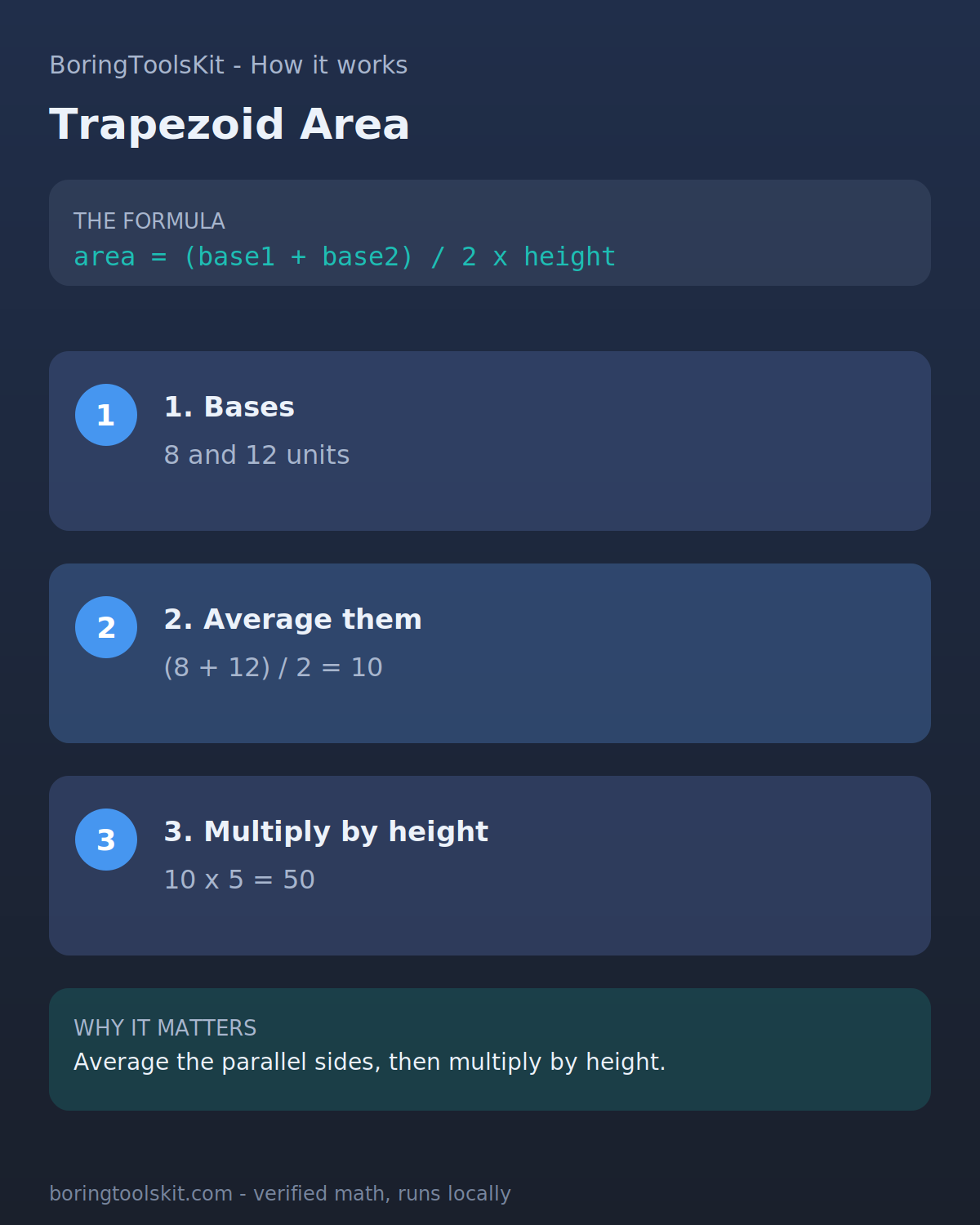
A trapezoid with parallel bases of 8 and 12 and a height of 5 has an area of (8 + 12) / 2 x 5 = 50 square units. Average the bases, multiply by height. Enter any bases and height in the BoringToolsKit trapezoid area calculator.
- The formula averages the two parallel sides, then multiplies by height. (Source: BoringToolsKit calculation methodology)
- A trapezoid with equal bases is a parallelogram: base x height. (Source: BoringToolsKit calculation methodology)
- Doubling the height doubles the area; the bases work the same way. (Source: BoringToolsKit calculation methodology)
How this calculator works
Formula
Area = (base1 + base2) / 2 x height.
Worked example
A trapezoid with bases of 8 and 12 and a height of 5 has an area of 50 square units.
Assumptions to verify
- The two bases are parallel.
- Height is the perpendicular distance between the bases.
Frequently asked questions
What if I only know the legs, not the height?
Use the Pythagorean theorem on the leg and the base offset to find the perpendicular height first.
Do the bases have to be parallel?
Yes. Without a parallel pair the shape is a general quadrilateral, not a trapezoid.
Cite this tool
BoringToolsKit. “Trapezoid Area Calculator.” boringtoolskit.com/trapezoid-area-calculator/. Free to reference in articles, syllabi, and answer posts with a link.
Privacy: Inputs and results stay in this browser. Any future sponsored recommendation or advertisement will be clearly labeled and kept separate from the calculation.
Why averaging the bases works, worked with real numbers
Take a trapezoid, duplicate it, rotate the copy 180 degrees, and join the two along one non-parallel leg. The two pieces form a parallelogram whose base is the sum of the original bases (a + b) and whose height is still h. That parallelogram has area (a + b) x h, and it is exactly two copies of the trapezoid, so one trapezoid is half of it: (a + b) / 2 x h. The same idea shows up as the midsegment: a line joining the midpoints of the legs has length (a + b) / 2, and the trapezoid's area equals that midsegment length times the height, which is the same as a rectangle of that width.
Worked example: b1 = 8, b2 = 4, h = 5. Step 1, add the bases: 8 + 4 = 12. Step 2, divide by 2: 12 / 2 = 6 (the midsegment). Step 3, multiply by the height: 6 x 5 = 30. The page reports Area 30.00 with the summary (8.0+4.0)/2 x 5. Two sanity checks on the same numbers: set b1 = b2 = 6 with h = 5 and you get 6 x 5 = 30, the plain rectangle case; set b1 = 8 and b2 = 4 with h = 5 again and rotating the duplicate confirms 12 x 5 = 60 for the pair, half of it 30. The average of the bases is always halfway between them, so a trapezoid always beats the smaller base times height and always loses to the larger one times height.
Boundary cases the formula handles but this calculator rejects
The formula itself is defined at zero and below, but the calculator gates on b1 > 0, b2 > 0, and h > 0, so several mathematically valid inputs return the Check the inputs message instead of a number. With b1 = 0, b2 = 6, h = 5 the true area is 15 (a triangle), yet a zero base is blocked. With b1 = -3, b2 = 7, h = 4 the raw formula would evaluate to (-3+7)/2 x 4 = 8, but negatives are rejected, so a signed or offset measurement must be converted to a positive length before entry. Empty or non-numeric text becomes 0 through the numeric conversion and is rejected the same way.
Rounding is the other limit. The area is printed with toFixed(2) and the inputs are echoed with toFixed(1), so tiny values collapse: b1 = 0.1, b2 = 0.1, h = 0.04 gives 0.004, displayed as 0.00, and the summary shows the height as 0.0, which hides what was typed. Large values carry no thousands separator: 1000000 and 1000000 with h = 1 prints 1000000.00. Units must match or the result is silently wrong: 120 cm and 80 cm with h = 50 cm gives 5000 cm2 (0.5 m2), while mixing 1.2 m with 80 cm computes (1.2+80)/2 = 40.6 of nothing useful. Convert everything to one unit first.