Updates automatically as you type.
Calculated in your browser; your inputs are not sent to us. Privacy
Calculation details
Planning estimate only, not financial, tax, or legal advice. Verify assumptions and current rules before making decisions.
This tool runs in your browser. Your calculator inputs and results are never transmitted to us or to ad/affiliate partners. Ads and sponsored links may set third-party cookies to serve and measure them, but they never receive your calculation values. If you explicitly save a scenario, its permitted fields stay in local browser storage until you clear them. See our Privacy Policy.
Use this result
Share the current inputs or ask ChatGPT to explain the calculation in context.
More options
What does this calculator estimate?
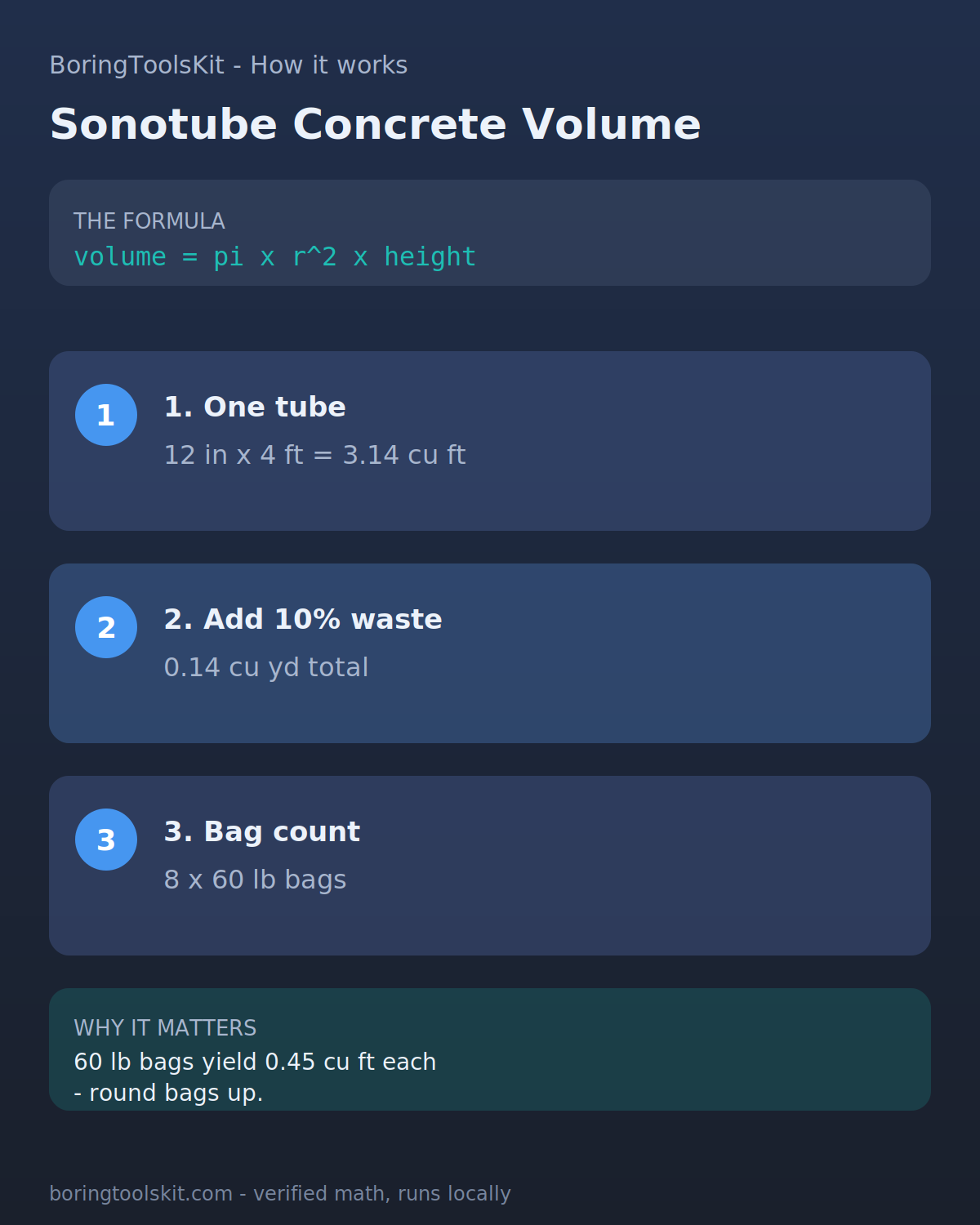
One 12-inch diameter, 4-foot tall sonotube holds about 3.14 cubic feet, or 0.128 cubic yards, of concrete. With 10% waste that is 8 bags of 60 lb mix or 6 bags of 80 lb. Enter diameter, height, and tube count in the BoringToolsKit sonotube calculator for your bag count.
- A 12 in x 4 ft column is 3.14 cubic feet: pi x radius squared x height. (Source: BoringToolsKit calculation methodology)
- One 60 lb bag of concrete mix yields about 0.45 cubic feet. (Source: BoringToolsKit calculation methodology)
- Always add about 10% waste for spillage and uneven hole bottoms. (Source: BoringToolsKit calculation methodology)
How this calculator works
Formula
Volume per tube (cu ft) = pi x (diameter/2/12)^2 x height (ft); bags = total volume x 1.10 / yield per bag.
Worked example
A 12 in x 4 ft sonotube holds pi x 0.5 ft squared x 4 ft = 3.14 cubic feet. With 10% waste that is 3.45 cu ft, which is 8 bags of 60 lb mix or 6 bags of 80 lb mix (QUIKRETE yields 0.45 and 0.60 cubic feet per bag).
Frequently asked questions
What is a sonotube concrete calculator and how does it work?
A sonotube concrete calculator is a browser-based tool that estimates the volume of concrete needed for cylindrical Sonotube forms. You enter the tube diameter, depth, and number of tubes, and it instantly calculates the cubic yards or feet of concrete required, no signup or download needed.
Do I need to create an account or sign up to use the sonotube concrete calculator?
No. This is a completely no-signup, browser-based tool. You can use it immediately in your web browser with no registration, no email, and no personal data collected.
How accurate are the results from the sonotube concrete calculator?
The calculator provides estimates based on standard cylindrical volume formulas using your input dimensions. It's a helpful planning tool, but always confirm with your concrete supplier and account for waste or over-excavation when ordering actual materials.
How much concrete do I need for a sonotube?
It depends on the diameter and height: volume equals pi times the radius squared times the height. A 12 inch diameter tube 4 feet tall needs about 3.14 cubic feet, or about 3.45 cubic feet once you add the recommended 10% waste allowance (roughly 8 bags of 60 lb mix).
How much concrete for an 18 inch sonotube?
An 18 inch diameter tube 4 feet tall holds about 7.07 cubic feet; budget about 7.8 cubic feet with 10% waste, which is about 18 bags of 60 lb mix or 13 bags of 80 lb mix at QUIKRETE yields of 0.45 and 0.60 cubic feet per bag.
Cite this tool
BoringToolsKit. “Sonotube Concrete Calculator.” boringtoolskit.com/sonotube-concrete-column/. Free to reference in articles, syllabi, and answer posts with a link.
Privacy: Inputs and results stay in this browser. Any future sponsored recommendation or advertisement will be clearly labeled and kept separate from the calculation.