Sodium Calculator

Sodium calculator: total sodium and salt intake from serving sizes and milligrams per serving, checked against daily limits. Free, private, runs in your browser.

Updates automatically as you type.

Calculated in your browser; your inputs are not sent to us. Privacy

Results will appear here.

General estimate for planning only — not medical advice. Consult a doctor about your specific situation.

Calculation details
Every figure above is calculated locally in your browser from the assumptions shown. No inputs are sent anywhere. See the methodology section below for how this tool works.
Use this resultShare the current inputs, or ask ChatGPT to explain the calculation in context.
Ask an AI to explain this result
Share this result

Review the generated output before relying on it.

This tool runs in your browser. Your calculator inputs and results are never transmitted to us or to ad/affiliate partners. Ads and sponsored links may set third-party cookies to serve and measure them, but they never receive your calculation values. If you explicitly save a scenario, its permitted fields stay in local browser storage until you clear them. See our Privacy Policy.

Use this result

Share the current inputs or ask ChatGPT to explain the calculation in context.

More options
Report a calculation issue
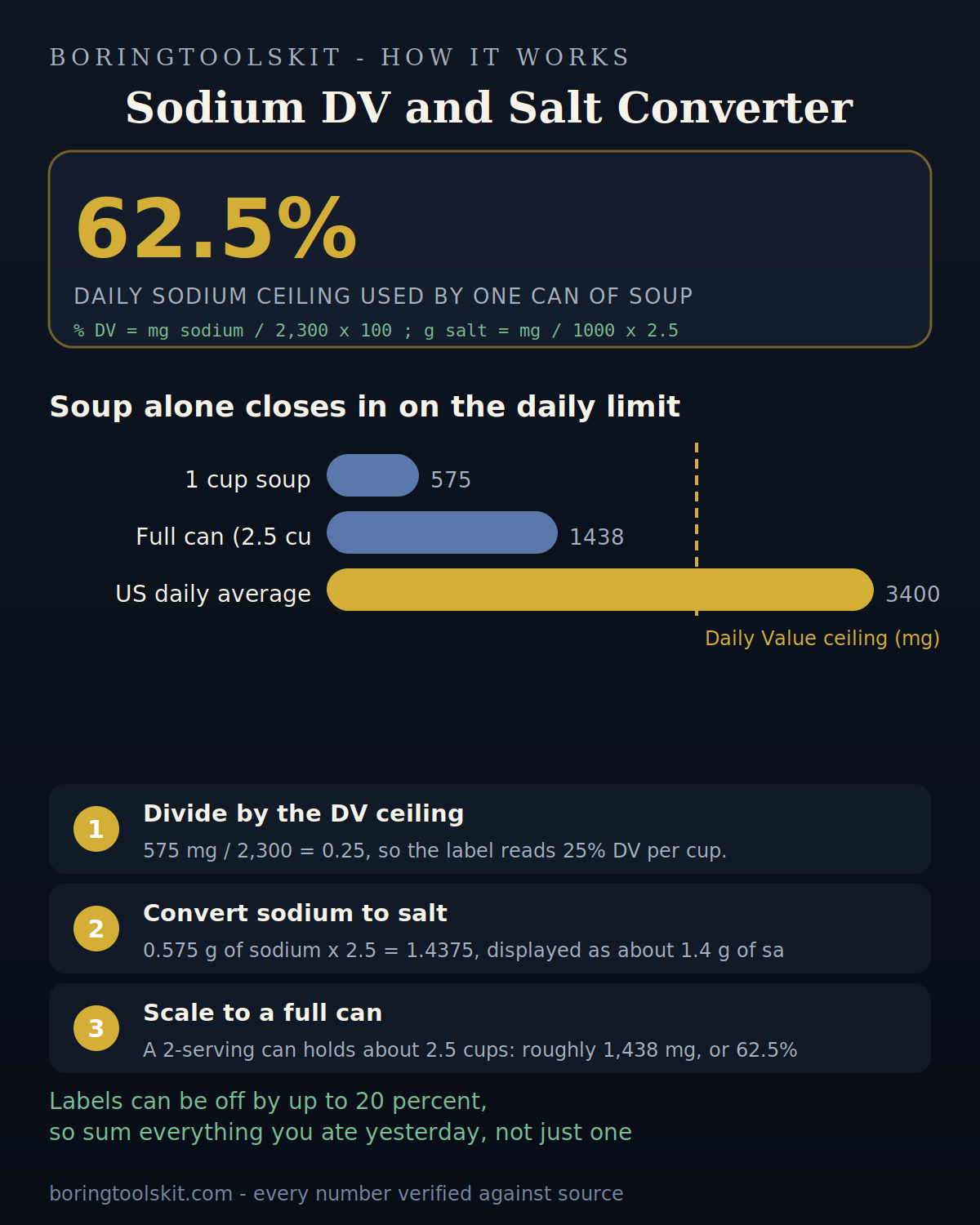
One can of soup hits 62.5% of the daily sodium ceiling
One full can of soup: 1,438 mg, or 62.5% of the ceiling.
Method & verification

How This Tool Works

fact-checked against our calculation methodology

Calculation Method

Reads Sodium and returns the result shown on this page.

Site methodology

No unrelated authority link is added merely to make this page look sourced. Tool-specific external sources are shown only when they directly support the method, rate, or rule.

Assumptions to Verify

  • These tools provide general estimates for planning and education only.
  • They are not medical advice and not a substitute for a qualified healthcare professional.
  • Always consult your doctor or another healthcare provider about your specific situation.

Privacy: The calculation runs in this browser. Shared links contain the page address only, not your inputs or results.

Worked Example: One Cup of Canned Soup

Suppose a nutrition label lists 575 mg of sodium per cup. The calculator divides 575 by 2,300, the Daily Value ceiling, and multiplies by 100: 575 / 2,300 = 0.25, so the result reads 25% DV. The salt conversion runs in the same call: 575 mg is 0.575 g of sodium, and sodium is multiplied by 2.5 to account for the chloride it is paired with in table salt, giving 0.575 x 2.5 = 1.4375, displayed as about 1.4 g of salt.

The same math shows why soup adds up fast. A typical 2-serving can holds about 2.5 cups, so finishing the can means roughly 1,438 mg of sodium, or 62.5% of the daily ceiling, from a single item before breakfast, bread, or a snack is counted. Checking 575 mg against 2,300 is a 15-second division you can do at the shelf: any label above 575 mg per serving is over 25% DV in one pour.

Where This Conversion Breaks Down

The 2.5 multiplier converts sodium to an equivalent mass of pure sodium chloride, but real salt is only about 97 to 99 percent NaCl, and many sodium sources are not salt at all. Baking soda contributes sodium without any chloride, and additives like sodium citrate or MSG in processed food carry sodium in other compounds. So the gram-of-salt figure is an approximation for comparison, not a measurement of salt shaker use. On a 2,300 mg diet the conversion implies about 5.75 g of salt, close to the WHO guidance of under 5 g, but the two figures should not be treated as interchangeable.

Labels also carry real tolerance. FDA compliance testing allows declared sodium to be off by up to 20 percent in either direction in packaged food, and restaurant items often have no published figure at all. Americans average roughly 3,400 mg per day, about 48% over the ceiling, and estimates attribute around 70% of intake to packaged and restaurant food rather than home cooking. That means the biggest use of this calculator is batch arithmetic: summing every item you ate yesterday, not checking a single label, because any one label can understate the day's total by hundreds of milligrams.