Sleep Debt Calculator

Sleep debt calculator: compare your actual nightly sleep against your personal sleep need over a week and see hours owed plus recovery time. Free, private.

Updates automatically as you type.

Calculated in your browser; your inputs are not sent to us. Privacy

Results will appear here.

General estimate for planning only — not medical advice. Consult a doctor about your specific situation.

Calculation details
Every figure above is calculated locally in your browser from the assumptions shown. No inputs are sent anywhere. See the methodology section below for the formulas used.
Use this resultShare the current inputs, or ask ChatGPT to explain the calculation in context.
Ask an AI to explain this result
Share this result

Review the generated output before relying on it.

This tool runs in your browser. Your calculator inputs and results are never transmitted to us or to ad/affiliate partners. Ads and sponsored links may set third-party cookies to serve and measure them, but they never receive your calculation values. If you explicitly save a scenario, its permitted fields stay in local browser storage until you clear them. See our Privacy Policy.

Use this result

Share the current inputs or ask ChatGPT to explain the calculation in context.

More options
Report a calculation issue
Chart of five nightly sleep totals against an 8.0 hour target
Five short nights build 6.5 hours of sleep debt.
Method & verification

How This Tool Works

fact-checked against our calculation methodology

Calculation Method

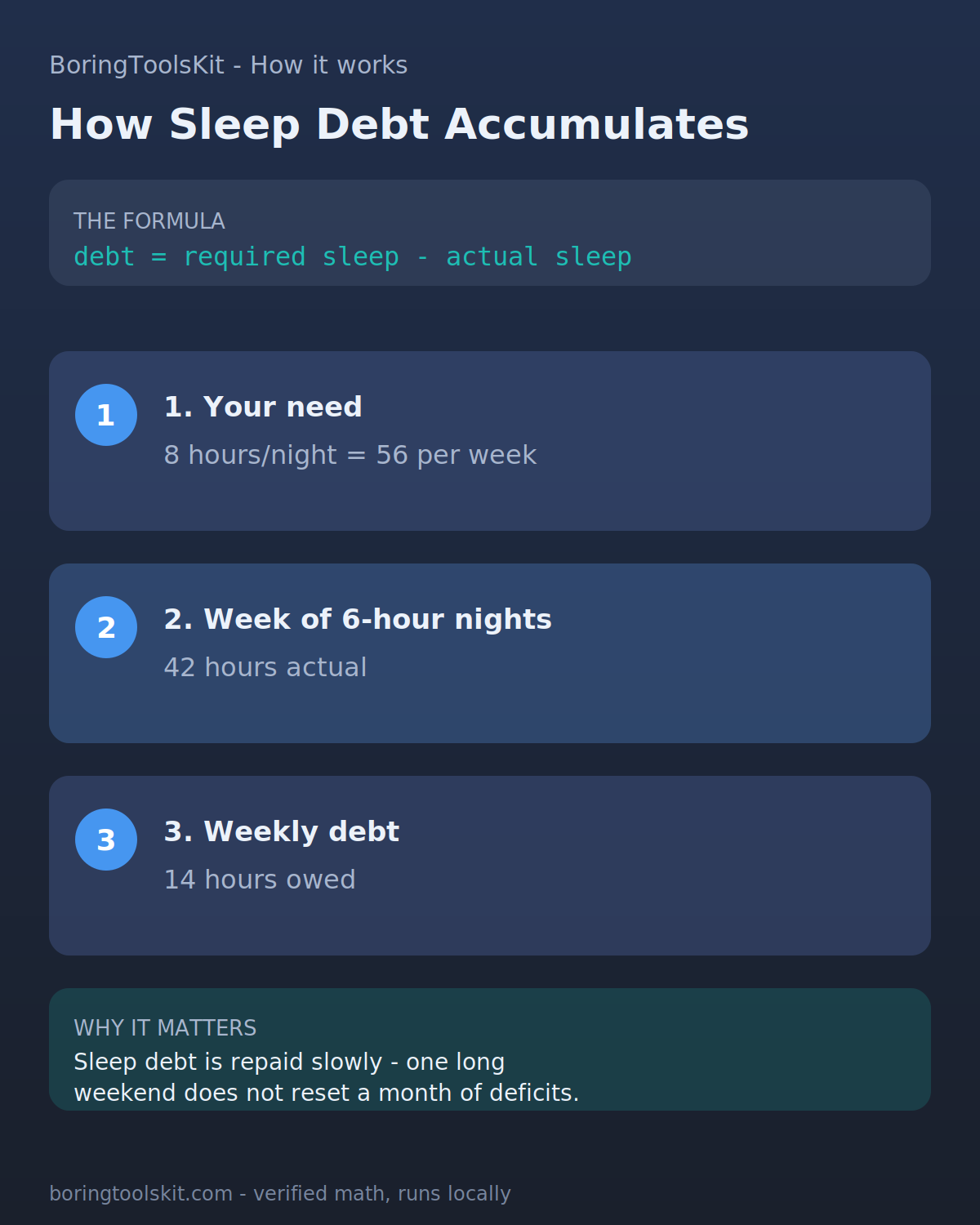
Sleep debt = (Target hours per night - Actual average hours) × Days tracked

Site methodology

No unrelated authority link is added merely to make this page look sourced. Tool-specific external sources are shown only when they directly support the method, rate, or rule.

Assumptions to Verify

  • These tools provide general estimates for planning and education only.
  • They are not medical advice and not a substitute for a qualified healthcare professional.
  • Always consult your doctor or another healthcare provider about your specific situation.

Privacy: The calculation runs in this browser. Shared links contain the page address only, not your inputs or results.

Worked example: five short nights

Say your target is 8.0 hours and over the last 5 nights you slept 6.5, 7.0, 6.0, 7.5, and 6.5 hours. The average is (6.5 + 7.0 + 6.0 + 7.5 + 6.5) / 5 = 33.5 / 5 = 6.7 hours. Enter target 8, actual 6.7, days 5.

The nightly gap is 8.0 - 6.7 = 1.3 hours, so the debt is 1.3 x 5 = 6.5 hours. At a recovery pace of 30 minutes (0.5 hours) per night, clearing it takes 6.5 / 0.5 = 13 nights, which the calculator rounds up to 2 weeks. If instead you averaged exactly 6.5 hours, the gap would be 1.5 hours and the debt 7.5 hours: 15 nights, rounded to 3 weeks. That 0.2-hour average difference costs 2 extra nights of catch-up, which is why small nightly slips compound faster than they feel.

The same arithmetic runs in reverse. Average 8.5 hours against an 8.0 target for 5 days and you carry 2.5 hours of surplus, which the tool reports as a negative debt rather than a reason to undersleep later.

Limits the formula does not model

Debt is treated as fully recoverable at 0.5 hours per night, but a single 10-hour weekend sleep does not undo five 6-hour nights: studies on weekend recovery sleep show metabolic markers like insulin sensitivity do not fully reset. The 30-minute pace is a planning heuristic, not physiology.

Days is unbounded, so entering 365 with a 1-hour gap returns 365 hours of debt, but attention and mood deficits saturate long before that; the linear model overstates what a bad month means. The tool also assumes a fixed target: if your true need is 9 hours and you set 8, every 'balanced' week is quietly carrying 7 hours of weekly debt that the number never shows. Nailing your personal target, typically 7 to 9 hours for adults, matters more than the recovery schedule. Finally, sleep quality is invisible here: 8 hours of fragmented sleep and 8 hours of consolidated sleep score identically.