Calculated in your browser; your inputs are not sent to us. Privacy
Results update when you run the tool.
This tool processes the selected input in your browser. Review the output before relying on it; format and file behavior can vary by browser and source data.
Your inputs and results stay in this browser. This page may send privacy-bounded aggregate interaction events described in Privacy; it does not send your entered values or result contents.
Use this result
Share the current inputs or ask ChatGPT to explain the calculation in context.
More options
What does this converter do?
Ring size calculator: US ring size from finger circumference. Free ring size calculator with the formula shown - runs entirely in your browser, no signup.
- US size 7 = 17.35 mm inner diameter; EU size 54.4; UK size N-1/2.
- Fingers run smaller in cold weather and swell in heat or late in the day — measure at room temperature, end of day.
- Wider bands (6 mm+) need a quarter to half size up from a 2 mm band on the same finger.
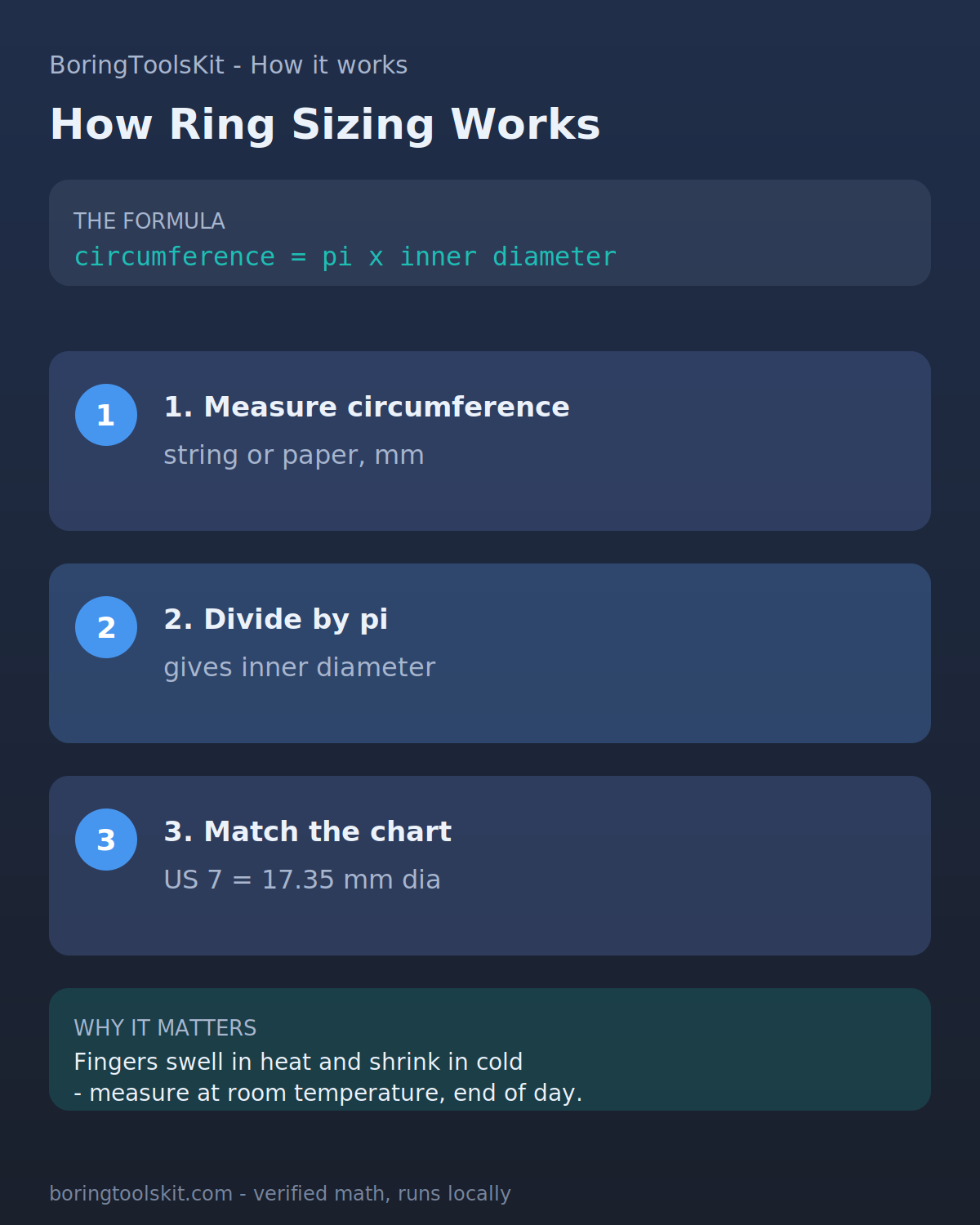
How this calculator works
Formula
Circumference C = pi x d; US ring sizes step ~0.81 mm in inner diameter (full sizes), roughly 0.4 mm at half sizes. US size 7 is 17.35 mm inner diameter / 54.4 mm inside circumference; EU sizes read the inside circumference in millimeters directly.
Sources
Sources support the method, terminology, or planning context. Editable assumptions remain your responsibility.
Assumptions to verify
- Manufacturer charts vary; conversion outputs are the standard-mapping midpoint.
- Measurements are body measurements unless the tool labels them as garment measurements.
- Between-size results round per the rule stated in the FAQ.
Frequently asked questions
Why does my ring size differ between jewelers?
Sizing is measured on tapered gauges that vary by maker, and comfort-fit interiors run a half size larger than flat interiors. Measure circumference and convert, rather than trusting a labeled gauge.
What if I fall between sizes?
Round the direction that matches use: clothing and shoes generally round up; ring sizes round down (a slightly loose ring still stays on; a tight one has to come off).
Cite this tool
BoringToolsKit. “Ring Size Calculator.” boringtoolskit.com/ring-size-calculator/ (reviewed 2026-09-20). Free to reference in articles, syllabi, and answer posts with a link.
Privacy: Inputs and results stay in this browser. Conversion runs locally in your browser; review the output before relying on it.
Worked example: from a ring you already own
Take a ring you already wear and lay it flat on a ruler marked in millimeters. Suppose you read the inside diameter as 18.1 mm. The circumference is diameter times pi: 18.1 x 3.14159 = 56.86 mm. The table in this calculator has size 8 at 57.0 mm and size 7 at 54.4 mm, so the distances are 0.14 mm and 2.46 mm. The nearest match wins and the result is US size 8.
You can go the other direction too. If you wrap a thin strip of paper around your finger and it measures 52.0 mm, the matching inside diameter is 52.0 / 3.14159 = 16.55 mm. The table puts size 6 at 51.9 mm (distance 0.1 mm) and size 7 at 54.4 mm (distance 2.4 mm), so the calculator returns US size 6. Note that 16.55 mm is also almost exactly the published diameter for size 6, which is why the nearest-circumference method and the diameter charts agree here.
The math only holds when you measure the right thing. The circumference column assumes the inner edge of the ring, not the outer edge. A band 1.5 mm thick reads about 3 mm larger around the outside than the inside; an outside reading of 60.0 mm on a 1.5 mm band corresponds to roughly a 57.0 mm inside circumference, still size 8, but a careless outside reading on a chunky 3 mm band can shift the answer a full size.
Limits and edge behavior of this calculator
The input guard rejects anything outside 40 to 70 mm. A reading of 39.9 mm, or a typo like 400, returns the check-the-input message instead of a size. At the low edge of the valid range, 40.0 mm is nearest to size 3 (44.1 mm, distance 4.1 mm), so it returns size 3 even though it is well below any standard US ring; treat that as a signal your measurement is off, since adult little fingers rarely measure under 44 mm. At the top edge, 70.0 mm sits 0.3 mm from size 13 (69.7 mm), so 70.0 returns size 13, but anything much above 69.7 mm is likely an outside-diameter mistake rather than a huge finger.
The table stops at size 13 because US sizes above 13 (about 70 mm and up) exist but are rarely stocked, and a nearest-neighbor match over a truncated table can silently round a real 13.5 down to 13. If your measurement is within 1 mm of 69.7 mm, confirm with a jeweler rather than trusting the single integer.
Smallest table gap is 2.55 mm between sizes, so measurements always land within 1.3 mm of some size; a midpoint reading like 55.7 mm (1.3 mm from size 7, 1.3 mm from size 8) is a genuine tie zone and finger flexibility at different times of day can flip it. Wider bands (6 mm and up) also fit tighter than the narrow-band sizing the table implies, so many jewelers recommend going a half size up for wide bands, which this single-number result cannot express.