Renting the right truck size saves you a second trip or a wasted big-truck rental. This matches your home's room count to the truck that fits.
Direct answer
What does this tool do?
Moving Truck Size Calculator computes the result directly in your browser — Renting the right truck size saves you a second trip or a wasted big-truck rental. This matches your home's room count to the truck that fits. Nothing you enter is uploaded or stored.
Rule of thumb (example sizes): studio/1-bed = 10-ft (402 cu ft); 2-bed = 14-ft (767 cu ft); 3-bed = 16-ft (899); 3-4 bed = 20-ft (1,010); 4-5 bed = 24-ft (1,452); 5+ = 26-ft (1,671). Gotchas: boxed vs loose items matter — a house full of packed boxes fills a bigger truck than the room count suggests. Safety: never overload the truck's rated capacity; an overloaded rental is a hazard and voids the rental agreement. These are general guides; your mover or rental company can size by inventory list.
How this calculator works
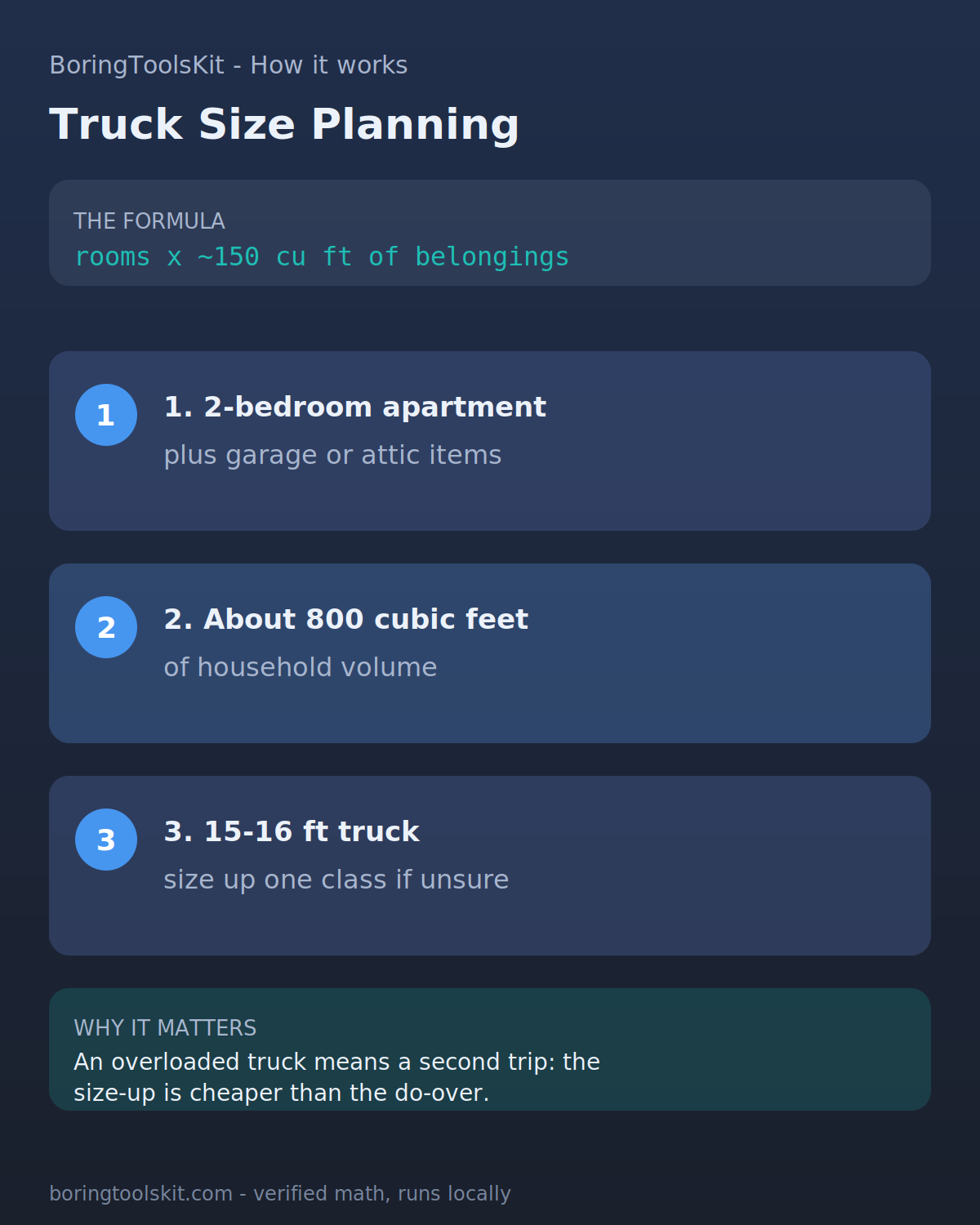
Truck capacity in cubic feet vs household volume: rooms x ~150 cu ft of belongings is the common planning factor, plus attic/garage overflow.
Worked example
A 2-bedroom apartment typically plans to a 15-16 ft truck (about 800 cu ft); a 3-bedroom house to a 20 ft truck (about 1,000+ cu ft).
Size up one class if you have a garage, attic, or dense furniture; an overloaded truck costs a second trip.
FAQ
How do I know which moving truck size I need?
Room count is the fastest proxy: a studio fits a 10-ft truck, a 2-bed a 14-ft, a 3-bed a 16-ft, and a 4-5 bed a 20-24-ft. If you've packed everything in boxes, count the volume and compare to the truck's cubic feet.
What if I overpack the recommended size?
Better to rent one size up if you're borderline — a second trip costs more than a larger truck. Heavy items like pianos and safes need specialty movers regardless of truck size.
Do I need a moving truck for a one-bedroom?
A cargo van or 10-ft truck usually suffices for a studio or one-bedroom. If you have large furniture, step up to a 14-ft to be safe.
Figures are editable example defaults for modeling, not quotes or advice. Financial, tax, and medical outcomes vary with your situation — verify with a qualified professional (CFP, CPA, tax advisor, or veterinarian).
Use this result
Share the current inputs or ask ChatGPT to explain the calculation in context.
From boxes and furniture to cubic feet: a full derivation
Estimate a 1-bedroom move with boxes only first. Say you pack 20 medium boxes (3 cu ft each) and 10 large boxes (4.5 cu ft each). Boxes: 20 x 3 = 60 cu ft, plus 10 x 4.5 = 45 cu ft, for 105 cu ft total.
Now add furniture as loose volume: a queen mattress and box (about 25 cu ft with frame), a sofa (50 cu ft), a dresser (20 cu ft), a desk (15 cu ft), a dining table with 4 chairs (30 cu ft), and an appliance like a washer (25 cu ft). Furniture subtotal: 25 + 50 + 20 + 15 + 30 + 25 = 165 cu ft.
Combined load: 105 + 165 = 270 cu ft. Trucks carry loose, air-gapped loads, so multiply by a packing efficiency factor of about 1.5 to 2: 270 x 1.5 = 405 cu ft effective demand. A 10-ft truck is rated near 400 cu ft, so this load sits exactly at the line. The rule of thumb says size up when borderline, so the 14-ft (about 700 cu ft) is the defensible choice, leaving roughly 295 cu ft of slack for stairs, awkward angles, and the boxes you forgot to count.
Where the estimate breaks: real loading practice
Rated capacity assumes a full rectangular fill, which never happens. A 26-ft truck at about 1,600 cu ft can feel full at 70 percent because wheel wells, door frame taper, and tie-down straps eat floor space; 1,600 x 0.7 = 1,120 cu ft usable in practice.
Weight is a separate limit. U-Haul's 20-ft truck has a payload around 5,600 lbs, and a fully loaded 3-bedroom move often runs 4,000 to 7,000 lbs. A load of books alone is brutal: 1 cu ft of packed books weighs 40 to 55 lbs, so 50 book boxes at 3 cu ft can hit 6,000 to 8,250 lbs and exceed payload even with visible floor space left.
Two more edges: appliances on dollies need straight runs, so a 3-foot hallway turn effectively removes about 10 sq ft of working area per maneuver; and attic or basement storage adds 50 to 150 cu ft that owners routinely undercount by half. If your computed demand lands within 20 percent of a truck's rating, rent the next size. A second trip typically costs the daily rate a second time, often 50 to 150 dollars more than the size-up fee.