Calculation details
Review the generated output before relying on it.
This tool runs in your browser. Your calculator inputs and results are never transmitted to us or to ad/affiliate partners. Ads and sponsored links may set third-party cookies to serve and measure them, but they never receive your calculation values. If you explicitly save a scenario, its permitted fields stay in local browser storage until you clear them. See our Privacy Policy.
Use this result
Share the current inputs or ask ChatGPT to explain the calculation in context.
What does this calculator estimate?
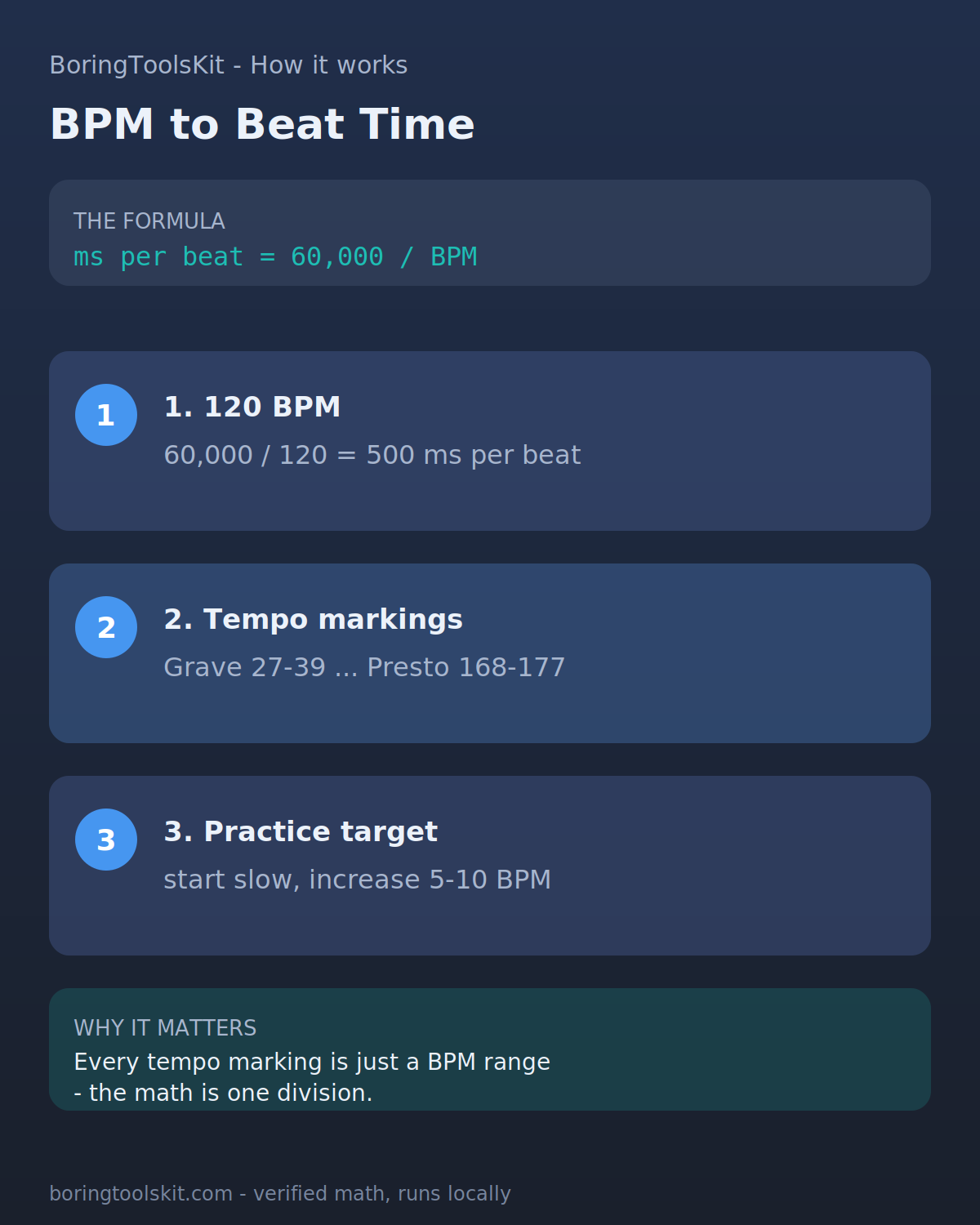
A 120 BPM metronome clicks every 500 ms (60,000 / 120). A Moderato marking corresponds to roughly 92-114 BPM.
- Click interval (ms) = 60,000 / BPM.
- 60 BPM clicks once per second; 120 BPM twice per second.
- Italian tempo marks are ranges: Largo ~40-60, Moderato ~92-114, Presto ~168-200.
How tempo marks map to BPM
Italian tempo terms describe speed ranges, not exact numbers — andante walks (≈92 BPM), allegro is lively (≈138 BPM), presto is fast (≈188 BPM). Knowing the mapping helps interpret sheet music and choose practice tempos.
Limitations to watch for
Tempo marks are approximations — composers use them with modifiers (allegro molto, allegro moderato) that shift the range. Metronome markings (♩ = 120) are exact; the Italian term is context.
How to use it in practice
Set the BPM from the metronome mark, or start at the middle of the tempo-mark range and adjust to comfort. Practice at 60–80% of performance tempo, then work up. Use the click track to lock your timing.
['Enter a BPM (or pick a tempo mark).', 'The tool identifies the tempo name and beat duration.', 'Play the click at your chosen tempo to practice.']
How this calculator works
Formula
Tempo marks map BPM ranges to Italian terms: larghissimo 25, grave 33, largo 50, larghetto 63, adagio 71, andante 92, moderato 114, allegro 138, vivace 166, presto 188, prestissimo 208. The tool matches your BPM and can play the beat.
Worked example
120 BPM falls between moderato (114) and allegro (138) — a brisk, comfortable tempo for practice.
Assumptions to verify
- Standard Italian tempo terminology is used.
- BPM refers to quarter-note beats.
- The tempo mark ranges are the common conventions.
Frequently asked questions
What do Italian tempo marks mean?
They describe speed: larghissimo ~25, grave ~33, largo ~50, adagio ~71, andante ~92, moderato ~114, allegro ~138, vivace ~166, presto ~188, prestissimo ~208 BPM.
What BPM is andante?
About 92 BPM — 'at a walking pace'. Allegro is about 138, presto about 188.
What tempo is 120 BPM?
Between moderato (114) and allegro (138) — a brisk but manageable practice tempo.
Are tempo marks exact?
No — they're ranges, and modifiers (allegro molto, più mosso) shift them. Metronome marks (♩ = 120) are exact.
How do I use a metronome effectively?
Start at 60–80% of your target tempo, play accurately, then increase in small steps (5 BPM).
What does BPM mean?
Beats per minute — the quarter-note pulse rate. 120 BPM = 2 beats per second.
Why is tempo important?
It sets the character of the music and trains consistent timing — the foundation of rhythm.
Cite this tool
BoringToolsKit. “Metronome BPM Calculator.” boringtoolskit.com/metronome-bpm-calculator/ (reviewed 2026-08-25). Free to reference in articles, syllabi, and answer posts with a link.
Privacy: Inputs and results stay in this browser. Any future sponsored recommendation or advertisement will be clearly labeled and kept separate from the calculation.