Metabolic Age Calculator

Metabolic age calculator: compare your BMR to age-based averages to estimate your body's metabolic age. Free, runs locally in your browser, no signup.

Updates automatically as you type.

Calculated in your browser; your inputs are not sent to us. Privacy

Results will appear here.

General estimate for planning only — not medical advice. Consult a doctor about your specific situation.

Calculation details
Every figure above is calculated locally in your browser from the assumptions shown. No inputs are sent anywhere. See the methodology section below for how this tool works.
Use this resultShare the current inputs, or ask ChatGPT to explain the calculation in context.
Ask an AI to explain this result
Share this result

Review the generated output before relying on it.

This tool runs in your browser. Your calculator inputs and results are never transmitted to us or to ad/affiliate partners. Ads and sponsored links may set third-party cookies to serve and measure them, but they never receive your calculation values. If you explicitly save a scenario, its permitted fields stay in local browser storage until you clear them. See our Privacy Policy.

Use this result

Share the current inputs or ask ChatGPT to explain the calculation in context.

More options
Report a calculation issue
Metabolic age calculation showing BMR 1767.5 versus age-table average 1630
BMR 1767.5 vs the 1630 age-table row: an 11-year gap, metabolic age 29.
Method & verification

How This Tool Works

fact-checked against our calculation methodology

Calculation Method

Computes Metabolic age from Age, Height, Weight and Gender.

Site methodology

No unrelated authority link is added merely to make this page look sourced. Tool-specific external sources are shown only when they directly support the method, rate, or rule.

Assumptions to Verify

  • These tools provide general estimates for planning and education only.
  • They are not medical advice and not a substitute for a qualified healthcare professional.
  • Always consult your doctor or another healthcare provider about your specific situation.

Privacy: The calculation runs in this browser. Shared links contain the page address only, not your inputs or results.

A Worked Example: 40-Year-Old Male, 178 cm, 85 kg

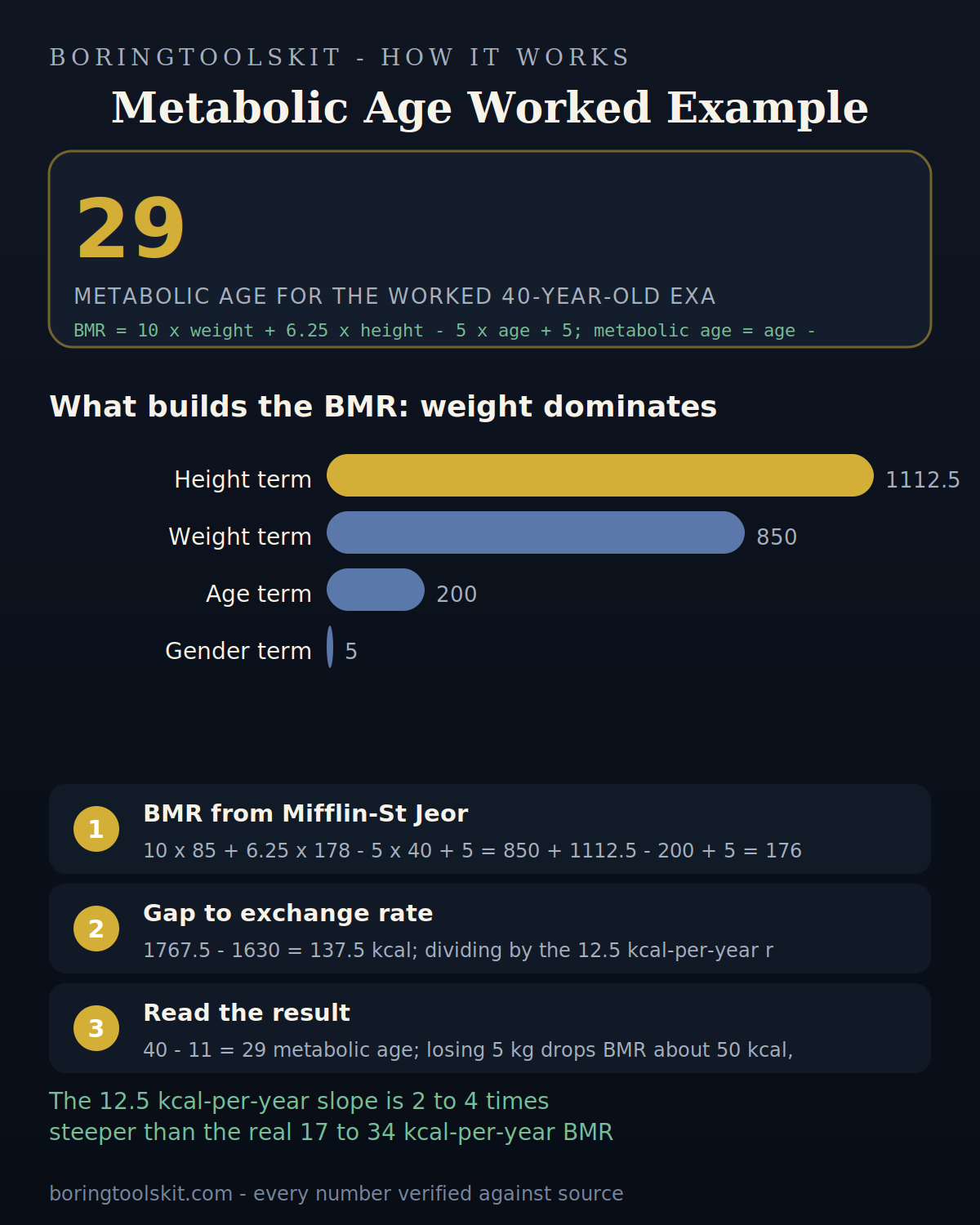
Start with the Mifflin-St Jeor BMR: 10 x 85 + 6.25 x 178 - 5 x 40 + 5. That is 850 + 1112.5 - 200 + 5, which gives 1767.5 kcal/day. The comparison baseline comes from the age table: a 40-year-old man maps to the 1630 kcal row, since 40 rounds to itself in the 5-year bands and the table tops out at age 70 for anyone older.

The gap is 1767.5 minus 1630, or 137.5 kcal. Dividing by the 12.5 kcal-per-year exchange rate converts that gap into 11 years. So the metabolic age reads 40 minus 11, which is 29. To push it the other way, losing 5 kg of fat at constant height drops the BMR by about 50 kcal, which shifts the result by 4 years: the same man at 80 kg would land at 33. Each 12.5 kcal of BMR is one year, so 25 kg of muscle gained slowly over a decade (adding roughly 250 kcal) would understate, not overstate, real metabolic improvement, because the model caps BMR movement at the age table's shape.

Where the Number Misleads

The 12.5 kcal-per-year slope is a modeling choice, not physiology. Real BMR declines roughly 1 to 2 percent per decade after 30, so for a 1700 kcal baseline that is only 17 to 34 kcal per year, meaning the calculator's exchange rate is about 2 to 4 times steeper than reality. A fit 55-year-old can show a metabolic age of 30 without any lab data backing that equivalence.

Edge cases also bite at the boundaries. A 19-year-old at 120 cm and 31 kg passes validation but the height-weight combo (BMI 21.5) sits on inputs the age table was never built for, since the table only spans ages 20 to 70 and everyone younger or older gets clamped to the edge row. Women get a flat 10 percent haircut off the male baseline, yet measured female BMR at the same age typically runs 5 to 10 percent lower than that shortcut implies. DEXA-derived muscle mass explains 60 to 70 percent of BMR variance in studies, which is why two people with identical calculator outputs can differ by 200 kcal in measured resting burn. Treat the output as a trend line for your own inputs, not a clinical age.