International Moving Cost Calculator
Moving overseas is priced by volume and method: shared or full sea container, or air freight. This estimates your cost by household size and shipping choice.
What does this tool do?
International Moving Cost Calculator computes the result directly in your browser — Moving overseas is priced by volume and method: shared or full sea container, or air freight. This estimates your cost by household size and shipping choice. Nothing you enter is uploaded or stored.
Three methods (editable examples): LCL shared-container ~$4-$10/cu ft; FCL 20-ft container flat ~$3,000-$5,000 base; air freight ~$3-$7/lb. Always add: origin/destination trucking, marine insurance (1-3% of value), customs clearance and duties, and port/terminal fees. Distance multiplier: short-haul (Europe) ~0.7×, mid-Atlantic/Pacific ~1.0×, around-the-world ~1.3×. Estimate weight: a packed household runs roughly 7 lb per cubic foot for air-freight budgeting. These are planning estimates — get a door-to-door quote from 2-3 international movers.
How this calculator works
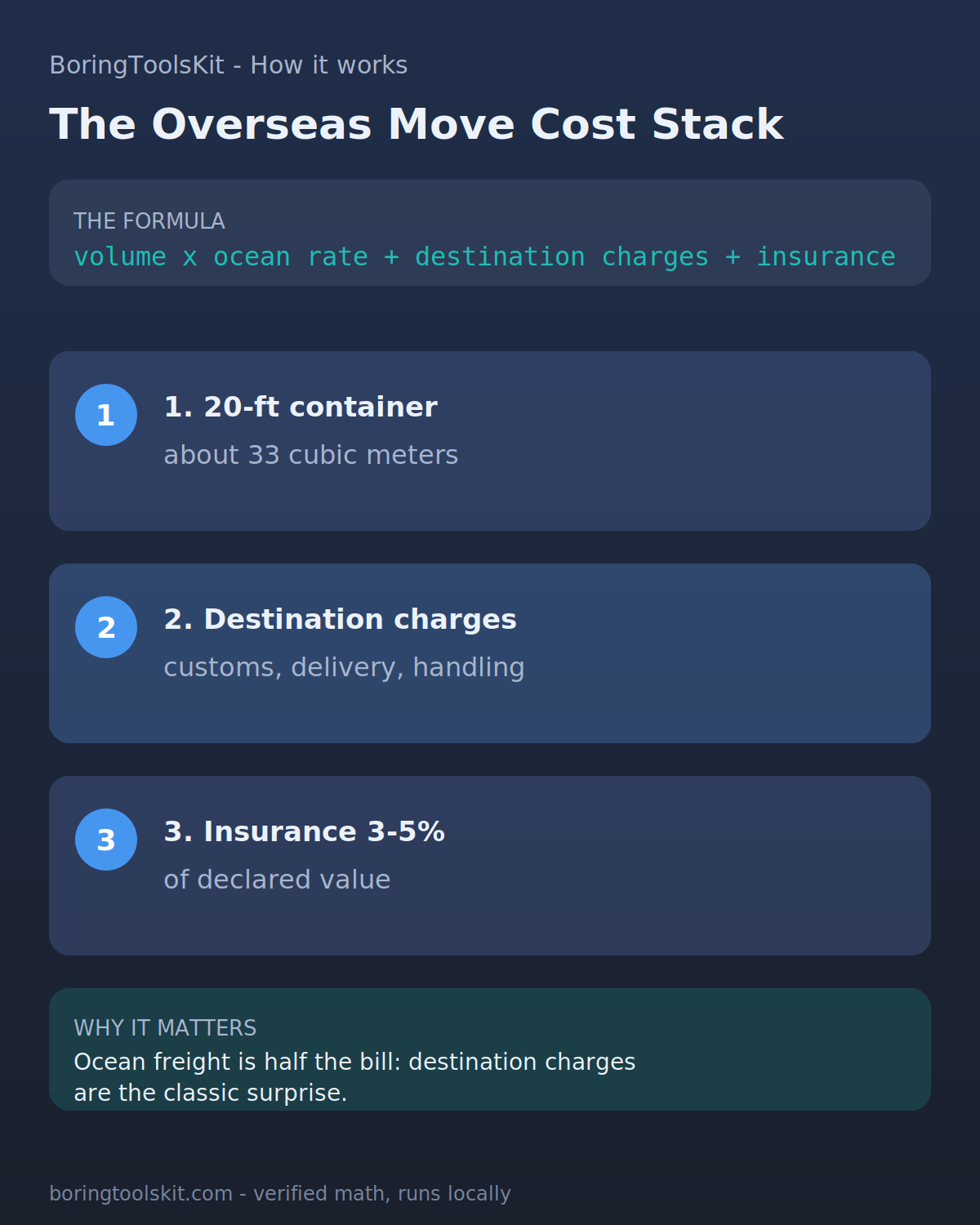
Cost = volume (cubic meters) x ocean rate + destination charges + insurance (3-5% of declared value). Air freight is priced per kg, roughly 5-10x ocean.
Worked example
A 20-foot container moves about 33 cubic meters; a full 20-ft overseas move commonly lands between $4,000 and $8,000 door-to-port depending on lane.
FAQ
How much does an international move cost?
A partial household (LCL) often runs $1,500-$5,000; a full 20-ft container $3,000-$6,000+; air freight $5,000-$15,000+, depending on distance and weight. Add insurance, customs, and destination trucking.
What is LCL vs FCL?
LCL (less than container load) shares a container with other shippers and you pay for your volume. FCL (full container load) reserves a whole 20-ft or 40-ft container — cheaper per cubic foot if you fill it.
Do I need insurance for an international move?
Yes — marine/transit insurance typically costs 1-3% of the declared value and protects against loss or damage in transit. It's a small premium for the value at stake.
Figures are editable example defaults for modeling, not quotes or advice. Financial, tax, and medical outcomes vary with your situation — verify with a qualified professional (CFP, CPA, tax advisor, or veterinarian).