GFR Calculator

GFR calculator: estimate glomerular filtration rate from serum creatinine, age, and sex using the CKD-EPI equation. Free, private, no signup, in your browser.

Updates automatically as you type.

Calculated in your browser; your inputs are not sent to us. Privacy

Results will appear here.

General estimate for planning only — not medical advice. Consult a doctor about your specific situation.

Calculation details
Every figure above is calculated locally in your browser from the assumptions shown. No inputs are sent anywhere. See the methodology section below for how this tool works.
Use this resultShare the current inputs, or ask ChatGPT to explain the calculation in context.
Ask an AI to explain this result
Share this result

Review the generated output before relying on it.

This tool runs in your browser. Your calculator inputs and results are never transmitted to us or to ad/affiliate partners. Ads and sponsored links may set third-party cookies to serve and measure them, but they never receive your calculation values. If you explicitly save a scenario, its permitted fields stay in local browser storage until you clear them. See our Privacy Policy.

Use this result

Share the current inputs or ask ChatGPT to explain the calculation in context.

More options
Report a calculation issue
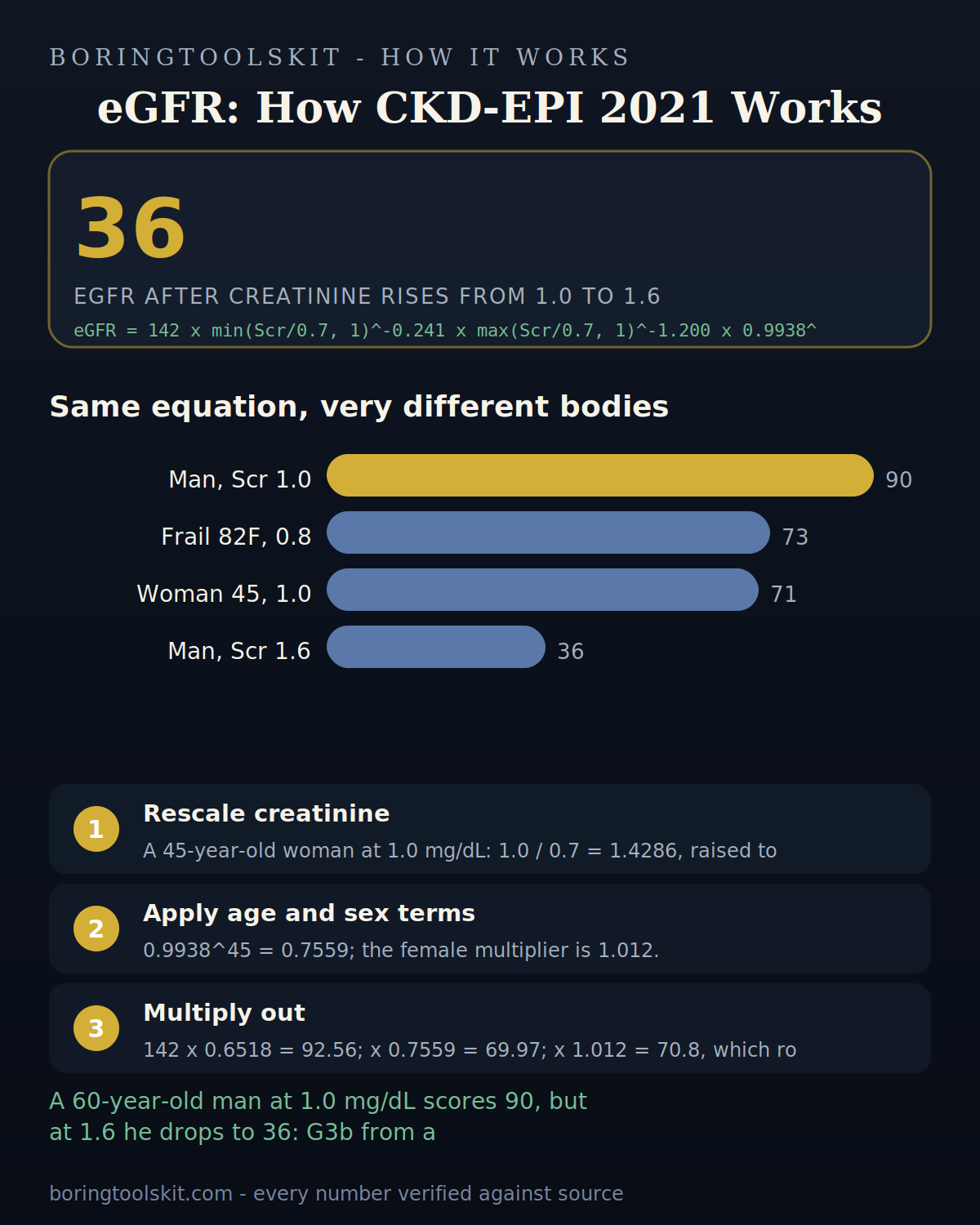
eGFR results for different ages and creatinine levels
A 60 percent creatinine rise takes eGFR from 90 to 36.
Method & verification

How This Tool Works

fact-checked against our calculation methodology

Calculation Method

Computes eGFR from Age, Creatinine and Sex assigned at birth.

Site methodology

No unrelated authority link is added merely to make this page look sourced. Tool-specific external sources are shown only when they directly support the method, rate, or rule.

Assumptions to Verify

  • These tools provide general estimates for planning and education only.
  • They are not medical advice and not a substitute for a qualified healthcare professional.
  • Always consult your doctor or another healthcare provider about your specific situation.

Privacy: The calculation runs in this browser. Shared links contain the page address only, not your inputs or results.

Worked example: the 2021 equation, step by step

Take a 45-year-old woman with a creatinine of 1.0 mg/dL. The equation first rescales creatinine: 1.0 divided by 0.7 gives 1.4286. Because that is above 1, only the second term applies, raised to the fixed exponent -1.200: 1.4286 to the power -1.200 equals 0.6518. The age term is 0.9938 raised to 45, which equals 0.7559. The female multiplier is 1.012.

Multiply it out: 142 x 0.6518 = 92.56; 92.56 x 0.7559 = 69.97; 69.97 x 1.012 = 70.8. The result rounds to 71 mL/min/1.73m2, which lands in stage G2 (mildly decreased), since it sits between 60 and 89.

Notice how the spline split works: at creatinine exactly 0.7 (the female reference value) the first term equals 1, so the estimate is driven purely by the -1.200 slope plus age. One number shows how sharply the slope bites: a 60-year-old man at the same 1.0 mg/dL scores 90, but raise his creatinine to 1.6 and he drops to 36, a G3b result, from a 60 percent creatinine increase.

Where the estimate bends and who it can mislead

The 2021 refactor removed the race coefficient but kept the creatinine ceiling problem: at low muscle mass, eGFR runs high. A frail 82-year-old woman weighing 48 kg with a creatinine of 0.8 gets an estimate near 73, yet her measured clearance is typically 15 to 25 percent lower than that, because creatinine production scales with muscle, not just kidney function. This matters for drug dosing: metformin and DOAC labels are keyed to renal function, so an inflated estimate can push a dose up.

Two edge cases the input validation will not flag. First, creatinine between 0 and about 0.4 is physiologically implausible in adults and usually means a lab reporting unit slip (umol/L typed as mg/dL); the calculator will happily compute a near-perfect score from it. Second, the spline kink at 0.7 (women) and 0.9 (men) means estimates are least precise right where G2 and G3a meet: a creatinine shift of 0.05 mg/dL around the kink can move the stage boundary itself.

In practice, guidelines call a result below 60 'chronic kidney disease' only after it repeats below 60 on tests at least 3 months apart. A single estimate of 58 in a well-hydrated 70-year-old is often just noise; the same number twice, six months apart, is a diagnosis conversation.