Generator Size Calculator

Generator size calculator: total your appliance and HVAC wattage, add starting surge, and pick the right generator size. Free, runs locally in your browser.

Updates automatically as you type.

Calculated in your browser; your inputs are not sent to us. Privacy

Results will appear here.
Calculation details
Every figure above is calculated locally in your browser from the assumptions shown. No inputs are sent anywhere. See the methodology section below for how this tool works.
Use this resultShare the current inputs, or ask ChatGPT to explain the calculation in context.
Ask an AI to explain this result
Share this result

Review the generated output before relying on it.

This tool runs in your browser. Your calculator inputs and results are never transmitted to us or to ad/affiliate partners. Ads and sponsored links may set third-party cookies to serve and measure them, but they never receive your calculation values. If you explicitly save a scenario, its permitted fields stay in local browser storage until you clear them. See our Privacy Policy.

Use this result

Share the current inputs or ask ChatGPT to explain the calculation in context.

More options
Report a calculation issue
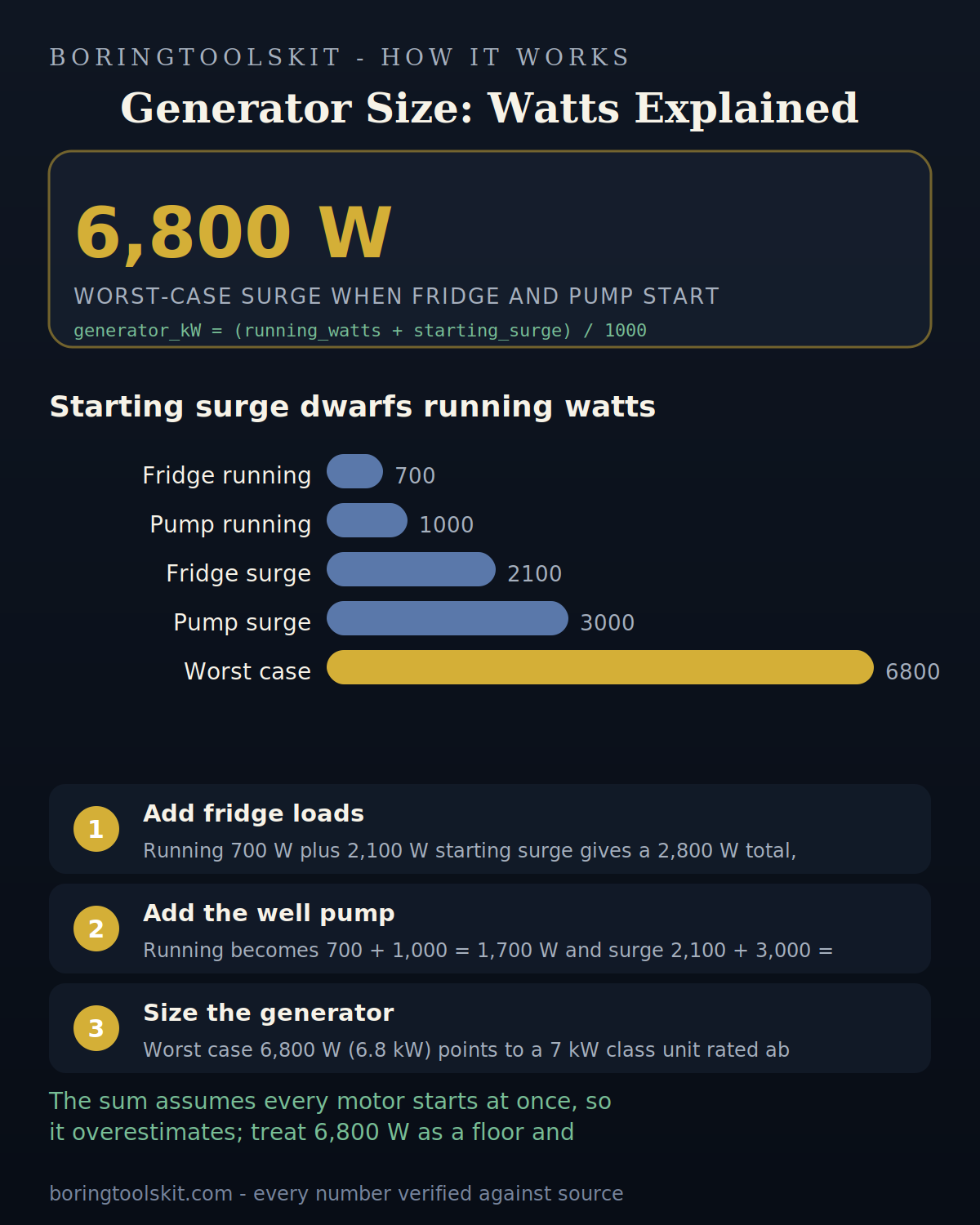
Refrigerator and well pump running watts vs starting surge
Combined worst-case surge reaches 6,800 W, pointing to a 7 kW generator.
Method & verification

How This Tool Works

Calculation Method

Computes Generator size from Running watts and Starting surge watts.

Site methodology

No unrelated authority link is added merely to make this page look sourced. Tool-specific external sources are shown only when they directly support the method, rate, or rule.

Assumptions to Verify

  • Measurements describe the simplified geometry entered.
  • Verify waste, package yield, product specifications, and supplier minimums before purchase.

Privacy: The calculation runs in this browser. Shared links contain the page address only, not your inputs or results.

Worked example: refrigerator plus well pump

A refrigerator draws about 700 W running and needs roughly 2,100 W to start (3x is a common compressor multiplier). Enter running 700 and surge 2,100: total = 700 + 2,100 = 2,800 W, shown as 2.8 kW. The calculator adds the two values rather than taking the larger one, because a generator must cover both loads at the instant the compressor kicks on.

Add a 1,000 W well pump with a 3,000 W start next and the totals combine: running 700 + 1,000 = 1,700 W, surge 2,100 + 3,000 = 5,100 W, worst case 6,800 W or 6.8 kW. That points to a 7 kW class generator with a surge rating of at least 6,800 W. If your device lists amps instead of watts, multiply by voltage first: 8 A at 120 V is 960 W. Power factors below 1 matter for motors; a 0.8 PF device drawing 5 A at 230 V is really 920 W, not 1,150 W.

Limits and real-world sizing practice

The sum assumes every motor starts at once, which overestimates size; staggered starts let a 5 kW unit run loads that sum to 6.8 kW. It also ignores load diversity: a fridge compressor cycles off, so its 700 W is not continuous. If surge is left at 0 the result equals running watts only, which undersizes motor loads badly. The output rounds to one decimal in kW, so a 6,860 W total and a 6,849 W total both display 6.9 kW, but 6,840 W displays 6.8 kW; always round your generator purchase up, never down.

What it cannot see: generators lose capacity at altitude and heat (roughly 3% per 1,000 ft above sea level for a fixed engine), inverter models often have a separate short-term surge window of a few seconds, and 240 V split loads need both legs balanced. Code also cares about transfer switches, not just wattage. Use the result as a floor, then check the specific unit's continuous and surge ratings on its spec sheet.