Frame Size Calculator

Frame size calculator: find your ideal bike frame size from your height and inseam for a comfortable, efficient fit. Free, private, runs in your browser.

Updates automatically as you type.

Calculated in your browser; your inputs are not sent to us. Privacy

Results will appear here.

General estimate for planning only — not medical advice. Consult a doctor about your specific situation.

Calculation details
Every figure above is calculated locally in your browser from the assumptions shown. No inputs are sent anywhere. See the methodology section below for how this tool works.
Use this resultShare the current inputs, or ask ChatGPT to explain the calculation in context.
Ask an AI to explain this result
Share this result

Review the generated output before relying on it.

This tool runs in your browser. Your calculator inputs and results are never transmitted to us or to ad/affiliate partners. Ads and sponsored links may set third-party cookies to serve and measure them, but they never receive your calculation values. If you explicitly save a scenario, its permitted fields stay in local browser storage until you clear them. See our Privacy Policy.

Use this result

Share the current inputs or ask ChatGPT to explain the calculation in context.

More options
Report a calculation issue
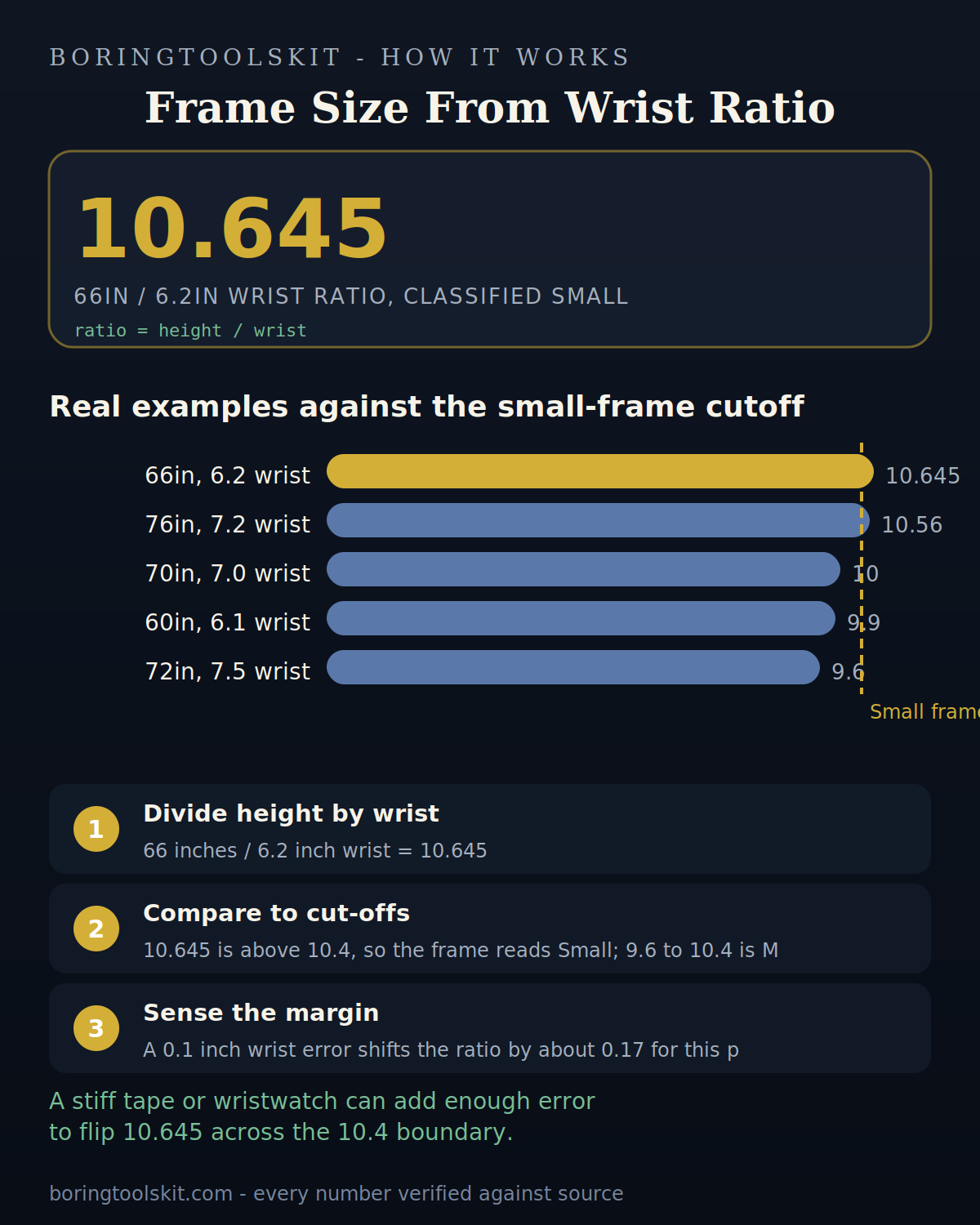
Wrist ratio examples plotted against the small frame cutoff
66 / 6.2 = 10.645, just above the 10.4 Small cut-off.
Method & verification

How This Tool Works

fact-checked against our calculation methodology

Calculation Method

Computes Body frame from Height and Wrist circumference.

Site methodology

No unrelated authority link is added merely to make this page look sourced. Tool-specific external sources are shown only when they directly support the method, rate, or rule.

Assumptions to Verify

  • These tools provide general estimates for planning and education only.
  • They are not medical advice and not a substitute for a qualified healthcare professional.
  • Always consult your doctor or another healthcare provider about your specific situation.

Privacy: The calculation runs in this browser. Shared links contain the page address only, not your inputs or results.

A worked example: 66 inches, 6.2 inch wrist

Take a person 66 inches tall with a wrist circumference of 6.2 inches. The ratio is 66 divided by 6.2, which equals 10.645. Because 10.645 is above the 10.4 threshold, the frame reads Small. The margin matters: anything between 10.4 and 10.9 sits within about half a point of the boundary, so a wrist measured with a stiff tape, or measured over a wristwatch, can flip the answer. Measuring the wrist just below the wrist bone, with the tape snug but not compressing the skin, keeps the reading within about 0.1 inches, which shifts the ratio by roughly 0.17 for this person.

Contrast that with someone 70 inches tall and a 7.0 inch wrist: 70 divided by 7.0 gives exactly 10.0, solidly Medium. The same 0.1 inch wrist error only moves this ratio by about 0.14. Taller people with proportionally thicker wrists land further from the boundaries, so their classification is more stable. The classification also feeds the healthy-weight range: a small frame typically trims about 10 percent off the midpoint of a standard height-weight table, so a 66 inch person with a Medium-frame range of roughly 118 to 148 pounds would see the upper end drop by about 10 to 15 pounds.

Where the 9.6 and 10.4 cut-offs break down

The ratio method assumes wrist circumference scales linearly with height, but bone structure does not. A 76 inch person with a 7.2 inch wrist scores 10.56 and is classified Small, yet their absolute wrist size is larger than a 60 inch person scoring 9.9 (6.1 inch wrist), who lands Medium. Extremely tall people are systematically pushed toward the Small bucket because the denominator grows faster than skeletal breadth, which is why the classic tables were built mostly from data on people between 60 and 72 inches tall.

Two other edge cases are worth knowing. First, the tape itself: cloth tapes stretch, and measuring over clothing can add 0.2 to 0.5 inches. On a 6.0 inch wrist that inflates the ratio by 0.35 to 0.9, enough to move someone from Small to Medium without any real change in frame. Second, body composition has no effect on the result at all. The ratio reads bone only, so a bodybuilder with a 7.5 inch wrist at 72 inches scores 9.6 exactly, right on the Medium and Large boundary, while their effective carrying weight is far above any standard table. Treat the output as one input to a weight target, not the deciding number.