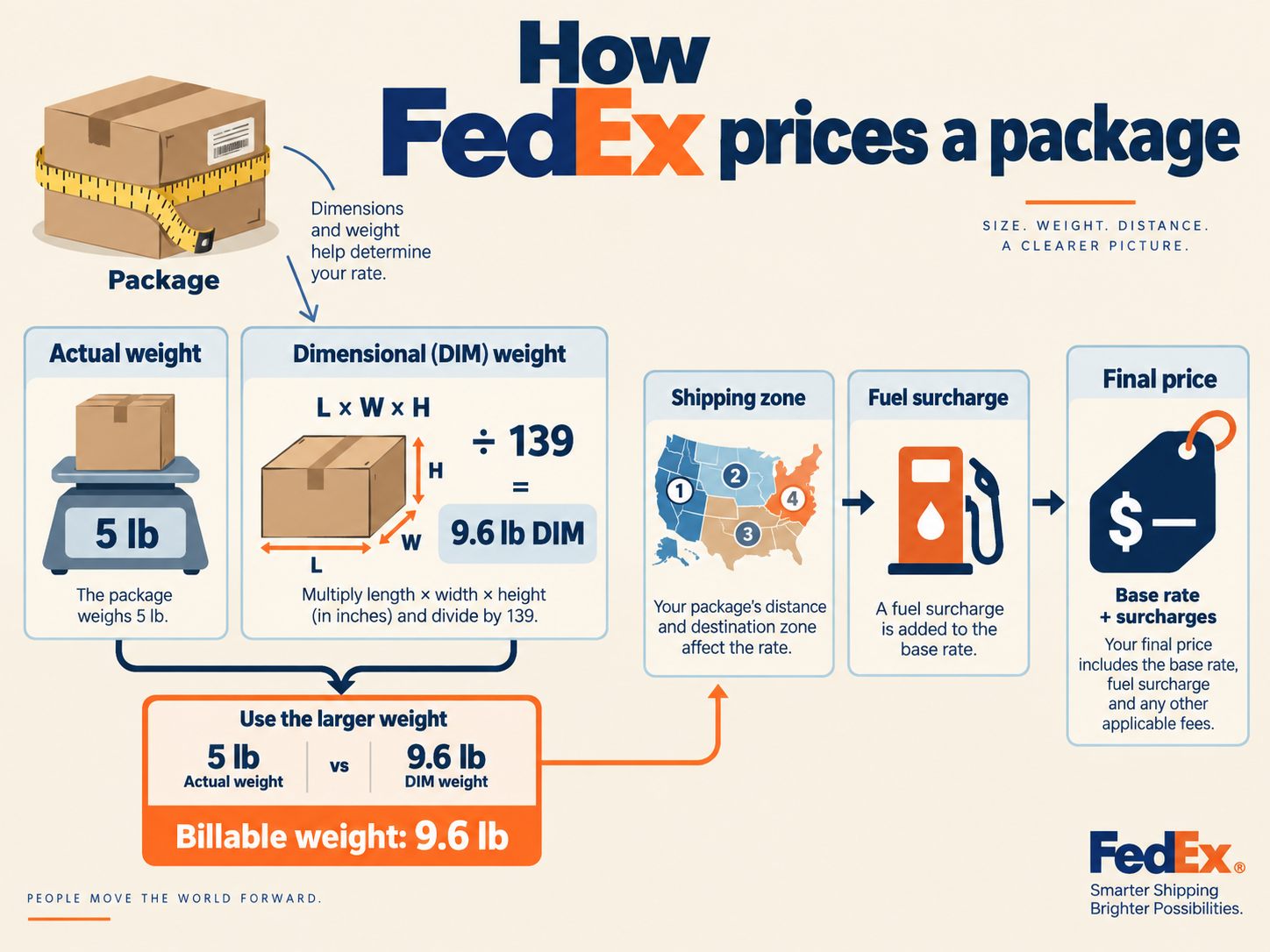
FedEx prices like UPS — billable weight via DIM ÷139, zone-based tables, and a fuel surcharge that moves weekly. Ground for economy, Express for speed; the math is the same.
Direct answer
What does this tool do?
FedEx Shipping Cost Calculator computes the result directly in your browser — FedEx prices like UPS — billable weight via DIM ÷139, zone-based tables, and a fuel surcharge that moves weekly. Ground for economy, Express for speed; the math is the same. Nothing you enter is uploaded or stored.
Reviewed by BoringToolsKit · September 1, 2026 · Example rates, editable — not carrier quotes.
Quick answer
How the estimate works
Cost ≈ base rate (billable weight) × zone multiplier × (1 + fuel %) + extras. Express services add a delivery-day premium you can fold into the base rate you enter.
Calculator
Estimated cost
-
Rate tables below are editable example defaults for modeling, not carrier quotes. Actual prices vary by negotiated rates, surcharges, and season. Confirm final cost with the carrier before shipping.
FedEx billable weight: actual weight vs DIM weight (length × width × height ÷ 139), then zone and fuel surcharges.
Example Ground rates (editable)
Billable weight
Zone 2
Zone 5
Zone 8
1 lb
$10.95
$12.80
$15.10
5 lb
$13.40
$16.60
$20.40
10 lb
$16.60
$21.10
$26.50
20 lb
$22.80
$29.80
$38.60
Example rates for modeling (vintage 2026); verify on fedex.com.
Methodology
Formula and assumptions
Same structure as UPS: billable = max(actual, DIM), DIM divisor 139; total = base × zone × (1 + fuel %) + extras. Express premiums vary by service — enter the base rate for your service tier.
Quick answers
FedEx Shipping Cost Calculator questions
FedEx DIM divisor?
139 for daily rates (inches³ per pound). Billable weight is the higher of actual and DIM.
Ground vs Express cost difference?
Express runs roughly 2-4x Ground at the same weight and zone, plus higher fuel surcharge. Model by editing the base rate.
Official quote?
No — modeling tool with editable example rates. Confirm on fedex.com.
Take a box measuring 12 x 10 x 8 inches that weighs 5 lb on the scale. Actual weight: 5 lb. DIM weight: 12 x 10 x 8 = 960 cubic inches, divided by the 139 divisor = 6.91, which rounds up to 7 lb. Billable weight is the higher of the two, so 7 lb, not 5 lb. This is the single most common surprise on small dense-void boxes: the packaging air, not the contents, sets the price.
Next, pick the base rate. The editable example table lists 5 lb at $16.60 and 10 lb at $21.10 for Zone 5, so a 7 lb parcel lands between them; using straight-line interpolation, the midpoint at 7 lb is (16.60 + 21.10) / 2 = $18.85. Then apply the fuel surcharge. At 16.5%: 18.85 x 1.165 = $21.96. Add a residential delivery fee of $5.25 and the modeled total is 21.96 + 5.25 = $27.21.
Notice what moved the number. Dropping the box to 11 x 9 x 7 inches (693 cubic inches, DIM 4.99 rounded to 5 lb) puts billable weight back at 5 lb, so the same parcel models at 16.60 x 1.165 = $19.34 plus the $5.25 fee, or $24.59. One inch of padding per dimension saved $2.62 in this example. That sensitivity is why the divisor and dimensions belong in every cost model, not just the rate table.
Where the model breaks: boundaries and real-world practice
The interpolation above is the model's weakest joint. FedEx pricing is a step function, not a line: a parcel billed at 7.0 lb pays the rate the carrier publishes for that bracket, and nothing between brackets exists in a real rate card. If the actual Zone 5 card prices 7 lb at $19.10, the model's $18.85 is low by $0.25 plus fuel, and the error scales with weight, since brackets get coarser (often 2 lb steps, then 5 lb) as weight rises. Always enter the published bracket rate for the rounded-up billable weight rather than interpolating when you know the card.
Boundary cases to test in the calculator: at a DIM of exactly the divisor boundary (960 / 139 = 6.91 rounds to 7, but 965 / 139 = 6.94 also rounds to 7, while 972 / 139 = 6.99 still rounds to 7 and 973 / 139 = 7.00 stays 7) the rounding rule means small dimension changes are free until a bracket flips. At 0% fuel surcharge the model returns the bare base plus extras, which is useful for isolating the surcharge share. A remote-area surcharge that reaches its example cap of $24.50 adds more than the entire Zone 2 base rate for a 1 lb parcel ($10.95), which is why residential-and-remote addresses can double a light shipment.
Practice notes: fuel surcharges are percentages applied to the base, not flat fees, so they scale with weight and service tier; Express fuel percentages typically run higher than Ground's. Oversize and additional-handling fees trigger on dimension thresholds rather than weight, and they are excluded from this model's extras list. Negotiated-rate shippers commonly see base discounts of 10-30% off daily rates, which no example table captures. Treat the output as a relative comparison tool between box sizes, zones, and services, and confirm the absolute number on fedex.com before quoting a customer.