Calculation details
Planning estimate only, not financial, tax, or legal advice. Verify assumptions and current rules before making decisions.
This tool runs in your browser. Your calculator inputs and results are never transmitted to us or to ad/affiliate partners. Ads and sponsored links may set third-party cookies to serve and measure them, but they never receive your calculation values. If you explicitly save a scenario, its permitted fields stay in local browser storage until you clear them. See our Privacy Policy.
Use this result
Share the current inputs or ask ChatGPT to explain the calculation in context.
More options
What does this calculator estimate?
A 401(k) employer match is money your employer adds to your account when you contribute. This calculator estimates it from your annual salary, your contribution percentage, your employer's match rate, and the percentage of salary the employer will match. As an example, on an $80,000 salary with a 6% contribution and a 50% match up to 6% of pay, the employer adds $2,400 a year on top of your $4,800 for a combined $7,200.
- A 50% match up to 6% of pay contributes $2,400 a year to an employee earning $80,000 who contributes 6%. (Source: BoringToolsKit calculation methodology)
- The 2026 employee deferral limit is $24,500; employer matches do not count against it. (Source: IRS)
- Missing the match is declining part of your own compensation. (Source: BoringToolsKit calculation methodology)
Understanding common match formulas
401k matches come in a few standard shapes. The most common is a percentage match up to a limit — e.g. 50% of your contributions up to 6% of salary. Dollar-for-dollar matches (100% up to 3–6%) are also common and effectively double that portion of your contribution. Some plans are tiered (100% of the first 3%, then 50% of the next 2%). This calculator models a single match rate with a salary-percentage cap; for tiered plans, enter the rate and cap that best matches the portion you contribute.
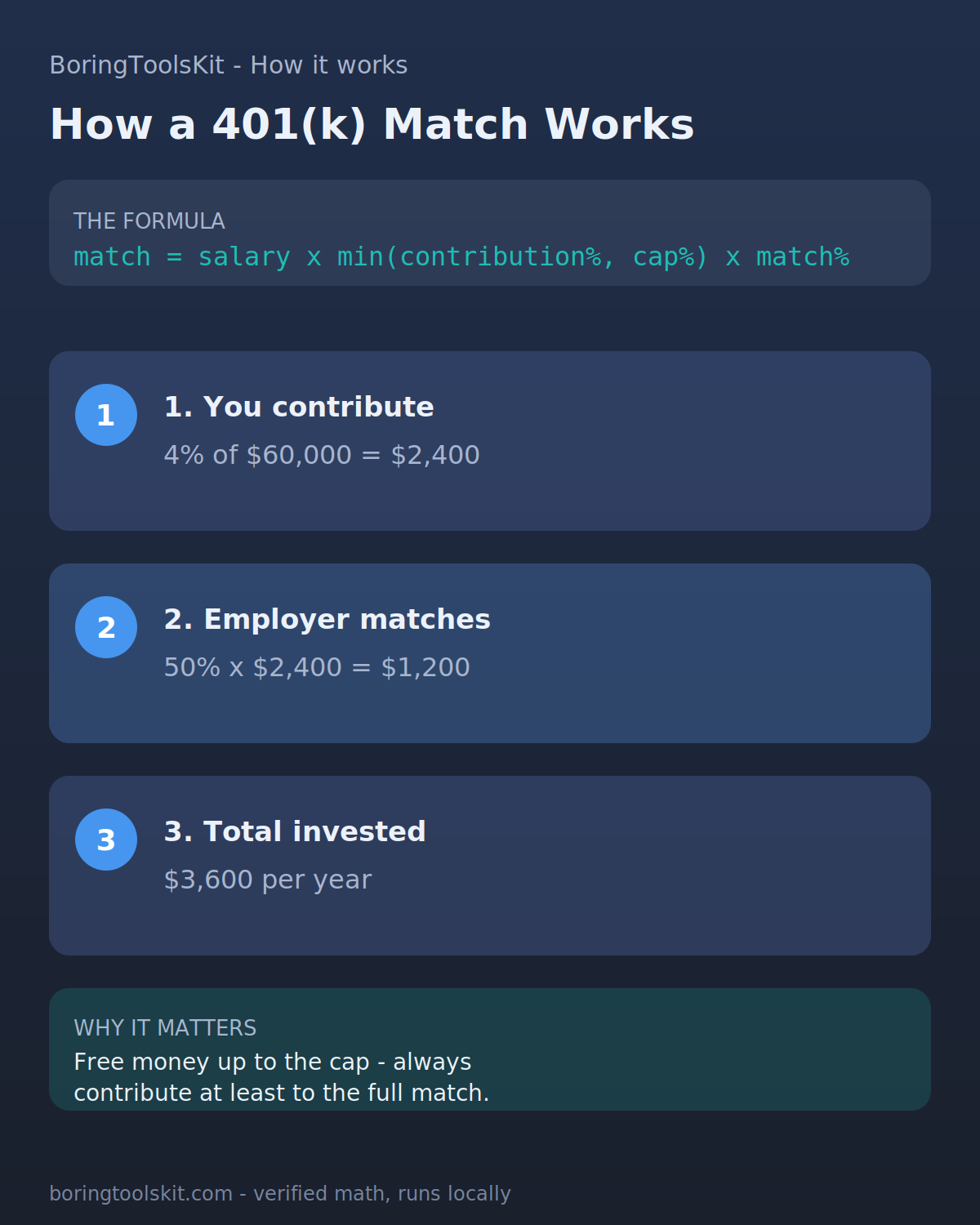
How this calculator works
Formula
Match = min(employee contribution %, match limit %) x employer match % x annual salary.
Worked example
An $80,000 salary with a 6% employee contribution ($4,800) and a 50% match up to 6% earns a $2,400 annual employer match.
Assumptions to verify
- The plan uses one simple match percentage up to one salary-percentage limit.
- Eligible salary equals the annual salary entered and is evenly distributed across pay periods.
- Vesting, true-up, annual legal limits, bonuses, plan exclusions, and investment growth are excluded.
Frequently asked questions
What does 50% match up to 6% mean?
The modeled employer contributes fifty cents per eligible dollar you contribute, on contributions up to 6% of eligible salary.
Why might payroll results differ?
Plans can use per-pay-period matching, annual true-ups, eligible-pay definitions, caps, and vesting schedules not modeled here.
Does this enforce annual contribution limits?
No. Limits change and individual rules vary; verify current limits and plan terms before changing payroll elections.
How is a 401k employer match calculated?
The employer match equals your annual salary times the match rate, capped at the percentage of salary the employer will match. On an $80,000 salary with a 50% match up to 6%, the employer contributes 50% of up to 6% of pay, which is $2,400 a year.
How much should I contribute to get the full 401k match?
Contribute at least the percentage of salary your employer matches — commonly 6%. In a 50%-up-to-6% plan, contributing 3% on an $80,000 salary captures only $1,200 of the available $2,400, leaving a $1,200 unclaimed match.
How is a 401k company match calculated?
The employer match equals your annual eligible salary × the match rate, capped at the percentage of salary the employer will match. With a 50% match up to 6% on an $80,000 salary, the employer contributes 50% of 6% of pay: $80,000 × 0.06 × 0.50 = $2,400 per year. This calculator models that formula and also shows how much you'd need to contribute to capture the full match.
What is a typical 401k employer match?
A very common plan is a 50% match on employee contributions up to 6% of salary, and many plans offer 100% on the first 3–4%. Some employers match dollar-for-dollar up to 6%. The exact formula is set by your plan and usually shown in the summary plan description — select the closest preset or enter your plan's numbers.
Should I contribute enough to get the full 401k match?
In almost every case yes — the match is free money on top of your salary. If your plan matches 50% up to 6% and you earn $80,000, contributing at least 6% earns you an extra $2,400 a year (an immediate 50% return on that portion). The calculator shows the unclaimed match you'd forgo by contributing less.
How much does the 401k match add per paycheck?
Divide the annual employer match by your number of pay periods. With a $2,400 annual match paid over 26 periods, that's about $92 per paycheck. This calculator reports both the annual and per-paycheck employer contribution.
Cite this tool
BoringToolsKit. “401k Employer Match Calculator.” boringtoolskit.com/401k-employer-match-calculator/ (reviewed August 2026). Free to reference in articles, syllabi, and answer posts with a link.
Privacy: Inputs and results stay in this browser. Any future sponsored recommendation or advertisement will be clearly labeled and kept separate from the calculation.
Match on $60k salary at 6%
What this means for your numbers: The match doubles the worked example's $3,600 to $7,200/year. Over 30 years at 7%, the match alone compounds to ~$340,000: the highest return in personal finance.
Illustrative breakdown using the worked example above. The calculator computes your own numbers with the same formula.