Calculated in your browser; your inputs are not sent to us. Privacy
Results update when you run the tool.
This tool processes the selected input in your browser. Review the output before relying on it; format and file behavior can vary by browser and source data.
Your inputs and results stay in this browser. This page may send privacy-bounded aggregate interaction events described in Privacy; it does not send your entered values or result contents.
Use this result
Share the current inputs or ask ChatGPT to explain the calculation in context.
More options
What does this converter do?
Volume converter that switches between liters, gallons, cups, milliliters, cubic meters, and more instantly. Free, private, runs in your browser, no signup.
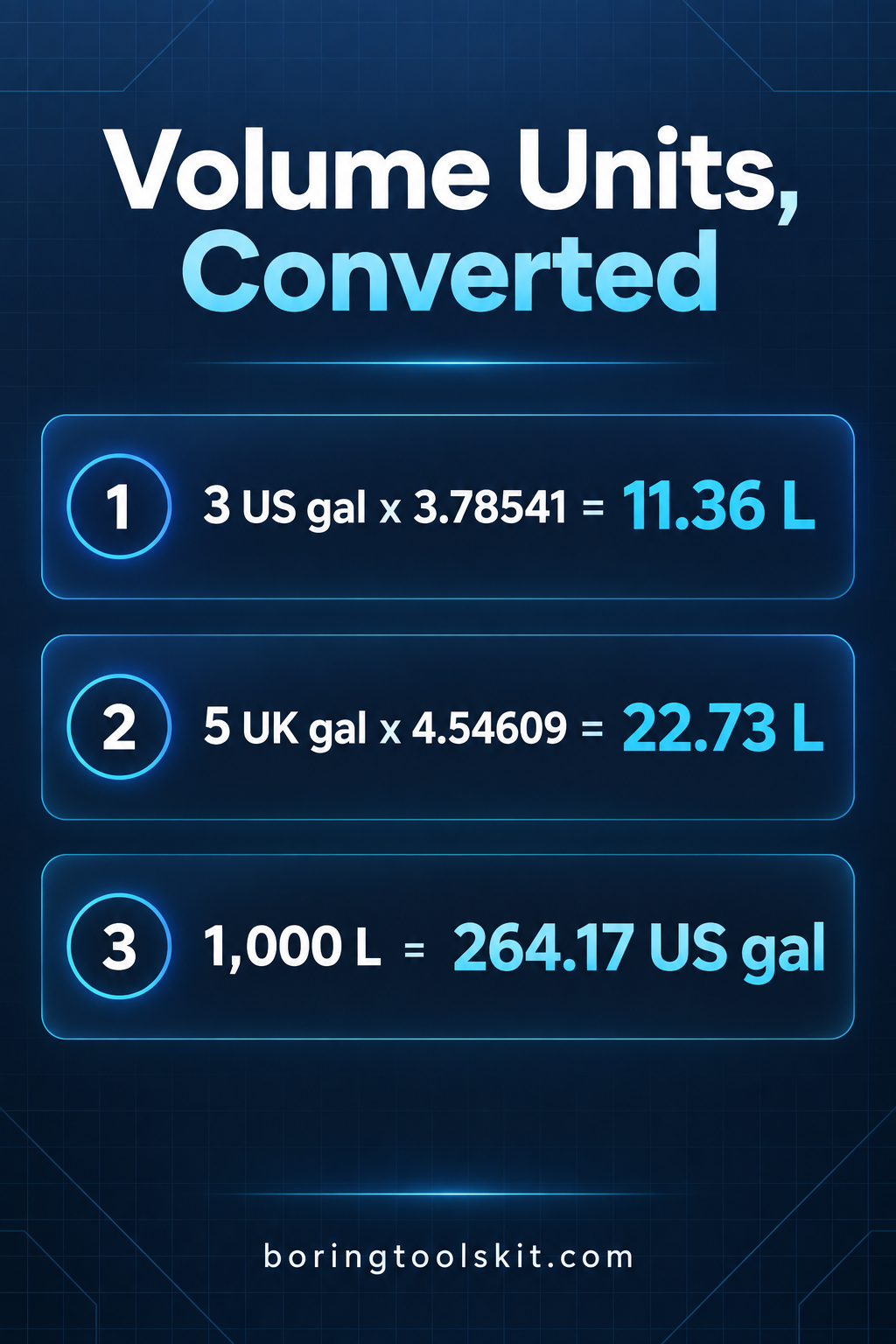
- 1 US gallon = 3.785 liter · 1 US cup = 236.6 milliliter · 1 US tablespoon = 14.79 milliliter
- All conversions route through the liter as the base unit, so every pair of units agrees regardless of which two you enter.
- Standard factors are shown in the formula panel at the precision the calculator actually uses, so the arithmetic and the panel agree.
Reference factors (volume)
Exact factors in terms of the liter, from NIST standards:
- 1 milliliter = 0.001 liter
- 1 US teaspoon = 0.00492892 liter
- 1 US tablespoon = 0.0147868 liter
- 1 US cup = 0.236588 liter
- 1 US quart = 0.946353 liter
- 1 liter = 1 liter
- 1 US gallon = 3.78541 liter
How this calculator works
Formula
Volume = value x (litres per source unit) / (litres per target unit). Factors: 1 US gal = 3.785411784 L, 1 US qt = 0.946352946 L, 1 US cup = 0.2365882365 L, 1 US fl oz = 0.02957352956 L, 1 mL = 0.001 L.
Worked example
1 US gallon = 3.785 liter · 1 US cup = 236.6 milliliter · 1 US tablespoon = 14.79 milliliter
Sources
Sources support the method, terminology, or planning context. Editable assumptions remain your responsibility.
Assumptions to verify
- Inputs are treated as exact decimal values.
- Standard (not historical or survey) unit definitions are used.
- The calculation uses the factors at the precision shown in the formula panel; rounding beyond that is display-only and adds no accuracy.
Frequently asked questions
Why convert through liter instead of directly?
Routing every unit through a single base (liter) means each unit needs only one exact factor against the standard, and any pair combines cleanly. Direct pair factors drift apart over time in hand-maintained tables; a base-unit graph cannot.
Where do these exact factors come from?
From published standards (NIST: SI units and US customary conversion tables). Units like the inch are defined exactly (1 in = 2.54 cm since 1959), so conversions between standard units are exact, not approximate.
How many decimal places should I trust?
The math is exact to the precision shown. The practical limit is your input: a tape measure is only good to ~1 mm and a kitchen scale to ~1 g, so 3–4 significant figures already exceeds the measurement's own accuracy.
Cite this tool
BoringToolsKit. “Volume Converter.” boringtoolskit.com/volume-converter/ (reviewed 2026-09-20). Free to reference in articles, syllabi, and answer posts with a link.
Privacy: Inputs and results stay in this browser. Conversion runs locally in your browser; review the output before relying on it.