Calculated in your browser; your inputs are not sent to us. Privacy
Results update when you run the tool.
This tool processes the selected input in your browser. Review the output before relying on it; format and file behavior can vary by browser and source data.
Your inputs and results stay in this browser. This page may send privacy-bounded aggregate interaction events described in Privacy; it does not send your entered values or result contents.
Use this result
Share the current inputs or ask ChatGPT to explain the calculation in context.
More options
What does this converter do?
Temperature converter converts between Celsius, Fahrenheit, Kelvin, and Rankine instantly with a reference table. Free, private, runs in your browser, no signup.
- All conversions route through the celsius as the base unit, so every pair of units agrees regardless of which two you enter.
- Standard factors are shown in the formula panel at the precision the calculator actually uses, so the arithmetic and the panel agree.
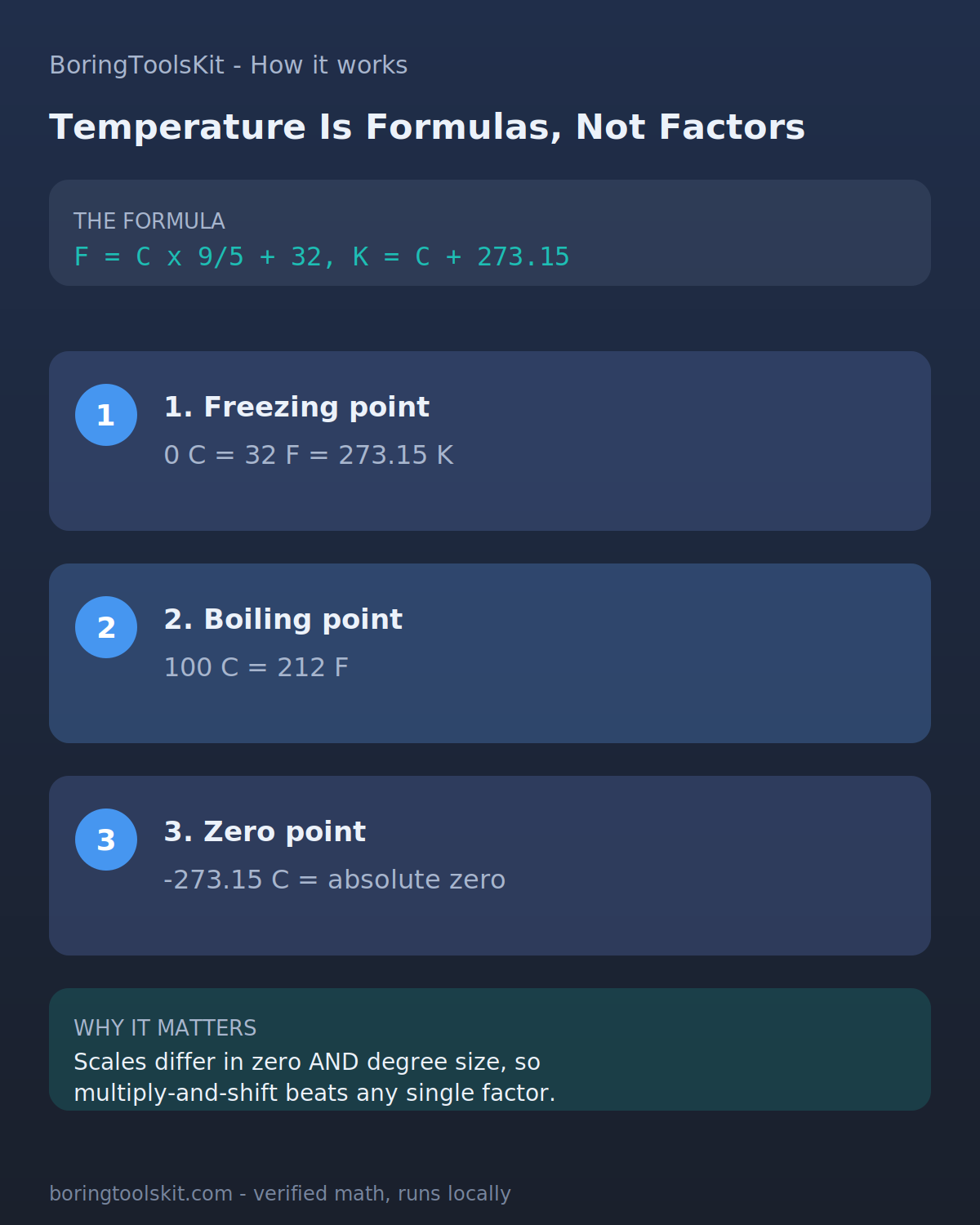
- Celsius and Kelvin share the same scale size (1 K = 1 °C of difference); only the zero point moves. Fahrenheit degrees are 5/9 the size of Celsius degrees.
Reference points
- Absolute zero: −273.15 °C = 0 K = −459.67 °F
- Water freezes: 0 °C = 32 °F = 273.15 K
- Water boils (1 atm): 100 °C = 212 °F
- Body temperature (average): 37 °C = 98.6 °F
How this calculator works
Formula
K = °C + 273.15; °F = °C × 9/5 + 32 (convert using exact formulas)
Sources
Sources support the method, terminology, or planning context. Editable assumptions remain your responsibility.
Assumptions to verify
- Inputs are treated as exact decimal values.
- Standard (not historical or survey) unit definitions are used.
- The calculation uses the factors at the precision shown in the formula panel; rounding beyond that is display-only and adds no accuracy.
Frequently asked questions
Why convert through celsius instead of directly?
Routing every unit through a single base (celsius) means each unit needs only one exact factor against the standard, and any pair combines cleanly. Direct pair factors drift apart over time in hand-maintained tables; a base-unit graph cannot.
How precise is the converted temperature?
The conversion applies the standard factors shown in the formula panel. The practical limit is your input: a thermometer is usually specified to about 0.5-1 degree, so extra digits beyond what you actually read do not add accuracy.
Cite this tool
BoringToolsKit. “Temperature Converter.” boringtoolskit.com/temperature-converter/ (reviewed 2026-09-20). Free to reference in articles, syllabi, and answer posts with a link.
Privacy: Inputs and results stay in this browser. Conversion runs locally in your browser; review the output before relying on it.
A worked example: 68 degrees Fahrenheit to Celsius and Kelvin
Take a comfortable room temperature of 68 degrees Fahrenheit. The converter first normalizes every input to Celsius. The Fahrenheit branch of the formula subtracts 32, then scales by 5/9: (68 - 32) x 5/9 = 36 x 5/9 = 180/9 = 20, so the Celsius intermediate is exactly 20.00 degrees C. Converting on to Kelvin is a pure offset with no scaling: 20 + 273.15 = 293.15 K. Selecting Rankine instead scales by 9/5 and adds 491.67: 20 x 9/5 = 36, and 36 + 491.67 = 527.67 degrees R.
The same 68 entered with the units reversed tells you whether the scale order matters, and it does. Treating 68 as Celsius gives (68 x 9/5) + 32 = 122.4 + 32 = 154.40 degrees F, which is hotter than water boils under household pressure. This is the classic input-order mistake, and the swap button beside the target unit exists to fix it in one click rather than retyping. Because the script rounds values under 1 absolute unit to 4 significant digits and everything else to 2 decimals, 0.5 degrees C displays as 0.5, while 98.6 degrees F converts to 37.00 degrees C on screen; the unrounded value of (98.6 - 32) x 5/9 = 66.6 x 5/9 = 37.0 confirms the display is not hiding drift.
Boundary cases: where temperature conversion behaves oddly
Temperature is the one common unit family with a true zero that means something physical, so negative inputs behave differently from length or weight. At -40, Fahrenheit and Celsius cross: (-40 - 32) x 5/9 = -72 x 5/9 = -40.00, the only value identical on both scales. Kelvin has no negatives at all: entering -1 with Kelvin selected as the source feeds -274.15 degrees C into the pipeline, and converting that to Kelvin yields -1.00 K, a number that is physically meaningless. The calculator will happily display it, because a converter transforms arithmetic, not physics.
Offset-heavy scales also punish percentage thinking. Doubling 10 degrees C to 20 degrees C is not a doubling of anything: in Kelvin the values are 283.15 K and 293.15 K, a 3.5 percent increase in thermal energy, not 100 percent. The Rankine path shows the same asymmetry in reverse: 0 degrees F is 459.67 degrees R, so any ratio quoted in Fahrenheit degrees is off by that additive constant. Finally, the display formatter suppresses thousands separators below 1,000 and switches to plain integer formatting above it, so 1,000.5 K reads as 1,001 while 999.5 K reads as 999.50; for laboratory work where the third decimal matters, treat the on-screen figure as a check, not a standard.