State income tax
Massachusetts state income tax brackets: top marginal rate 9.0%
Massachusetts’s top marginal state income tax rate is 9.0% on single-filer income over $1,107,750, across 2 brackets.
Quick answer
Current massachusetts state income tax brackets: top marginal rate 9.0% rules and rates by state, with the calculator to apply them to your own numbers.
Reviewed by BoringToolsKit · August 26, 2026 · This state's rate verified 2026-09-12 against the state's own document: mass.gov Massachusetts tax rates - wages withheld at 5.00%; additional 4% surtax above $1,107,750 for tax year 2026. Simplified illustration for a single filer — excludes the standard deduction, exemptions, credits, and any local/city income taxes, and real state rules differ (married-filer brackets, phase-outs, inflation indexing). Rules change year to year; verify with the state revenue department. Informational, not tax advice.
How Massachusetts taxes income
Graduated brackets tax only the income inside each band — so most filers pay far less than the top rate. Massachusetts has 2 single-filer brackets; the top marginal rate of 9.0% kicks in at $1,107,750.
Run your numbers
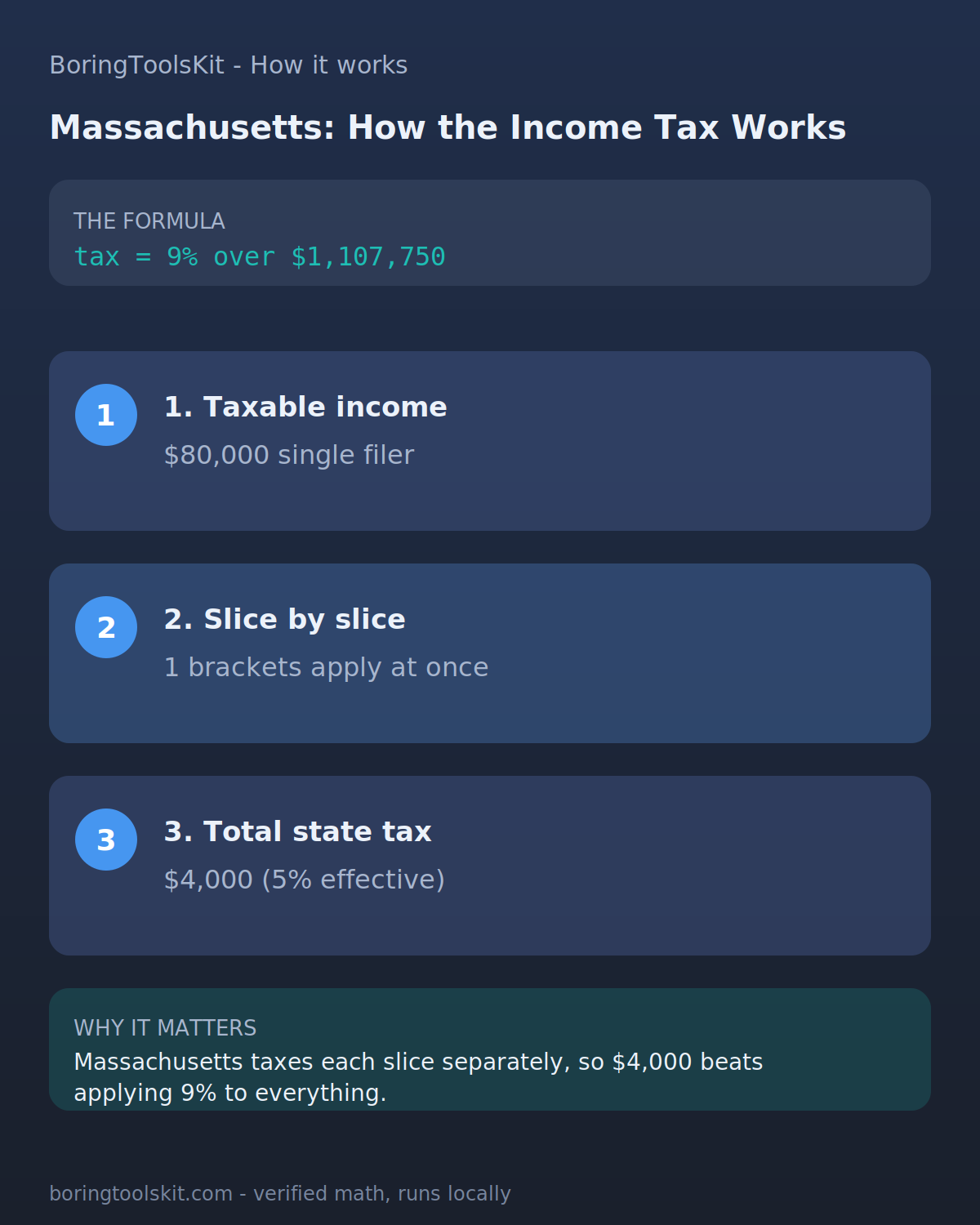
$80,000 single filer in Massachusetts
Graduated brackets tax only the income inside each band. On $80,000, Massachusetts taxes each slice like this:
| Rate | Starts at | Taxed amount | Tax |
|---|---|---|---|
| 5.0% | $0 | $80,000 | $4,000 |
| Total | $4,000 |
Marginal rate 5.0% · effective rate 5.00% — the last dollar is taxed at the marginal rate, but the whole income averages to the effective rate.
| Rate | Single-filer taxable income |
|---|---|
| 5.0% | Up to $1,107,750 |
| 9.0% | Over $1,107,750 |
Single-filer tax at common incomes
Estimated state income tax before deductions and credits:
| Income | Tax | Effective rate |
|---|---|---|
| $50,000 | $2,500 | 5.00% |
| $100,000 | $5,000 | 5.00% |
| $150,000 | $7,500 | 5.00% |
Simplified illustration for a single filer — excludes the standard deduction, exemptions, credits, and any local/city income taxes, and real state rules differ (married-filer brackets, phase-outs, inflation indexing). Rules change year to year; verify with the state revenue department. Informational, not tax advice.
State income tax questions, answered
What is the difference between marginal and effective state income tax?
Your marginal rate taxes only the last dollar of income; your effective rate is total state tax divided by total income. In a graduated state most filers’ effective rate is well below the top marginal rate.
Does Massachusetts tax all income at the top rate?
No. Graduated brackets tax only the income inside each band, so the rate you see on the last dollar is not the rate on the first dollar.
Which states have no individual income tax?
Alaska, Florida, Nevada, New Hampshire, South Dakota, Tennessee, Texas, Washington, and Wyoming collect no state individual income tax on wages.
Is this calculator tax advice?
No — this is a simplified illustration for a single filer that excludes the standard deduction, exemptions, credits, and local/city taxes. Verify with the state revenue department.
Put the rate to work
See the state income tax comparison table, the full bracket index, or the salary-to-hourly converter.