Sprinkler Precipitation Rate Calculator
The precipitation rate (in/hr) is how fast your sprinklers add water. It depends on flow (GPM) and the area they cover — the standard 96.3 constant does the conversion.
What does this tool do?
Sprinkler Precipitation Rate Calculator computes the result directly in your browser — The precipitation rate (in/hr) is how fast your sprinklers add water. It depends on flow (GPM) and the area they cover — the standard 96.3 constant does the conversion. Nothing you enter is uploaded or stored.
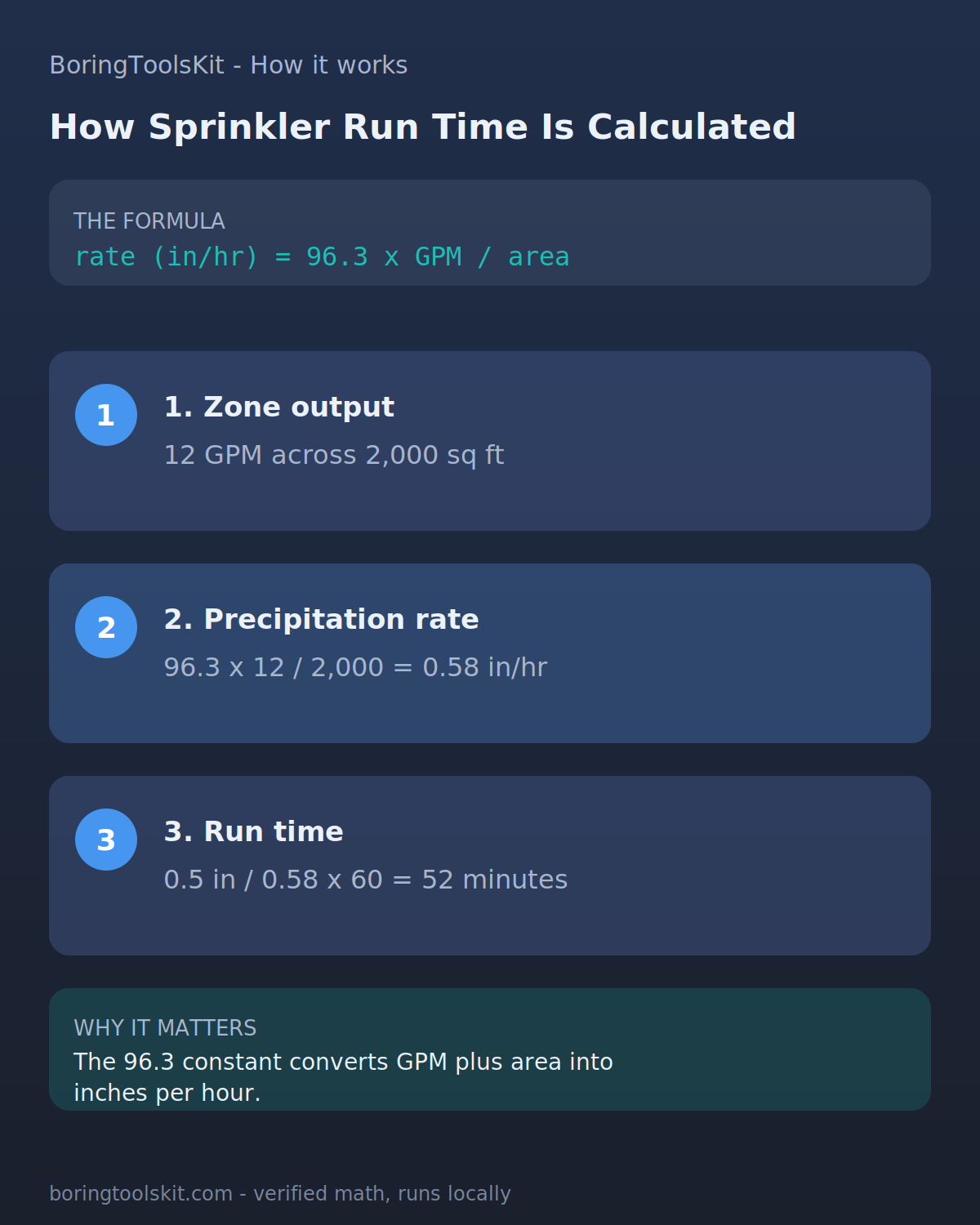
Formula: precipitation rate (in/hr) = 96.3 × GPM ÷ area (sq ft). The constant 96.3 = 60 min/hr × 12 in/ft ÷ 7.48 gal/ft³ (the universal sprinkler-design constant). Run time = target inches ÷ rate × 60. Use: size zones so all heads in a zone match type (matching precipitation), then set run time to replace ET minus rainfall.
How this calculator works
Formula: precipitation rate (in/hr) = 96.3 × GPM ÷ area (sq ft). The constant 96.3 = 60 min/hr × 12 in/ft ÷ 7.48 gal/ft³ (the universal sprinkler-design constant). Run time = target inches ÷ rate × 60. Use: size zones so all heads in a zone match type (matching precipitation), then set run time to replace ET minus rainfall.
Worked example
A zone with 12 GPM over 2,000 sq ft has a precipitation rate of 0.58 in/hr (96.3 x 12 / 2,000). To apply 0.5 inches takes about 52 minutes of run time (0.5 / 0.58 x 60).
Flow and Coverage Area Set the Rate
The rate responds directly to the ratio of flow to area. The 96.3 constant never changes; it only converts gallons per minute and square feet into inches per hour. Double the zone flow and the rate doubles. Double the area those same gallons cover and the rate is cut in half. Every result comes from that one ratio.
The target depth input does not change the rate. It only changes the run time, since run time equals target inches divided by the rate, times 60. Typical fixed spray heads apply 1.0 to 1.5 inches per hour, while rotary heads apply 0.3 to 0.6. Replacing one inch therefore takes 100 to 200 minutes on rotors but only 40 to 60 minutes on spray heads.
How to Enter Numbers You Can Trust
Enter the combined flow of every head running in the zone, not a single head's rating. For area, measure the actual footprint the zone waters, including the overlap between heads. If different head types share one zone, the result is only a blended average: the faster heads overwater their share while the slower ones stay dry, so group heads by type for a rate you can act on.
Use the target depth to schedule, not to guess. Set it to the water your plants use between rains, which is evapotranspiration minus rainfall, then run for the calculated time. Check the rate against your soil before long cycles: sandy soil absorbs water quickly, while clay accepts it slowly and sheds the excess as runoff. On slow-draining soil, split the run time into shorter cycles.
FAQ
What is the 96.3 in sprinkler design?
It converts GPM and square feet into inches per hour. 96.3 = 60 minutes/hour × 12 inches/foot ÷ 7.48 gallons per cubic foot. It is the standard precipitation-rate constant used by irrigation designers.
Why do my zones water unevenly?
Heads of different types (spray vs rotary) have very different precipitation rates. If they share a zone, part of the area gets too much water and part too little. Group same-type heads in the same zone.
What is a good precipitation rate?
Fixed spray heads typically apply 1.0-1.5 in/hr; rotary heads 0.3-0.6 in/hr; drip far lower. Match the rate to your soil's infiltration — sandy soil absorbs faster than clay, which is prone to runoff.
Figures are editable example defaults for planning, not guarantees. Water needs vary by crop, soil, weather, season, and local climate — check ET data (NOAA, your state CIMIS/AgriMet network) and verify with your local extension service or agronomist.