Calculated in your browser; your inputs are not sent to us. Privacy
Results update when you run the tool.
This tool processes the selected input in your browser. Review the output before relying on it; format and file behavior can vary by browser and source data.
Your inputs and results stay in this browser. This page may send privacy-bounded aggregate interaction events described in Privacy; it does not send your entered values or result contents.
Use this result
Share the current inputs or ask ChatGPT to explain the calculation in context.
More options
What does this converter do?
Shoe size conversion calculator: convert US, UK, EU, and centimeter shoe sizes for men, women, and kids instantly. Free, private, runs locally, no signup.
- US men's and women's scales differ by about 1.5 sizes (women's 8.5 = men's 7).
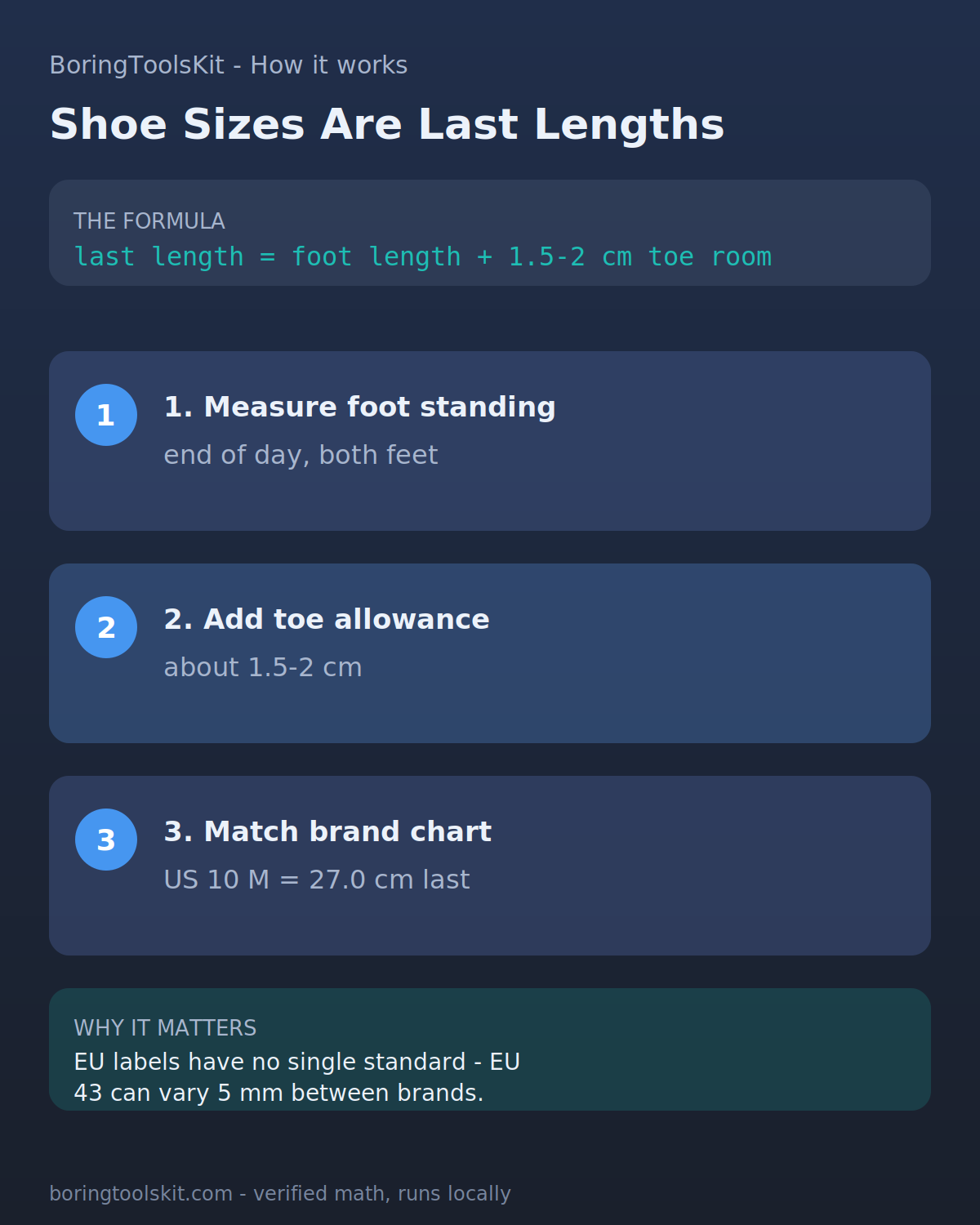
- EU sizing has no single standard — EU 43 can vary by up to 5 mm between brands.
- Measure feet at the end of the day while standing, weight on both feet.
How this calculator works
Formula
Last length, not foot length, is what size labels encode: a shoe adds roughly 1.5–2 cm of toe allowance to the foot measurement. US men's 10 = EU 43-44 = UK 9 = 27.0 cm last length (foot ~25.5 cm).
Sources
Sources support the method, terminology, or planning context. Editable assumptions remain your responsibility.
Assumptions to verify
- Manufacturer charts vary; conversion outputs are the standard-mapping midpoint.
- Measurements are body measurements unless the tool labels them as garment measurements.
- Between-size results round per the rule stated in the FAQ.
Frequently asked questions
Why do my shoes from two brands in 'the same' size fit differently?
EU and US size labels are conventions, not measurements. Brands choose their own lasts; a D and a 2E in the same label length differ by several millimeters of width. Trust your measured foot length in cm against each brand's chart.
What if I fall between sizes?
Round the direction that matches use: clothing and shoes generally round up.
Cite this tool
BoringToolsKit. “Shoe Size Conversion.” boringtoolskit.com/shoe-size-conversion/ (reviewed 2026-09-20). Free to reference in articles, syllabi, and answer posts with a link.
Privacy: Inputs and results stay in this browser. Conversion runs locally in your browser; review the output before relying on it.
Worked example: US men's 9 to EU, UK and centimetres
Take a US men's size 9 and run the formulas by hand. First the EU size: 9 + 33 = 42. Next the UK size: 9 - 0.5 = 8.5. Then the foot length: 9 x 0.847 = 7.623, and 7.623 + 18.3 = 25.923, which rounds to 25.9 cm. So a US men's 9 corresponds to a UK 8.5, an EU 42, and a foot measuring about 25.9 cm.
The same US 9 for women's sizing shifts by a constant offset. EU: 9 + 31 = 40. UK: 9 - 2.5 = 6.5. Foot length: 9 x 0.847 = 7.623, plus 17.7 = 25.223, rounding to 25.2 cm. Comparing the two shows exactly what the gender difference means here: women's and men's charts differ by a flat 2 units on the EU scale and 2 units on the UK scale, while the centimetre column differs by only 0.7 cm (18.3 vs 17.7 offset). That 0.7 cm is the practical gap you feel when buying the same numbered size across a men's and women's line from the same brand.
One more check with the cap: US men's 18 gives EU 51 (18 + 33), UK 17.5 (18 - 0.5), and 18 x 0.847 = 15.246, plus 18.3 = 33.5 cm. Sizes that large exist mostly in specialty workwear and athletic footwear, where manufacturers often run their own lasts, so treat the centimetre figure as a starting point for a brand's own size chart rather than a universal truth.
Boundary cases and where the conversion breaks down
The input window is US 1 to 18, and both edges behave differently. At the low end, US women's 1 produces EU 32 and a UK size of -1.5: a negative UK number, which is how UK charts label youth and junior sizes rather than an error. At the high end, US men's 18 produces EU 51, which sits past the largest size many mainstream brands list (EU 47 to 48 is a common retail ceiling), so a converter result there may not exist as a purchasable shoe.
The two-system check also exposes the child size gap. US children's sizes are numbered below adult sizes on the same scale in real charts, but this calculator uses one continuous adult scale, so a US 1 read as a men's size (EU 32) and a US 1 in a kids' chart (EU 16 to 17, roughly) are different shoes entirely. If the wearer is a child, use a dedicated kids' chart instead.
Half sizes and brand drift are the other limits. The formula accepts only whole numbers, but roughly half of real inventory is half sizes; a US 9.5 is between the whole-size results, about 0.42 cm wider on the centimetre column. And because the constants (33, 31, 0.847, 18.3, 17.7) are averages across brands, running shoes from some makers fit a half size off this estimate in either direction. The calculator's own output says it plainly: brands differ, treat it as approximate. For a purchase you cannot return, match a measured foot length in centimetres against the specific brand's chart instead of trusting any converted number.