SEO Traffic Value Calculator

Organic traffic has real dollar value — either as revenue or as what you'd pay for ads to replace it. This puts a number on your SEO efforts.

Direct answer

What does this tool do?

SEO Traffic Value Calculator computes the result directly in your browser — Organic traffic has real dollar value — either as revenue or as what you'd pay for ads to replace it. This puts a number on your SEO efforts. Nothing you enter is uploaded or stored.

Revenue value: monthly organic visits × conversion rate × average order value. Replacement cost: visits × paid CPC — what buying that traffic with ads would cost each month. Why it matters: organic traffic that ranks persists and compounds; paid traffic stops the moment you stop paying. Caveat: not all organic visitors convert like paid ones — this is an estimate to justify SEO spend, not a guarantee.

How this calculator works

Value = monthly visits x CTR to money page x conversion rate x order value x margin. Equivalent ad cost = visits x CPC you would otherwise pay.

Worked example

5,000 visits/month at a $1.50 equivalent CPC is $7,500/month of traffic you are not buying; actual business value depends on your conversion rate.
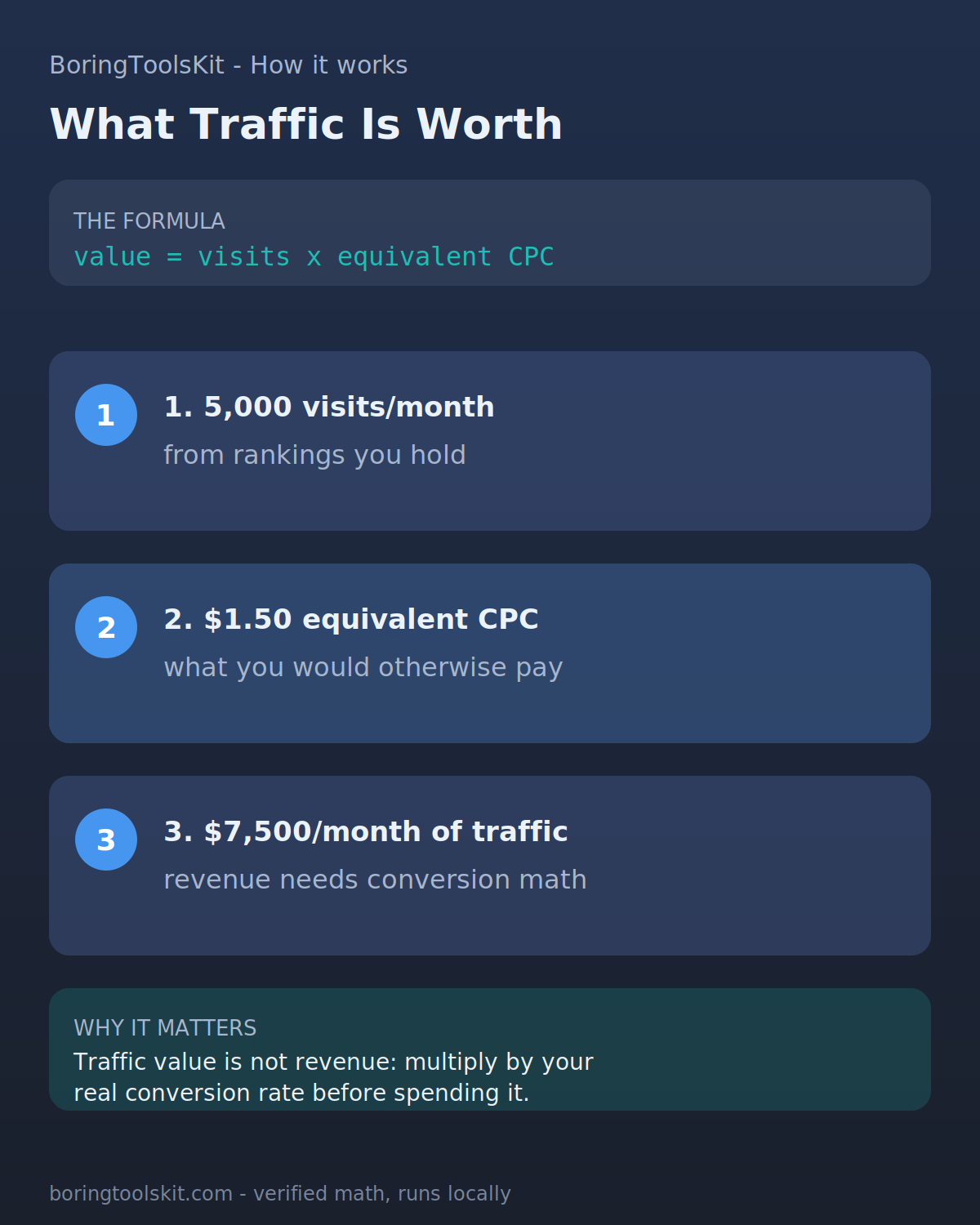
SEO traffic value: visits times equivalent CPC, then conversion reality
Traffic value is not revenue: multiply by your real conversion rate before believing it.

FAQ

How is SEO traffic value calculated?

Most simply: monthly organic visitors × conversion rate × average order value = revenue value. A second lens is replacement cost: visitors × average CPC of the keywords you'd otherwise pay for.

Why is organic traffic worth more than paid?

It compounds (rankings build over time), persists without ongoing spend, and tends to have strong intent. The replacement-cost calculation shows what you'd pay in ads to match it.

Is this number real revenue?

It's an estimate of the revenue attributable to organic traffic at your conversion rate and order value. Use it to justify SEO investment, but treat it as a modeled figure, not booked revenue.

Figures are editable example defaults for modeling, not quotes or advice. Financial, tax, and medical outcomes vary with your situation — verify with a qualified professional (CFP, CPA, tax advisor, or veterinarian).

Use this result

Share the current inputs or ask ChatGPT to explain the calculation in context.

More options
Report a calculation issue

A second worked example: valuing the same traffic by what ads would cost

Pick simple inputs: 4,000 monthly organic visitors, a 2.5% conversion rate, a $65 average order value, and a $1.20 average CPC for the keywords involved. Revenue lens first: 4,000 x 0.025 = 100 orders per month, and 100 x $65 = $6,500 of modeled revenue per month.

Replacement-cost lens: 4,000 visitors x $1.20 per click = $4,800 per month to buy the same clicks, or $57,600 per year. If those keywords actually cost $2.40 per click, replacement cost doubles to $9,600 per month while revenue value stays at $6,500, which flags an expensive paid channel rather than better organic traffic.

Reverse-check the result: $4,800 divided by $1.20 returns 4,000 clicks, and $6,500 divided by $65 returns 100 orders. If the result does not divide back into the inputs, a field is wrong.

Boundary cases: zero, negatives, and where the model breaks

At a 0% conversion rate the revenue value is exactly $0 no matter the visitor count: 20,000 visitors x 0 x $65 = 0. The replacement-cost lens still shows 20,000 x $1.20 = $24,000 per month in avoided ad spend.

Negative inputs are never a business scenario. A conversion rate of -5% or an order value of -$65 yields a meaningless negative output; treat it as a typo, not a discount. Realistic e-commerce conversion sits roughly between 1% and 4%, so 4,000 visitors at 10% claiming 400 organic orders a month is more likely a mislabeled field than a strong store.

The model is linear, so there is no cap: doubling visitors doubles both estimates. That suits cost-per-click math but overstates portfolios leaning on one keyword. If 60% of the 4,000 visitors come from a single ranking and it slips to page two, real revenue can fall near 100%. Estimate on the durable share of traffic, or model the loss separately.